

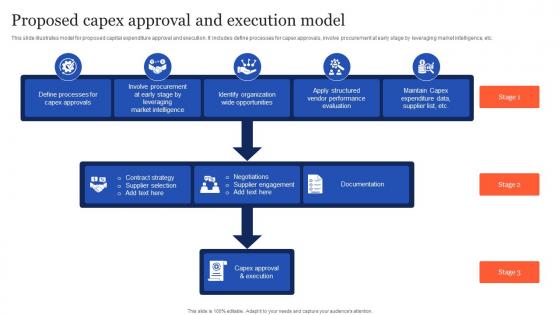
Proposed Capex Approval And Execution Model




Try Before you Buy Download Free Sample Product
 Impress Your
 Audience
 100%
100% Editable
 Save Hours
 of Time


This slide illustrates model for proposed capital expenditure approval and execution. It includes define processes for capex approvals, involve procurement at early stage by leveraging market intelligence, etc.
People who downloaded this PowerPoint presentation also viewed the following :
Proposed Capex Approval And Execution Model with all 6 slides:
Use our Proposed Capex Approval And Execution Model to effectively help you save your valuable time. They are readymade to fit into any presentation structure.





FAQs for Proposed Capex Approval
Key components of a Capex Model include initial investment costs, depreciation schedules, cash flow projections, ROI calculations, and payback period analysis. These elements work together by enabling organizations to evaluate project viability, compare investment alternatives, and optimize resource allocation, with many businesses finding that comprehensive capex modeling ultimately delivers better financial decisions and enhanced operational efficiency.
A Capex Model helps strategic financial planning by forecasting capital expenditures, evaluating investment returns, and aligning spending with business objectives. Through detailed analysis of asset lifecycles, cash flow projections, and ROI calculations, organizations streamline resource allocation, minimize financial risks, and optimize budget distribution across departments, ultimately delivering improved operational efficiency and competitive advantage in capital-intensive industries.
Depreciation in a Capex Model allocates asset costs over their useful lives, impacting financial statements, tax calculations, and cash flow projections through systematic expense recognition. This accounting method enables organizations to accurately track asset values, optimize tax benefits, and make informed replacement decisions, while providing stakeholders with realistic long-term financial performance visibility and strategic capital planning insights.
Effective capital expenditure forecasting combines historical spending analysis, strategic planning alignment, asset lifecycle assessment, and market condition evaluation. Through detailed asset replacement schedules and growth projections, organizations streamline budget allocation, enhance operational efficiency, and minimize unexpected costs, with many companies finding that systematic capex modeling delivers improved cash flow management and competitive advantage.
Common pitfalls when building a Capex Model include underestimating project timelines, failing to account for inflation and cost escalations, inadequate stakeholder input, and insufficient contingency planning. These oversights often lead to budget overruns and project delays, with many organizations finding that incorporating detailed risk assessments, regular model updates, and cross-functional collaboration ultimately delivers more accurate forecasting and better resource allocation.
Sensitivity analysis enhances Capex Models by testing how key variables like discount rates, project timelines, and cost assumptions impact investment outcomes, revealing potential risks and opportunities. Through scenario modeling, organizations can identify critical factors affecting project viability, optimize resource allocation, and make more informed strategic decisions, ultimately delivering greater confidence in capital investment choices and improved financial planning accuracy.
Key metrics for evaluating capital investment effectiveness include net present value (NPV), internal rate of return (IRR), payback period, return on investment (ROI), and discounted cash flow analysis. These financial indicators work together to assess profitability, risk, and strategic value, with many organizations finding that combining quantitative metrics with qualitative factors like market positioning ultimately delivers more comprehensive investment decisions.
Inflation impacts Capex Model projections by increasing future equipment costs, extending payback periods, and reducing real returns on capital investments. Financial teams incorporate inflation adjustments through escalation factors, cost indices, and scenario planning, with many organizations finding that proactive inflation modeling enables more accurate budget forecasting and strategic timing decisions for major capital expenditures.
**INPUT**: What software tools are commonly used to create Capex Models? **OUTPUT**: Common Capex modeling software includes Microsoft Excel, SAP Capital Investment Management, Oracle Primavera, Adaptive Insights, and specialized tools like @RISK for Monte Carlo analysis. These platforms streamline capital budgeting through automated calculations, scenario modeling, and integrated reporting capabilities, with many organizations finding that advanced tools enhance forecasting accuracy and strategic decision-making. **Word count: 54 words**
Capex models should be reviewed quarterly for operational adjustments and updated annually for strategic planning, with additional reviews triggered by significant market changes, regulatory shifts, or major business pivots. Many organizations find that regular quarterly assessments enable faster response to emerging opportunities while annual comprehensive updates ensure long-term capital allocation strategies remain aligned with evolving business objectives and market conditions.
Best practices for stakeholder collaboration in Capex Model development include establishing clear roles and responsibilities, implementing regular cross-functional meetings, creating standardized documentation processes, ensuring transparent communication channels, and utilizing collaborative planning software. These approaches streamline decision-making by aligning finance, operations, and executive teams early in the planning cycle, ultimately delivering more accurate forecasts and faster approval processes across organizations.
A Capex Model supports M&A decision-making by evaluating target companies' capital investment requirements, asset utilization efficiency, and future spending obligations across operations. Through detailed analysis of historical spending patterns, asset lifecycles, and integration costs, acquirers can assess synergy potential, identify redundant investments, and optimize combined capital allocation strategies, ultimately delivering more accurate valuations and strategic integration planning.
Capex models vary significantly across industries, with tech companies prioritizing software licenses, cloud infrastructure, and R&D equipment, while manufacturing focuses on heavy machinery, production lines, and facility expansions. These differences reflect each sector's operational needs, with tech emphasizing scalability and innovation cycles, and manufacturing requiring substantial physical assets, ultimately delivering industry-specific competitive advantages and operational efficiency.
Tax implications significantly influence Capex Models through depreciation schedules, tax shields from capital investments, and timing considerations for asset purchases. Companies strategically plan capital expenditures around tax benefits, accelerated depreciation opportunities, and fiscal year-end considerations, with many organizations finding that proper tax planning can reduce overall project costs by 15-30% while enhancing long-term financial returns.
Real-world Capex Model successes include Amazon's massive warehouse automation investments, Tesla's Gigafactory construction, and Netflix's content production facilities expansion. These strategic capital expenditures enabled Amazon to streamline logistics and reduce delivery times, helped Tesla scale manufacturing while lowering per-unit costs, and allowed Netflix to control content creation, ultimately delivering competitive advantages and substantial long-term returns.
-
The templates are handy and I can personalize them as per my needs. Glad to be your subscriber!
-
I want to express my gratitude to SlideTeam’s presentation design services team for helping me create the best presentation of my life!