

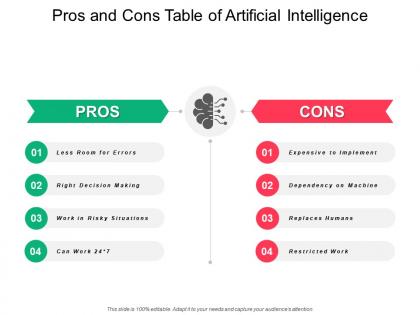
Pros and cons table of artificial intelligence





Try Before you Buy Download Free Sample Product
 Impress Your
 Audience
 100%
100% Editable
 Save Hours
 of Time


Our Pros And Cons Table Of Artificial Intelligence are topically designed to provide an attractive backdrop to any subject. Use them to look like a presentation pro.
People who downloaded this PowerPoint presentation also viewed the following :
Pros and cons table of artificial intelligence with all 5 slides:
Use our Pros And Cons Table Of Artificial Intelligence to effectively help you save your valuable time. They are readymade to fit into any presentation structure.

FAQs for Pros and cons table
So narrow AI is what we've got right now - stuff that's really good at one specific thing, like recognizing faces or translating languages. AGI though? That's the holy grail - basically a digital brain that could think and learn like humans do across any topic. Picture narrow AI as that friend who's incredible at math but can't cook toast. AGI would be someone who could jump from calculus to cooking to creative writing without missing a beat. Honestly, we're still pretty far from that despite all the hype you see online. For whatever you're building, just assume you're dealing with narrow AI and plan around those limitations.
Honestly, AI is crazy good at processing tons of data super fast - way faster than any human team could handle. You'll get insights about customer patterns and market trends you'd totally miss otherwise. The best part? No more waiting weeks for reports when you need answers now. Real-time analytics are a game changer for planning stuff out. Though I'd probably start small if I were you - maybe test it on inventory or customer segmentation first. It basically kills all that guesswork that usually makes strategic decisions feel like you're just winging it.
So there's a bunch of tricky stuff to think about. Privacy is massive - medical data is super sensitive and hackers love that stuff. Algorithm bias is another nightmare that can screw over certain patient groups. Transparency matters too because doctors need to actually understand what the AI is doing, not just blindly trust it. When things go sideways (and they will), you need clear accountability structures. Oh, and get different people involved from day one - not just the tech bros. Set up good governance before you launch anything. Trust me, fixing this mess after the fact is way harder than doing it right upfront.
So ML is basically like having a really smart pattern-spotter that can handle way more data than any human ever could. Your predictions actually get better over time without you doing anything - which is honestly the coolest part. Healthcare uses it to flag risky patients, banks catch fraud faster, retailers figure out what to stock. The algorithms juggle tons of variables at once instead of just looking at basic trends. Oh, and if you're thinking about trying it out, pick one specific thing first. Don't go crazy and try to overhaul everything - trust me on that one.
So AI's actually pretty solid for sustainability stuff. Smart grids can optimize your power usage automatically. Supply chain models predict waste before it happens. Even transportation gets way more efficient with the right algorithms. For your company, start simple - maybe analyze energy patterns first or optimize delivery routes. Predictive maintenance is huge too since you're not constantly replacing equipment that's still good. Honestly, I'd pick one specific problem like cutting energy costs rather than going after everything. Way less overwhelming that way, and you'll actually see results instead of spinning your wheels on some massive overhaul project.
So basically AI can process way more network data than any human team could handle - we're talking real-time analysis of everything. It picks up on weird patterns, spots malware signatures, sometimes even catches attacks before they actually happen. Plus it handles the routine threat responses automatically, which honestly saves your team from going insane with repetitive tasks. The trick is feeding it good data and keeping it updated, otherwise you'll get bombarded with false alarms. Think of it like having an incredibly smart watchdog that actually stays awake 24/7.
So basically AI looks at what your customers browse and buy, then shows them stuff they'll actually want. Product recommendations are huge - most platforms already have this built in, you just flip it on. Pretty wild how good the algorithms get at reading people honestly. You can customize homepages, adjust prices based on demand, personalize emails, all that. Chatbots help too for customer service. I'd start with recommendations since that's the easiest win. The AI literally learns their behavior patterns and gets creepy accurate at predicting purchases.
Honestly, it's gonna be rough. Manufacturing and customer service jobs will disappear fast, plus anything involving data analysis. But new stuff will pop up too - AI development roles, jobs where humans work alongside AI systems, maybe more creative positions. The real problem? That transition period is gonna suck for people who can't retrain quickly enough. Companies will love the productivity boost and lower costs, but income inequality could get way worse if we screw up the workforce shift. Oh, and figure out which parts of your job only humans can do - that's your safety net right there.
Dude, AI bias is no joke - hiring algorithms literally discriminate against people and loan systems do the same thing. Most of it stems from crappy training data that bakes in old prejudices, or just poor design choices. The subtle stuff is what really gets me though. You gotta start by checking your data sources since that's where the problems usually live. Get diverse teams working on this, test for bias constantly during development, and honestly? Keep monitoring even after you launch because new biases pop up. Oh, and make sure your training datasets actually represent different groups properly.
Honestly, your biggest headache is gonna be getting AI to work with whatever ancient systems you're already using. Most companies have data scattered everywhere - different platforms, old formats, the whole mess. People will push back hard too because nobody likes change, especially when it involves robots doing their job. Training costs add up fast. Oh, and don't even get me started on compliance nightmares. Security teams hate everything new. Start with just one thing though - pick something small and prove it works before going crazy with AI everywhere.
Dude, AI is literally a game-changer for remote work. It handles all the tedious stuff - scheduling meetings, transcribing calls, even pulling action items from your Zoom sessions. ChatGPT speeds up email writing like crazy. Project management tools now predict problems before they blow up, which honestly saves my sanity. The time you get back is insane. Instead of drowning in admin work, your team can actually do meaningful stuff. Oh, and those AI meeting assistants? Total lifesaver. Start with something small and you'll see what I mean.
Autonomous AI is the big one to watch - systems running complex stuff without babysitting from humans. Generative AI is getting insanely good too, gonna change how your teams handle content and coding. Oh, and edge AI processes data locally instead of cloud, which is way faster and more secure. Regulation's heating up everywhere, so you'll need to stay compliant. Honestly, I'd start with small pilot projects now rather than waiting. Better to figure out what actually works for your business before all this really takes off. Trust me on this one.
Honestly, start with just one tool - don't go crazy trying to change everything at once. AI's really good at personalizing stuff for each kid based on how they learn and their pace. The grading automation is a lifesaver too, gives you actual time to teach instead of marking papers all night. My favorite thing though? AI tutoring systems. Kids will ask the "stupid" questions they're too embarrassed to ask you directly. Some of mine actually prefer it that way! You can also generate practice problems on the fly and create those interactive simulations that actually keep them engaged. Plus it'll flag which students are struggling before you even notice.
Honestly, the biggest thing is making sure you can actually explain what your AI is doing. Document everything - your algorithms, where the data comes from, how decisions get made. There's some solid explainable AI tools out there now that'll break down the "why" behind each choice, and they're getting pretty good. Set up regular audits and bias testing too. Log all the AI decisions so you've got a paper trail. Keep humans in the loop for the big stuff though - that's non-negotiable. Bottom line: if someone asks "why did it decide that?" you better have an answer ready.
Dude, AI's literally everywhere in creative stuff now. Music generation, script writing, digital art - the whole deal. Netflix uses it for those show recommendations and even optimizes thumbnails. Gaming companies are doing crazy procedural world building with it. Oh and Spotify's playlist thing? That's AI too. Wild how fast it's moving, right? Here's the thing though - most of the time it's not replacing creatives, just helping them out. My advice? Start messing around with these tools as creative partners instead of freaking out about them taking over. Way better mindset.
-
Innovative and attractive designs.
-
Very unique, user-friendly presentation interface.
-
Excellent Designs.
-
Very well designed and informative templates.
-
Unique research projects to present in meeting.
-
Best way of representation of the topic.