


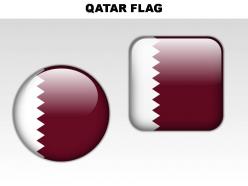
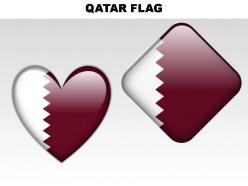
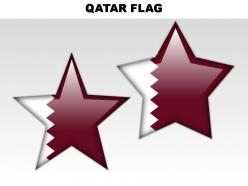
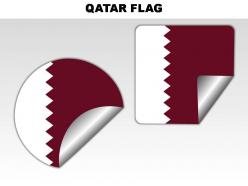
Qatar country powerpoint flags




Try Before you Buy Download Free Sample Product
 Impress Your
 Audience
 100%
100% Editable
 Save Hours
 of Time


Our Qatar Country Powerpoint Flags will prove worthy instruments for your growth. They will poitively enhance your reputation as a professional.
People who downloaded this PowerPoint presentation also viewed the following :
Qatar country powerpoint flags with all 11 slides:
Set pulses racing with our Qatar Country Powerpoint Flags. They will raise the expectations of your team.
FAQs for Qatar
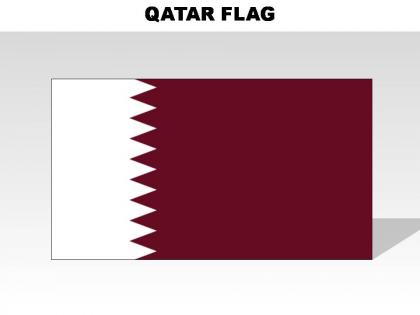
The Qatari flag originates from the 19th century when Qatar was a British protectorate, evolving from red banners used by local tribes to distinguish maritime vessels. The distinctive maroon color, called "Qatar Red," developed from natural dyes exposed to sunlight, while the white represents peace and the nine-point serrated edge symbolizes Qatar as the ninth member of the Persian Gulf's reconciled emirates.
Qatar's flag features maroon and white, where the deep maroon represents the blood shed during 19th-century wars and symbolizes courage, while white signifies peace and the nation's historical role in maritime trade. This distinctive color combination, along with the nine-pointed serrated edge representing Qatar as the ninth member of the Arabian Gulf's reconciled emirates, reflects the country's journey from conflict to prosperity, ultimately reinforcing national unity and cultural pride.
The Qatari flag underwent minimal changes since its adoption, with the most significant being the standardization of the maroon color shade in 1971 and official proportional refinements. While the distinctive serrated edge and maroon-white color scheme remained consistent, these adjustments enhanced visual consistency across government institutions, diplomatic missions, and international events, ultimately delivering stronger national brand recognition and ceremonial uniformity.
Qatar's serrated edge features nine distinctive points that separate the maroon and white sections, making it the only national flag worldwide with this specific geometric design element. This unique architectural feature enhances the flag's visual recognition and symbolic representation, with many international organizations finding that the serrated border creates immediate identification advantages during diplomatic events, sporting competitions, and cultural exchanges, ultimately delivering stronger national brand recognition.
Qatar's flag represents Islamic values through its maroon color symbolizing the blood of martyrs and sacrifice in faith, while the white represents peace and purity central to Islamic teachings. The serrated edge reflects the country's maritime heritage and trading history, with the flag's design emphasizing Qatar's identity as the ninth member of the "reconciled Emirates," ultimately showcasing cultural pride and religious devotion in the Gulf region.
Qatar's flag has gained prominent international visibility through hosting the 2022 FIFA World Cup, the 2006 Asian Games, and various Formula 1 Grand Prix events. These major sporting spectacles, along with Qatar's increasing diplomatic role in regional mediation and its significant energy partnerships, have elevated the maroon and white banner's recognition globally, ultimately enhancing Qatar's nation branding and soft power influence.
Qatar's flag features prominently in national celebrations through ceremonial displays, parade formations, government building decorations, and as backdrop elements during official speeches. During Qatar National Day, Independence Day, and major sporting events like FIFA World Cup ceremonies, the maroon and white banner enhances patriotic atmosphere while officials reference its symbolism in addresses, ultimately strengthening national identity and civic pride across public gatherings.
The Qatar flag serves as a vital diplomatic symbol, representing national sovereignty in bilateral meetings, international summits, embassy functions, trade negotiations, and cultural exchanges. Through its distinctive maroon and white design, Qatar enhances its diplomatic presence at global forums, strengthens diplomatic protocol adherence, and reinforces its strategic positioning in international relations, with many diplomatic missions finding that symbolic representation significantly elevates Qatar's diplomatic standing.
Qatari citizens view their flag as a powerful symbol of national unity, cultural heritage, and sovereignty, deeply connecting it to their identity and independence achieved in 1971. The distinctive maroon and white colors evoke pride in Qatar's maritime history, tribal traditions, and modern transformation, with many citizens finding that the flag represents their nation's remarkable journey from pearl diving to global prominence.
Yes, Qatar follows strict flag protocols including displaying it prominently during national holidays, ensuring it never touches the ground, and positioning it at equal height with other nations' flags during international events. Government buildings, schools, and businesses observe these customs during Qatar National Day and National Sport Day, with many organizations finding that proper flag etiquette demonstrates respect and strengthens national unity.
Common misconceptions include believing the maroon represents blood or violence, when it actually symbolizes Qatar's historical strength and heritage, and assuming the white stripe indicates surrender or peace treaties, while it represents Qatar's peaceful intentions and pursuit of harmony. Many also incorrectly think the nine-point serrated edge represents tribal divisions, when it actually signifies Qatar as the ninth member of the Arabian Gulf's reconciled Emirates following the 1916 treaty.
Qatar's flag features a distinctive maroon and white serrated border design that sets it apart from other Gulf nations, which typically use red, green, black, and white in horizontal or vertical arrangements. While neighboring countries like UAE, Kuwait, and Saudi Arabia incorporate multiple colors in geometric patterns, Qatar's unique maroon shade and zigzag border creates immediate visual distinction, ultimately delivering stronger national brand recognition in the increasingly interconnected Gulf region.
The 2022 FIFA World Cup significantly elevated the Qatar flag's global visibility through extensive media coverage, stadium displays, ceremonial presentations, and merchandise distribution worldwide. This unprecedented international exposure enhanced Qatar's national branding and cultural recognition, with many organizations finding that major sporting events deliver substantial soft power benefits, ultimately strengthening the nation's global diplomatic presence and tourism appeal.
The Qatar flag effectively conveys national unity through its distinctive maroon and white symbolism representing heritage and peace, strategic placement in opening slides, background elements, and ceremonial contexts. When incorporated into corporate presentations, government briefings, and cultural events, the flag enhances credibility and patriotic connection, with many organizations finding that thoughtful flag integration strengthens audience engagement and reinforces shared national values.
Educational resources for understanding Qatar's flag significance include government cultural websites, Qatar National Library archives, museum exhibitions, academic databases, and cultural heritage programs. These resources explore the flag's symbolic elements, historical evolution, and national identity representation, with many educational institutions and cultural organizations offering comprehensive materials that enhance understanding of Qatar's heritage, ultimately delivering deeper appreciation for the nation's cultural foundations and contemporary significance.
-
Professional and unique presentations.
-
Designs have enough space to add content.