


Quality Control Flowchart For Implementing Iso 9001




Try Before you Buy Download Free Sample Product
 Impress Your
 Audience
 100%
100% Editable
 Save Hours
 of Time


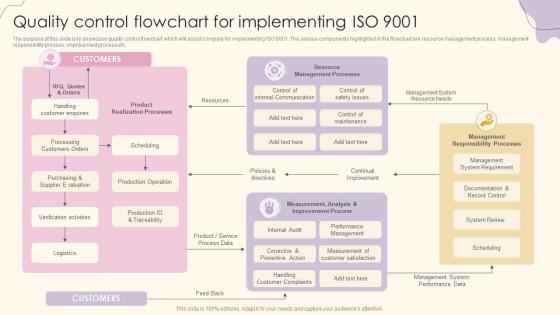
The purpose of this slide is to showcase quality control flowchart which will assist company for implementing ISO 9001. The various components highlighted in the flowchart are resource management process, management responsibility process, improvement process etc.
People who downloaded this PowerPoint presentation also viewed the following :
Quality Control Flowchart For Implementing Iso 9001 with all 6 slides:
Use our Quality Control Flowchart For Implementing Iso 9001 to effectively help you save your valuable time. They are readymade to fit into any presentation structure.





FAQs for Quality Control Flowchart For
So you need clear quality standards first - that's your foundation. Regular inspections are key, plus good documentation systems. Training your team properly makes a huge difference. Here's the thing though - most companies totally mess up the tracking and analysis part. Like, they'll spot defects but not actually dig into why they're happening. Root cause analysis is everything because otherwise you're just playing whack-a-mole with problems. Set up corrective action procedures and make sure someone owns each step. Oh, and map your current process before changing anything - sounds boring but you can't fix what you don't actually understand.
So basically, quality control happens after you've already made stuff - you're testing it to catch problems. Quality assurance is the opposite though, it's all about setting up your processes beforehand so things don't go wrong. Like QC is that final "okay does this thing actually work?" moment. But QA? That's designing your whole system to avoid disasters from the start. Honestly, if you're looking to improve manufacturing, focus on QA first. Way cheaper to prevent problems than scramble to fix them later - learned that one the hard way!
Look, SPC is basically your early warning system - catches quality problems before they blow up your budget. Track your key metrics over time and watch for weird patterns that mean something's going off track. Way better than that useless check engine light in my Honda! You're preventing issues instead of just inspecting stuff after it's already messed up. Set up control charts for the important parameters, get your control limits locked down, then train everyone to jump on it when the data shows funky variation. Root cause fixes beat sorting good from bad parts every single time.
Look, good quality control stops garbage products from hitting your customers' hands. That builds trust over time. Bad QC though? You're rolling dice with every relationship - honestly, people have zero patience for defective stuff anymore. It cuts down on returns and angry emails too, which is nice. Happy customers stick around and tell their friends about you. I'd start by figuring out what breaks most often and fix that first. You'll notice the difference in feedback pretty fast.
Document what you're doing now and figure out where things usually go wrong. Make some basic checklists for the important stuff and get everyone trained on them. Honestly, I've watched so many small businesses jump straight into these crazy complex systems - total disaster. Pick one or two critical spots to focus on first, maybe final inspection or when you hand things off to customers. Oh, and do regular team meetings to talk through what's working. Short ones though, nobody wants another long meeting. The real trick is getting everyone to actually care about it, not just go through the motions.
So ISO 9001 is basically a framework that makes you document all your quality stuff and standardize it. You'll be thinking more systematically about what customers actually want, plus continuous improvement and risk management - which honestly, most companies should already be doing but just haven't gotten around to it. Regular audits are required, and you have to make decisions based on actual data instead of just winging it. This keeps everyone accountable and helps you spot problems early. My advice? Map out what you're currently doing first - that way you can see exactly where the gaps are before diving in.
Honestly, I'd start with whatever's killing you right now. Data collection problems? Go digital with dashboards or something like Minitab - way easier to spot issues early. Machine vision systems are clutch for catching defects that people miss (especially after lunch when everyone's half-asleep). SPC software handles the statistical stuff automatically. Digital checklists keep everything consistent, and MasterControl is decent for documentation if you're into that. But seriously, don't overthink it. Pick your biggest headache first - whether that's automation for consistency or just getting better data tracking.
Look, training your people is probably the fastest way to improve quality control. When they actually know what to look for, they'll catch defects before they become huge headaches. The thing is, you can't just tell them "follow the rules" - they need to understand why those standards exist in the first place. Otherwise they'll cut corners when you're not watching. Focus your training on the specific spots where you keep seeing problems pop up. Cover the technical stuff, sure, but also throw in real scenarios they'll actually deal with day-to-day. It sounds super basic but most places skip this step.
Defect rates and customer complaints are your bread and butter - they show if you're actually catching problems. First-pass yield matters a ton since it reveals how often you nail things on the first try. Cost of quality is solid too (prevention vs fixing stuff after). Oh, and track how long inspections take - that can get out of hand fast. Your team's accuracy rates are honestly underrated but super critical. I'd probably start with 3-4 metrics that hit your worst pain points. Build up slowly once you've got decent baseline data to work with.
Honestly, analytics will blow your mind for quality control. Real-time production data lets you predict defects before they happen - way better than playing catch-up later. You'll spot which factors actually mess with quality (some might surprise you). Historical data helps set smarter thresholds too, instead of just guessing. I'd start simple though - just collect what you're already measuring and look for patterns between your inputs and defect rates. Different shifts and suppliers will show totally different trends. The predictive side is where it gets really cool since you're stopping problems instead of fixing them.
Honestly, the worst part is when everyone's doing things their own way - zero consistency. Your team will probably push back on changes too, which is super annoying but expected. Data's another headache because people either track random stuff or nothing at all. Start by writing down what you're actually doing now, then spot where things go sideways. Get everyone together regularly to align on what "good" looks like. Here's the thing though - don't just tell them what to do. Let them help figure out the fixes or they'll hate it. Oh, and tackle one problem at a time. Trust me on that one.
So basically, QC changes completely depending on what could kill people in your industry. Food companies obsess over contamination and FDA stuff - they're constantly doing microbial tests and following HACCP rules. Electronics is more about "does this thing actually work" and durability testing. The equipment is totally different too. Food places use pH meters and metal detectors, while electronics needs oscilloscopes and thermal cameras. Even the paperwork requirements are night and day different. My advice? Figure out what your worst-case scenario looks like first. That'll tell you everything about how to set up your quality process.
Automation's pretty much taken over QC these days. Cameras, sensors, real-time monitoring software - all that stuff handles the boring repetitive checks way faster than any team could. What's cool is you get consistent results without worrying about someone having an off day, you know? Plus your people can actually work on interesting problems instead of staring at spreadsheets all day. The speed difference is honestly crazy. I'd start with whatever manual process is eating up most of your time - that's usually your best bet for automation.
Honestly, customer feedback is like your wake-up call for quality control. Your internal testing might miss stuff that customers find immediately - they use products in ways you'd never expect. When complaints roll in, trace them back to see where your QC process dropped the ball. I'd set up weekly reviews where your QC team looks at customer complaints and updates their testing based on real problems. It's basically using your customers as an extra layer of quality assurance, which sounds bad but actually works really well. Create that feedback loop and you'll catch way more issues.
Dude, the whole quality control space is getting wild right now. Predictive analytics can spot defects before they even happen, which blows my mind honestly. You've got automated inspection systems that make human checkers look like they're moving in slow motion. Real-time IoT monitoring across production lines is becoming standard - pharma and automotive companies are going crazy with this stuff. Oh, and everyone's obsessed with tracking environmental impact alongside the usual quality metrics now. It's actually smart business though. Companies jumping on this early are crushing their competition. You should definitely see what applies to your industry because the gap's only getting bigger.
-
One word for SlideTeam–Versatile!
-
“I've always gotten excellent slides from them and the customer service is up to the mark.”