


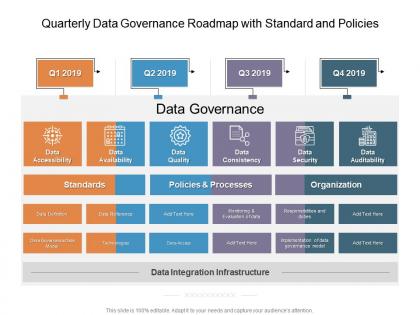
Quarterly data governance roadmap with standard and policies




Try Before you Buy Download Free Sample Product
 Impress Your
 Audience
 100%
100% Editable
 Save Hours
 of Time


A cohesive work plan is essential for achieving the desired target. Communicate your vision and lay a firm ground in front of your audience with our PowerPoint layout. Align your project milestones, budgets, deliverables, deadlines, and all the requisite information for a dynamic presentation by employing this amazingly designed Quarterly Data Governance Roadmap With Standard And Policies. Maximize team efficiency and streamline a work plan efficiently by introducing our ready made roadmap PowerPoint theme. You can quickly establish coordination between different activities across the organization and present an insight to your colleagues by utilizing this useful business tool. Color code specific tasks, prioritize, and keep a close eye on the deadlines with the help of our eye catchy PowerPoint template. Download our Quarterly Data Governance Roadmap With Standard And Policies for excelling at productive management.
People who downloaded this PowerPoint presentation also viewed the following :
Quarterly data governance roadmap with standard and policies with all 2 slides:
Use our Quarterly Data Governance Roadmap With Standard And Policies to effectively help you save your valuable time. They are readymade to fit into any presentation structure.
FAQs for Quarterly data governance roadmap with
Key components include data stewardship roles, quality standards, privacy policies, access controls, and lifecycle management protocols. These elements work together by establishing clear accountability, ensuring regulatory compliance, and maintaining data integrity across organizations, with many enterprises finding that structured governance frameworks ultimately deliver improved decision-making capabilities and reduced operational risks.
Organizations measure data governance success through data quality metrics, compliance audit results, user adoption rates, incident reduction tracking, and business outcome improvements. These measurements enable companies to demonstrate ROI by monitoring faster decision-making, reduced regulatory risks, and enhanced operational efficiency, with many finding that comprehensive metrics ultimately deliver competitive advantage and stakeholder confidence.
Data stewardship plays a crucial role in maintaining data quality by establishing clear ownership, implementing validation processes, monitoring data accuracy, and enforcing compliance standards across organizations. Through dedicated stewards, companies streamline data management workflows, reduce inconsistencies, and enhance decision-making capabilities, with many financial services and healthcare institutions finding that structured stewardship programs ultimately deliver improved operational efficiency and regulatory compliance.
Data governance mitigates breach risks by establishing access controls, encryption protocols, audit trails, and compliance frameworks that protect sensitive information throughout its lifecycle. These structured approaches enable organizations to identify vulnerabilities, monitor data movement, and respond quickly to threats, with many financial institutions and healthcare providers finding that comprehensive governance significantly reduces exposure while ensuring regulatory compliance.
Implementing data governance in large enterprises faces challenges including data silos across departments, inconsistent data quality standards, complex regulatory compliance requirements, resistance to cultural change, and resource allocation constraints. These obstacles often result in fragmented data strategies and delayed decision-making, with many organizations finding that phased implementation approaches and executive sponsorship help overcome resistance while delivering improved operational efficiency and regulatory compliance.
Technology revolutionizes data governance by automating compliance monitoring, enabling real-time data quality assessments, and streamlining policy enforcement across organizational systems. Through AI-powered tools and cloud platforms, financial institutions and healthcare organizations enhance data accuracy, accelerate regulatory reporting, and minimize human error, ultimately delivering improved operational efficiency and stronger regulatory compliance.
Organizations should implement clear classification frameworks based on data sensitivity, regulatory requirements, and business criticality, establish consistent labeling standards, define access controls for each classification level, and regularly review classifications as data evolves. Through automated classification tools and comprehensive staff training, companies in sectors like healthcare and financial services streamline compliance processes, enhance security protocols, and ensure proper resource allocation, ultimately delivering improved data protection and operational efficiency.
Data governance adapts to cloud services through updated policies for multi-cloud environments, enhanced encryption protocols, automated compliance monitoring, and centralized access controls across platforms. Organizations like financial institutions and healthcare providers are implementing cloud-specific governance frameworks that maintain data sovereignty while enabling scalability, ultimately delivering improved security oversight and regulatory compliance in distributed infrastructures.
Data governance provides the foundational framework that enables organizations to meet regulatory compliance requirements through structured policies, clear accountability, and consistent data management practices. By establishing robust data quality standards, access controls, and audit trails, governance frameworks help organizations demonstrate compliance with regulations like GDPR, HIPAA, and SOX, ultimately reducing regulatory risks while streamlining reporting processes.
Companies ensure stakeholder buy-in for data governance by demonstrating clear ROI through cost savings and risk reduction, involving key stakeholders in strategy development, and providing comprehensive training programs. Through executive sponsorship and phased implementation, organizations streamline compliance processes, enhance decision-making capabilities, and deliver measurable business outcomes, with many finding that collaborative governance frameworks ultimately drive sustained engagement and strategic advantage.
**INPUT**: What metrics are essential for assessing data governance effectiveness? **OUTPUT**: Essential data governance metrics include data quality scores, compliance rates, data lineage completeness, access control accuracy, and incident response times. These measurements enable organizations to track operational efficiency, regulatory adherence, and risk mitigation across departments, with many financial services and healthcare institutions finding that comprehensive metrics ultimately deliver enhanced decision-making capabilities and competitive advantage. [Word count: 54 words]
Organizations align data governance with business objectives by establishing clear data stewardship roles, implementing metrics that track business outcomes, and creating governance frameworks that support strategic decision-making and regulatory compliance. Through cross-functional collaboration between IT and business units, companies streamline data quality, enhance operational efficiency, and accelerate analytics-driven insights, ultimately delivering competitive advantage and measurable business value.
Metadata management serves as the foundation of data governance by providing comprehensive documentation, lineage tracking, quality standards, and automated classification of data assets across organizations. Through centralized metadata repositories, companies can streamline compliance reporting, enhance data discovery, and accelerate analytics initiatives, with many financial services and healthcare institutions finding that robust metadata management ultimately delivers greater regulatory transparency and operational efficiency.
Artificial intelligence enhances data governance practices by automating data classification, detecting quality issues in real-time, and ensuring policy compliance across systems. Through machine learning algorithms, organizations streamline data lineage tracking, accelerate anomaly detection, and minimize manual oversight burdens, with many financial institutions and healthcare providers finding that AI-driven governance delivers improved accuracy and operational efficiency.
Emerging trends in data governance include automated data cataloging, AI-driven compliance monitoring, federated governance models, privacy-preserving analytics, and cloud-native governance frameworks. These approaches streamline data management by enhancing discoverability, automating regulatory compliance, and enabling decentralized control, with many financial services and healthcare organizations finding that automated governance delivers faster insights while maintaining strict regulatory standards.
-
Excellent template with unique design.
-
Great quality slides in rapid time.