


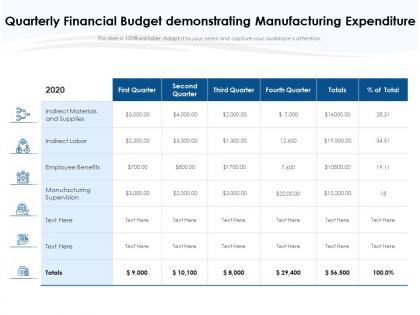
Quarterly financial budget demonstrating manufacturing expenditure




Try Before you Buy Download Free Sample Product
 Impress Your
 Audience
 100%
100% Editable
 Save Hours
 of Time


Our Quarterly Financial Budget Demonstrating Manufacturing Expenditure are topically designed to provide an attractive backdrop to any subject. Use them to look like a presentation pro.
People who downloaded this PowerPoint presentation also viewed the following :
Quarterly financial budget demonstrating manufacturing expenditure with all 2 slides:
Use our Quarterly Financial Budget Demonstrating Manufacturing Expenditure to effectively help you save your valuable time. They are readymade to fit into any presentation structure.
FAQs for Quarterly financial budget
**INPUT**: What are the key components to include in a manufacturing budget? **OUTPUT**: Key manufacturing budget components include direct materials, labor costs, overhead expenses, equipment maintenance, quality control measures, and inventory management. These elements work together by enabling accurate cost forecasting, resource allocation, and production planning, with many manufacturers finding that comprehensive budgeting streamlines operations while delivering improved efficiency and competitive advantage. [Word count: 53 words]
Fluctuating raw material costs directly impact manufacturing budgets by creating unpredictable expense variations, affecting profit margins, and complicating financial forecasting and procurement planning. These price volatilities force manufacturers in sectors like automotive, electronics, and textiles to implement dynamic pricing strategies, diversify suppliers, and maintain strategic inventory buffers, ultimately requiring more flexible budget structures.
Manufacturers can improve budget accuracy through predictive analytics, real-time production monitoring, supplier contract optimization, demand forecasting integration, and cross-departmental collaboration frameworks. These strategies enable organizations to anticipate cost fluctuations, streamline resource allocation, and minimize unexpected expenses, with many manufacturing companies finding that data-driven budgeting delivers significantly enhanced financial control and operational efficiency.
Labor cost significantly impacts manufacturing budgets through direct wages, benefits, overtime expenses, and productivity levels, often representing 20-40% of total production costs. Manufacturing companies, particularly in automotive and electronics sectors, find that strategic workforce planning, automation integration, and skills development programs help optimize labor expenses while maintaining quality, ultimately delivering improved operational efficiency and competitive advantage.
Technology streamlines manufacturing budgeting through predictive analytics, automated cost tracking, real-time monitoring systems, and integrated planning platforms. These solutions enhance accuracy by analyzing historical data, forecasting demand fluctuations, and identifying cost optimization opportunities, with many manufacturers finding that automated budgeting reduces planning cycles while delivering improved resource allocation and competitive operational efficiency.
Manufacturing budgets should be reviewed monthly for operational adjustments and updated quarterly for strategic planning, with comprehensive annual reviews incorporating market changes, technology upgrades, and capacity expansions. This regular cadence enables manufacturers to respond quickly to supply chain disruptions, demand fluctuations, and cost variations, while maintaining operational efficiency and competitive positioning in increasingly dynamic markets.
Common manufacturing budget pitfalls include underestimating material cost fluctuations, ignoring equipment maintenance expenses, failing to account for seasonal demand variations, overlooking quality control costs, and inadequate contingency planning. These oversights can significantly impact operational efficiency and profitability, with many manufacturers finding that comprehensive forecasting and regular budget reviews help minimize unexpected expenses while maintaining competitive advantage.
Manufacturers leverage forecasting techniques to enhance budgets by utilizing demand planning algorithms, seasonal trend analysis, and predictive maintenance modeling. These approaches enable more accurate resource allocation, inventory optimization, and capacity planning, with automotive and electronics manufacturers finding that advanced forecasting reduces operational costs by 15-25% while improving production efficiency and strategic decision-making.
Manufacturing budget performance should be tracked through production cost per unit, material cost variance, labor efficiency ratios, overhead absorption rates, capacity utilization percentages, and inventory turnover metrics. These measurements enable manufacturers to identify cost overruns, optimize resource allocation, and streamline operations, with many facilities finding that regular monitoring delivers improved profit margins and enhanced competitive positioning.
External economic factors significantly influence manufacturing budget planning through inflation rates, currency fluctuations, commodity prices, interest rates, and supply chain disruptions. These variables impact raw material costs, labor expenses, and operational overhead, with many manufacturers finding that incorporating economic forecasting models and flexible budget scenarios enables better resource allocation, risk mitigation, and ultimately maintains competitive advantage during volatile market conditions.
Direct costs like raw materials and labor tie directly to production volumes, while indirect costs such as factory overhead, utilities, and administrative expenses remain relatively stable regardless of output levels. Understanding this distinction enables manufacturers to accurately forecast variable expenses, optimize resource allocation during demand fluctuations, and make strategic pricing decisions that maintain profitability across different production scenarios.
Lean manufacturing principles help optimize budgets by eliminating waste, reducing inventory costs, streamlining production processes, and improving resource allocation efficiency. Through value stream mapping and continuous improvement methodologies, manufacturers significantly minimize material waste, reduce labor costs, and accelerate production cycles, ultimately delivering enhanced profitability and competitive advantage in increasingly cost-conscious markets.
Budgeting for new product introductions presents challenges including uncertain development costs, unpredictable market demand, fluctuating material prices, complex regulatory requirements, and evolving technology needs. Manufacturing organizations find that these variables create cascading budget impacts, with many automotive and electronics companies ultimately building flexible contingency frameworks to manage cost overruns while maintaining competitive launch timelines.
Regulatory compliance costs factor into manufacturing budgets through direct expenses like certification fees, testing requirements, documentation systems, and specialized personnel training. These investments, while initially costly, ultimately deliver enhanced product quality, market access, and reduced liability risks, with many manufacturers finding that proactive compliance strategies provide significant competitive advantages and operational efficiency.
Manufacturers can effectively communicate budgets through visual dashboards, detailed variance reports, regular stakeholder meetings, and clear ROI projections that align with strategic objectives. These approaches enhance transparency by presenting complex financial data in accessible formats, enabling stakeholders to understand resource allocation decisions while demonstrating how budget investments drive operational efficiency and competitive advantage.
No Reviews