


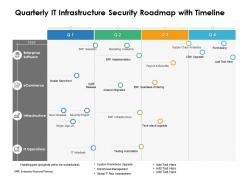
Quarterly it infrastructure security roadmap with timeline





Try Before you Buy Download Free Sample Product
 Impress Your
 Audience
 100%
100% Editable
 Save Hours
 of Time


A cohesive work plan is essential for achieving the desired target. Communicate your vision and lay a firm ground in front of your audience with our PowerPoint layout. Align your project milestones, budgets, deliverables, deadlines, and all the requisite information for a dynamic presentation by employing this amazingly designed Quarterly IT Infrastructure Security Roadmap With Timeline. Maximize team efficiency and streamline a work plan efficiently by introducing our ready made roadmap PowerPoint theme. You can quickly establish coordination between different activities across the organization and present an insight to your colleagues by utilizing this useful business tool. Color code specific tasks, prioritize, and keep a close eye on the deadlines with the help of our eye catchy PowerPoint template. Download our Quarterly IT Infrastructure Security Roadmap With Timeline for excelling at productive management.
People who downloaded this PowerPoint presentation also viewed the following :
Quarterly it infrastructure security roadmap with timeline with all 2 slides:
Give your audience a fulfilling experience. They will find our Quarterly IT Infrastructure Security Roadmap With Timeline elevating.
FAQs for Quarterly it infrastructure security
Okay so there's basically five things you need to nail down. Start with figuring out what assets you have and how risky they are - sounds boring but it's actually pretty crucial. Then get your network security sorted with firewalls and proper segmentation. Access management is huge too - who can get into what and how you're verifying them. Oh, and you definitely need solid monitoring plus a plan for when things go sideways. Compliance is the last piece, though that's usually dictated by whatever industry rules you're stuck with. Don't try to do everything at once - assess where you are now, then tackle your biggest vulnerabilities over the next year or so.
Start with a full security audit - map out what you've got right now. Run vulnerability scans and review your policies. Check who has access to what. Also inventory everything (yes, including that random server nobody talks about). Interview the key people to figure out what's actually broken and what compliance stuff you need to hit. Honestly, a third-party assessor might be worth it if your team's too close to the problem. The whole point is getting a real picture of where you stand - the good, bad, and ugly - so you can build a roadmap that fixes actual problems instead of theoretical ones.
Okay so risk assessments are basically how you figure out what's actually broken instead of panicking about everything at once. Start by listing your important stuff, then work out what threats are realistic for your situation. I swear, security news makes everything sound like the apocalypse, but you need actual data to decide where to spend money first. The results tell you which fixes matter most and when to tackle them. NIST has a decent framework if you don't know where to start - just document what you've got and go from there. Way better than guessing.
So compliance basically becomes the backbone of your whole security plan. You've got to map out SOC 2, HIPAA, PCI DSS - whatever applies to you - and build your timeline around those requirements. It's a pain but honestly there's no getting around it. Start by figuring out where you currently stand with compliance, then tackle those gaps first since they're the biggest business risk. You can always add extra security stuff later, but the mandatory requirements have to come first or you're looking at potential fines. Build your roadmap phases around systematically closing those compliance holes.
Definitely start with a good SIEM for centralized logs - that's your foundation. Network monitoring tools are huge too (SolarWinds, PRTG, whatever fits your budget). EDR solutions will watch your endpoints. The vendor scene is honestly crazy right now, changes every few months it feels like. Vulnerability scanners should run regular sweeps, and you need intrusion detection watching the perimeter. Don't forget backup monitoring - weird stuff happens there more than you'd think. MFA isn't really "monitoring" but throw it on everything anyway. Bottom line: get visibility first. Can't protect what you can't see, right?
Don't treat incident response like some separate thing you'll figure out later. Build it right into your security planning from day one. Every new control or infrastructure change should include how you'll actually detect and handle problems. I've watched teams panic because they had solid defenses but zero clue what to do when stuff hit the fan - not pretty. Map your response steps to each security layer as you add them. Test everything with quarterly tabletop exercises (trust me, this stuff breaks when you need it most). Keep updating the plan when your setup changes.
Definitely go role-based - your finance people don't need server stuff but phishing? Critical. Run actual simulated phishing tests instead of those death-by-PowerPoint sessions. Way more effective, honestly. Cover the basics: strong passwords, spotting social engineering tricks, how to report weird stuff. Keep it short though - people's attention spans are terrible. Quarterly repeats work well since everyone forgets. The real trick is making security feel normal, not like some IT burden dumped on them. Oh, and create an easy reporting system where people won't feel dumb asking questions.
Start with a risk assessment to figure out your biggest vulnerabilities. What's your "crown jewels" - the stuff that'd make you panic if it went down at 3am? That's where you focus first. Then factor in compliance stuff since those deadlines aren't flexible. Look for quick wins next - maximum security bang for your buck. The longer strategic investments come after. Honestly, a scoring matrix helps tons here. Weight everything by risk, cost, and business impact so you're not just guessing. Makes the whole prioritization thing way less overwhelming and you'll actually have data backing your decisions.
Track both tech and business stuff to get the real picture. Mean time to detect incidents, vulnerabilities you've patched, login failures - that kind of thing. User training completion rates are huge too since people mess up constantly (sorry, but it's true). Business metrics matter just as much though. Downtime costs, audit results, incident expenses. Leadership needs to see the money side or they won't care. Honestly, pick 3-5 things you can actually track consistently instead of going crazy with spreadsheets everywhere. Better to nail a few metrics than half-ass a dozen.
Honestly, AI and ML are game-changers for security - they can automate threat detection way faster than any human team could handle. You'll catch network patterns and zero-day attacks that would normally slip through. The algorithms predict vulnerabilities before hackers even find them, plus they auto-quarantine sketchy activity. Your security team stops wasting time on boring repetitive tasks and can actually tackle the serious strategic stuff. I'd start with AI-powered SIEM tools or endpoint detection - boring names but they work. You get instant visibility improvements and decent baseline protection right off the bat.
Ugh, budget fights are the worst - leadership never gets why security matters until something breaks. Legacy systems? Good luck touching those without everything falling apart. Finding decent security people is like hunting unicorns right now, everyone's fighting over the same talent pool. Your users will hate any new protocols that add extra steps to their day. Honestly, the threat landscape moves so fast you're always playing catch-up while still fixing old vulnerabilities. My advice? Go for some easy wins first to show ROI and build momentum with the higher-ups.
Dude, get your IT and security people talking to each other instead of just tossing demands back and forth. Security knows the actual threats you're facing. IT knows what'll work with your current setup and won't blow the budget. They can figure out which controls matter most and avoid rolling out stuff that crashes everything. Catching problems during planning beats scrambling later when things break. Honestly, it cuts down on all the blame games too - which, let's be real, gets old fast. Just have them sit in on each other's meetings first. You'd be shocked how much that simple step helps.
Look, auditing is like getting your car inspected - kinda annoying but you'll catch problems before they become disasters. Your security plan sounds great on paper, but quarterly reviews show what's actually happening. Controls stop working, new vulnerabilities pop up, stuff breaks. I learned this the hard way when we skipped audits for like 8 months and missed some obvious gaps. Do internal checks every few months and bring in outside experts annually. Otherwise you're flying blind with outdated info. Trust me, it's way better than explaining to your boss why hackers got in through something you could've caught.
Build adaptability right into your roadmap from day one. Most companies completely skip this part, then act shocked when they're scrambling to catch up. Get regular threat intel feeds running and do quarterly risk reviews. Your security team needs direct access to industry sharing groups and vuln databases - this stuff changes fast. Don't write your roadmap once and call it done. Budget for surprise threats and figure out clear escalation when new risks pop up. Honestly, just schedule your first quarterly review for next month and start there.
Start with an access audit this week - bet you'll find people with way more permissions than they need. Set up role-based controls so everyone only sees what's actually required for their job. Honestly, the principle of least privilege saves so much headache later. You'll also want continuous monitoring to flag weird behavior, like Janet from accounting suddenly diving into engineering files at 2am. Regular access reviews are clutch, especially when people leave - can't tell you how many ghost accounts I've seen floating around. Oh, and make sure people feel safe reporting sketchy stuff without getting blamed.
No Reviews