

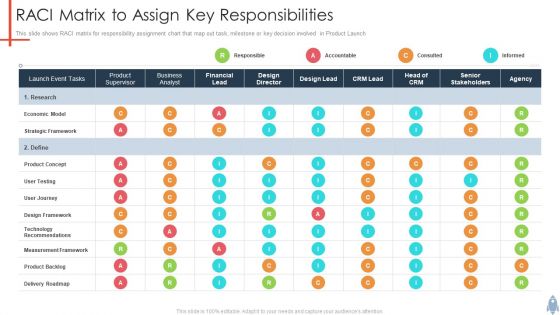
Raci matrix to assign key responsibilities product launch plan ppt information




Try Before you Buy Download Free Sample Product
 Impress Your
 Audience
 100%
100% Editable
 Save Hours
 of Time


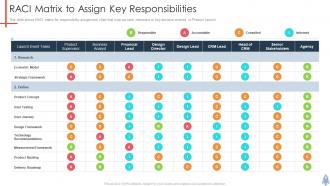
This slide shows RACI matrix for responsibility assignment chart that map out task, milestone or key decision involved in Product Launch
People who downloaded this PowerPoint presentation also viewed the following :
Raci matrix to assign key responsibilities product launch plan ppt information with all 2 slides:
Use our Raci Matrix To Assign Key Responsibilities Product Launch Plan Ppt Information to effectively help you save your valuable time. They are readymade to fit into any presentation structure.
FAQs for Raci matrix to assign key responsibilities product launch
Okay so a RACI matrix basically stops that whole "I thought YOU were doing it" disaster. You know how projects always have those moments where something critical just... doesn't happen? This fixes that. Break down your deliverables, then assign everyone a letter: R for who actually does the work, A for who owns the outcome, C for people you need input from, and I for whoever just needs updates. Honestly, the "consulted vs informed" thing trips people up at first, but you'll get it. It's like giving everyone a clear lane so nobody's stepping on toes or assuming someone else has it covered.
So RACI breaks down like this: **Responsible** does the actual work, **Accountable** is the one person (seriously, just one!) who's on the hook if things go sideways, **Consulted** means you need their input before making moves, and **Informed** just gets updates afterward. The accountable role is where teams usually mess up. I've watched so many projects blow up because three different people all thought they were the one in charge. Figure out who's really accountable first - like who's actually getting blamed if it fails? Then you can map everyone else around that person. Makes the whole thing way cleaner.
Yeah, RACI matrices can totally work for agile - just don't go overboard with them. Build quick, lightweight ones for each sprint instead of some massive upfront document that'll be outdated in two weeks anyway. Focus on the big decisions and deliverables, not every little task. You'll need to update roles as they shift between sprints (and trust me, they always do). I'd start by mapping roles for your current sprint's main user stories. It actually helps clarify who owns what without all the bureaucratic nonsense that makes agile teams roll their eyes.
So many people screw up RACI by putting too many folks as "Responsible" - then nobody knows who's actually doing what. Only assign ONE person as "Accountable" too, not like three people (I've seen this disaster happen). Don't forget to include the stakeholders who actually matter. Some teams go way overboard making these things super complicated when honestly, simple works better. The worst mistake though? Building it without asking your team first. If people hate their assignments from the start, you've basically created expensive wall decoration. Get everyone's input and keep it straightforward.
Honestly, RACI matrices are game-changers for avoiding those "wait, who's supposed to do this?" disasters. You map out all your deliverables, then assign each person either Responsible, Accountable, Consulted, or Informed for every task. No more awkward finger-pointing when deadlines hit! The best part? When someone new joins the team or your boss starts asking questions, you don't have to re-explain everything - just show them the chart. I've seen teams waste hours in meetings just figuring out roles that should've been decided upfront. Start simple though, don't overthink it.
Start by listing all your project tasks and figuring out who's involved. Go through each task and assign roles - one person Responsible (actually does it), one Accountable (owns the result), plus whoever needs to be Consulted or just Informed. Here's the annoying part: getting people to agree on these assignments. Everyone thinks they should have more say than they actually need! I swear some people collect meeting invites like trophies. Once you hash it out though, write it down somewhere obvious. You'll definitely need to reference it later when people start getting confused about who's supposed to be doing what.
Don't assume everyone knows what RACI means - seriously, walk through each role with your team out loud and make them confirm they get it. I've watched projects completely blow up because people had totally different ideas about being "consulted." Document it all somewhere everyone can actually find it (not buried in some random folder). Quick check-ins help too. Honestly, the best thing you can do is straight up ask "does everyone still know what they're supposed to be doing?" and then actually wait for real answers, not just head nods.
Yeah totally! RACI matrices work for basically anything. The R-A-C-I part stays the same, but you just swap in whatever roles make sense for your project. Software teams might have product owners and QA people. Construction uses contractors and inspectors. Healthcare brings in doctors and regulatory folks - honestly, those regulatory people are everywhere in healthcare. You just figure out who actually does the work in your situation, then drop those roles into the framework. Makes accountability way clearer. I've seen it work across tons of different industries.
Honestly? Just use Excel or Google Sheets first. Most RACI matrices are super simple - you're literally just tracking who's responsible, accountable, etc. for different tasks. If you need fancier project management stuff later, Microsoft Project or Smartsheet work well. Lucidchart's nice too if your team's really into the visual thing. But I've watched so many people immediately jump to these expensive tools when a basic spreadsheet would've been fine. The main thing is picking whatever your whole team can actually access and won't hate updating. Because honestly, the fanciest RACI matrix is useless if nobody touches it after week one.
So when you see overlaps in your RACI, first thing - break those messy responsibilities down into smaller chunks. Usually that shows you where the real boundaries are. Like, maybe one person's actually approving budget stuff while the other handles timeline approvals, you know? If there's still overlap after that (which honestly happens more than it should), just talk to the people involved. Hash it out directly instead of leaving it vague - trust me, that ambiguity will bite you later. Once you figure out who does what, update your RACI matrix so everyone's on the same page.
Oh man, RACI charts are honestly pretty great for software projects - like figuring out who does code reviews or gets looped in on big architecture calls. Marketing campaigns too since there's always a million people involved. We used one during a merger at my old job and it actually prevented so much chaos when teams from both companies were stepping on each other. Here's the thing though - you can't just make the chart and call it done. People need to actually follow it or it's useless. Try it on your next cross-team project and watch those "wait, wasn't that your job?" conversations disappear.
Check your RACI matrix at every big milestone, plus whenever scope or team stuff changes. I do monthly reviews on longer projects - seriously saves you from those cringe "whose job was this again?" situations. New team member joins? Update it right away. Same goes for role changes or new deliverables. Don't let it sit there collecting digital dust while everyone's confused about responsibilities. Set a calendar reminder so you don't forget (I'm terrible at remembering otherwise). Share any updates with your team immediately so nobody's operating with outdated info.
Honestly, start with who's actually good at what and whether they have bandwidth. No point putting Sarah in charge if she's already juggling three other deadlines, right? Look at how decisions really happen on your team - not the org chart version, but reality. Some groups love detailed breakdowns, others just want the big picture. I'd say map it to how you guys already work together instead of cramming yourselves into some textbook model. Keep it simple at first. You can always tweak things once you see what's actually creating confusion versus what's helping people stay on track.
A RACI matrix is honestly a game-changer for risk stuff. Basically you assign someone to be "Responsible" for watching specific risks, then the "Accountable" person makes the calls when shit hits the fan. Super helpful during those chaotic moments where everyone's like "wait, I thought YOU were handling this." Plus it stops all the finger-pointing later because everyone can see exactly what their job is. I learned this the hard way on a project last year - wish I'd set one up from day one. Just make sure you actually reference it when things get messy, otherwise it's pointless.
Look, getting everyone involved when you're building that RACI matrix is seriously worth it. People actually care about the project when they help define their own roles instead of just getting told what to do. Your stakeholders know the real work better than you anyway - they'll spot the weird overlaps or impossible deadlines you'd totally miss. Saves you from those super awkward mid-project moments where everyone's staring at each other like "I thought you were handling this?" Trust me, spend that extra hour getting input upfront. You'll avoid weeks of chaos later, and honestly your sanity will thank you.
-
Much better than the original! Thanks for the quick turnaround.
-
Content of slide is easy to understand and edit.
-
Excellent template with unique design.
-
Use of different colors is good. It's simple and attractive.