


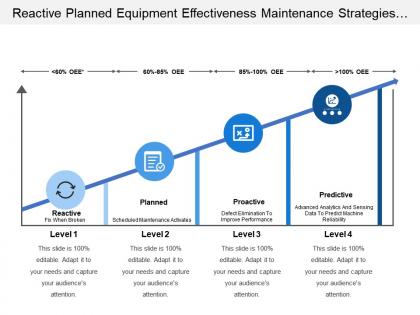
Reactive planned equipment effectiveness maintenance strategies levels with icons




Try Before you Buy Download Free Sample Product
 Impress Your
 Audience
 100%
100% Editable
 Save Hours
 of Time


Get folks from diverse fields to collaborate with our Reactive Planned Equipment Effectiveness Maintenance Strategies Levels With Icons. Bring about a distinctive flavor.
People who downloaded this PowerPoint presentation also viewed the following :
Reactive planned equipment effectiveness maintenance strategies levels with icons with all 5 slides:
Our Reactive Planned Equipment Effectiveness Maintenance Strategies Levels With Icons allow you to act with authority. Folks feel duty bound to follow.




FAQs for Reactive planned equipment effectiveness maintenance strategies
Reactive maintenance addresses equipment failures after they occur, focusing on quick repairs and minimal downtime, while proactive maintenance prevents failures through scheduled inspections, predictive analytics, and preventive interventions. While reactive strategies minimize upfront costs, proactive approaches deliver greater long-term efficiency, reduced emergency expenses, and enhanced operational reliability, with manufacturing and healthcare facilities finding significantly lower total maintenance costs.
Reactive maintenance significantly reduces operational efficiency by causing unplanned downtime, increasing repair costs, and disrupting production schedules across manufacturing, healthcare, and logistics operations. This approach forces organizations to allocate resources inefficiently, with many finding that equipment failures cascade into delayed deliveries, compromised service quality, and higher labor costs, ultimately undermining competitive advantage.
Common equipment failure causes requiring reactive maintenance include wear and tear, electrical component breakdown, mechanical stress, inadequate lubrication, and environmental factors like corrosion. These failures often result from aging infrastructure, unexpected operational demands, and deferred preventive care, with many manufacturing and processing facilities finding that addressing root causes through strategic maintenance planning ultimately reduces emergency repairs and enhances operational reliability.
Organizations effectively track reactive maintenance requests through computerized maintenance management systems (CMMS), mobile reporting apps, centralized work order systems, real-time asset monitoring, and standardized priority classification protocols. These digital platforms streamline request submission, automate technician assignments, and provide comprehensive maintenance histories, with manufacturing facilities and healthcare institutions finding that integrated tracking systems reduce response times by 40% while improving resource allocation and operational efficiency.
Relying heavily on reactive maintenance typically results in 3-5 times higher costs than preventive strategies, including emergency repair expenses, extended equipment downtime, and premium pricing for urgent parts and labor. While reactive approaches minimize upfront planning investments, manufacturing and healthcare facilities increasingly find that unplanned failures create cascading operational disruptions, ultimately delivering reduced asset lifespans and significantly higher total ownership costs.
IoT sensors and predictive analytics reduce reactive maintenance reliance by continuously monitoring equipment conditions, detecting anomalies before failures occur, and enabling data-driven maintenance scheduling. Through real-time asset monitoring, organizations in manufacturing, healthcare, and energy sectors streamline operations, minimize unexpected downtime, and optimize resource allocation, ultimately delivering significant cost savings and enhanced operational efficiency.
Training and staff preparedness significantly minimize reactive maintenance effects by ensuring faster response times, accurate problem diagnosis, efficient resource allocation, and proper safety protocols during emergency repairs. Well-trained maintenance teams can quickly identify root causes, implement temporary solutions, and execute permanent fixes more effectively, ultimately reducing equipment downtime, preventing secondary damage, and maintaining operational continuity even when unexpected failures occur.
Industry standards and regulations significantly influence reactive maintenance practices by establishing minimum response times, safety protocols, documentation requirements, and equipment reliability benchmarks that organizations must meet. In highly regulated sectors like healthcare, aerospace, and manufacturing, these frameworks ensure maintenance teams follow standardized procedures for emergency repairs, maintain detailed failure records, and implement corrective actions that comply with safety mandates, ultimately delivering regulatory compliance while minimizing operational risks.
Reactive maintenance offers lower upfront costs and maximum equipment utilization until failure, making it suitable for non-critical assets with minimal safety implications. However, this approach presents significant disadvantages including unpredictable downtime, higher emergency repair costs, and potential safety risks, with many manufacturing and healthcare organizations finding that purely reactive strategies ultimately compromise operational efficiency and customer satisfaction.
Maintenance teams can prioritize reactive tasks through severity classification, equipment criticality assessment, safety risk evaluation, production impact analysis, and resource availability considerations. While this approach presents both challenges and opportunities, many organizations find that implementing structured triage systems with clear escalation protocols ultimately delivers faster response times and optimized resource allocation.
Organizations balance reactive and preventive maintenance by implementing condition-based monitoring, prioritizing critical assets through risk assessment, and allocating resources based on equipment criticality and failure patterns. This strategic combination enables manufacturers, utilities, and healthcare facilities to minimize unplanned downtime while optimizing maintenance costs, ultimately extending asset life through data-driven decisions that deliver both operational efficiency and competitive advantage.
Key metrics include mean time to repair (MTTR), maintenance costs per incident, equipment downtime duration, failure frequency rates, and labor efficiency ratios. These measurements enable organizations to assess response effectiveness, cost control, and resource allocation, with many manufacturing and healthcare facilities finding that tracking these indicators ultimately delivers better maintenance planning and competitive operational advantages.
A well-structured reactive maintenance plan enhances customer satisfaction by minimizing downtime through rapid response protocols, clear communication channels, and prioritized repair sequences that address critical issues first. Organizations in hospitality, retail, and healthcare find that streamlined reactive processes, combined with transparent customer updates and swift resolution times, ultimately deliver better service reliability and stronger customer relationships.
Airlines like Southwest and manufacturing companies such as General Electric have effectively managed reactive maintenance through rapid response protocols, extensive spare parts inventory, and skilled emergency repair teams. These organizations streamline downtime by maintaining strategic stockpiles, deploying mobile repair units, and implementing fast-track procurement processes, ultimately delivering cost-effective solutions while minimizing operational disruptions.
Communication between departments significantly impacts reactive maintenance efficacy by enabling faster issue identification, coordinating resource allocation, and streamlining repair processes across operations, engineering, and procurement teams. Poor interdepartmental communication leads to delayed responses, duplicated efforts, and extended downtime, while seamless information sharing allows organizations to minimize equipment failures, reduce repair costs, and ultimately maintain operational continuity in increasingly complex industrial environments.
-
Graphics are very appealing to eyes.
-
Unique design & color.