


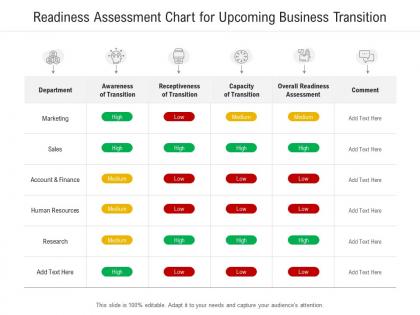
Readiness assessment chart for upcoming business transition




Try Before you Buy Download Free Sample Product
 Impress Your
 Audience
 100%
100% Editable
 Save Hours
 of Time


Our Readiness Assessment Chart For Upcoming Business Transition are topically designed to provide an attractive backdrop to any subject. Use them to look like a presentation pro.
People who downloaded this PowerPoint presentation also viewed the following :
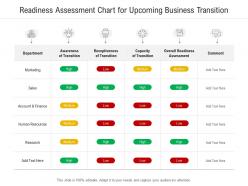
Readiness assessment chart for upcoming business transition with all 2 slides:
Use our Readiness Assessment Chart For Upcoming Business Transition to effectively help you save your valuable time. They are readymade to fit into any presentation structure.
FAQs for Readiness assessment chart for
Businesses should assess financial stability, operational efficiency, market positioning, organizational capabilities, and leadership readiness to determine transition preparedness. These factors work together by revealing resource availability, process scalability, and competitive advantages, with many organizations finding that comprehensive assessments across finance, operations, and personnel ultimately deliver clearer transition strategies and higher success rates.
Companies can effectively communicate transition plans through transparent timelines, regular progress updates, dedicated communication channels, stakeholder-specific messaging, and proactive risk mitigation strategies. This multi-channel approach enables organizations to maintain trust and alignment across investors, employees, and customers, while addressing concerns early and ensuring smoother implementation, ultimately delivering enhanced stakeholder confidence and operational continuity.
Company culture serves as the foundation for transition success, influencing employee adaptability, communication effectiveness, stakeholder trust, and organizational resilience throughout change processes. A strong, flexible culture enables smoother integration during mergers, facilitates knowledge transfer in leadership transitions, and maintains operational continuity, with many organizations finding that investing in cultural alignment early significantly reduces transition risks while accelerating post-change performance outcomes.
Key financial indicators include revenue trends, profit margins, cash flow patterns, debt-to-equity ratios, and asset valuations. These metrics enable potential buyers or investors to assess operational efficiency, financial stability, and growth potential, with many organizations finding that comprehensive financial analysis streamlines negotiations and ultimately delivers higher transition valuations.
Leadership aligns vision with transition strategy through clear communication, stakeholder engagement, strategic roadmapping, and consistent messaging across all organizational levels. This alignment enables smoother implementation, reduces resistance, and accelerates adoption, with many organizations finding that leaders who actively champion the transition while addressing concerns ultimately deliver faster results and stronger buy-in.
Effective transition readiness metrics include stakeholder engagement scores, process documentation completeness, resource allocation assessments, risk mitigation preparedness, and change management capability evaluations. These tools enable organizations to identify gaps early, streamline preparation phases, and minimize disruption during implementation, with many companies finding that comprehensive readiness measurement reduces transition timelines and ultimately delivers smoother organizational transformations.
Employee engagement and feedback can be incorporated through regular surveys, focus groups, cross-functional transition committees, town halls, and one-on-one sessions with leadership. These approaches enable organizations to identify concerns early, customize communication strategies, and build employee buy-in, while many companies finding that engaged workforces adapt more quickly, ultimately delivering smoother transitions and sustained operational performance.
Common pitfalls include inadequate communication strategies, insufficient stakeholder engagement, poor resource allocation, resistance to change management, and unrealistic timeline expectations. These challenges can be avoided by establishing comprehensive communication frameworks, conducting thorough risk assessments, and implementing phased transition approaches, with many organizations finding that early stakeholder involvement and flexible resource planning ultimately deliver smoother transitions and sustained competitive advantage.
Technology facilitates seamless business transitions by automating data migration, streamlining workflow integration, and providing real-time analytics for decision-making throughout the process. Cloud platforms, AI-driven project management tools, and automated communication systems enable organizations to maintain operational continuity, reduce downtime, and accelerate implementation timelines, ultimately delivering competitive advantage during critical transformation periods.
Contingency plans provide critical risk mitigation during business transitions by identifying potential disruptions, establishing alternative strategies, and ensuring operational continuity when unexpected challenges arise. They enable organizations to respond swiftly to market shifts, regulatory changes, or implementation delays, ultimately protecting revenue streams and maintaining stakeholder confidence throughout the transition process.
Regulatory and compliance considerations significantly impact transition readiness by requiring thorough risk assessments, updated documentation, and stakeholder alignment before implementation. Organizations must navigate industry-specific requirements, data protection standards, and reporting obligations, with many financial services and healthcare institutions finding that early compliance integration streamlines transitions and minimizes costly delays.
Staff should receive comprehensive training covering new systems and processes, change management techniques, communication protocols, role-specific skill development, and cross-functional collaboration methods. Through structured learning programs, hands-on workshops, and ongoing support resources, organizations enable smoother adaptation, reduce resistance, and maintain productivity during transitions, with many finding that well-trained teams accelerate implementation timelines significantly.
Customer relations during business transitions require transparent communication, proactive support, and consistent service delivery to maintain trust and minimize disruption. Organizations can enhance relationships by establishing dedicated transition teams, providing regular updates through multiple channels, and offering additional support resources, with many companies finding that proactive engagement during change periods ultimately strengthens customer loyalty and competitive positioning.
Successful business transition case studies include Netflix's shift from DVD to streaming, Amazon's expansion from books to cloud services, and IBM's transformation from hardware to consulting and AI. These organizations demonstrate that successful transitions require strategic vision, gradual implementation phases, and continuous customer value delivery, with many finding that early market positioning and adaptable infrastructure ultimately determine competitive advantage.
Businesses assess competitive landscapes through market analysis, competitor benchmarking, customer feedback evaluation, industry trend monitoring, and strategic positioning reviews. These comprehensive assessments enable organizations to identify market gaps, understand competitive advantages, and anticipate industry shifts, with many companies finding that thorough landscape analysis ultimately delivers more informed transition strategies and sustainable competitive positioning.
-
Professional and unique presentations.
-
Really like the color and design of the presentation.
-
Excellent work done on template design and graphics.
-
Appreciate the research and its presentable format.
-
Professional and unique presentations.
-
The Designed Graphic are very professional and classic.
-
Really like the color and design of the presentation.
-
Wonderful templates design to use in business meetings.