

Real time analysis of security alerts information and event management dashboard




Try Before you Buy Download Free Sample Product
 Impress Your
 Audience
 100%
100% Editable
 Save Hours
 of Time


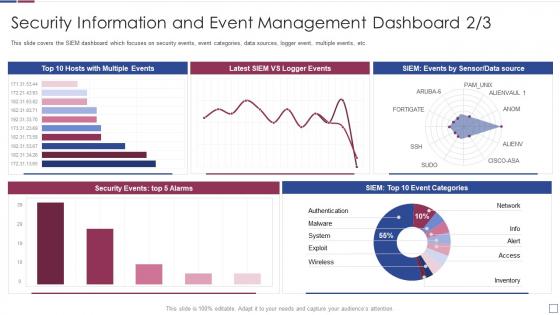
This slide covers the SIEM dashboard which focuses on security events, event categories, data sources, logger event, multiple events, etc.
People who downloaded this PowerPoint presentation also viewed the following :
Real time analysis of security alerts information and event management dashboard with all 7 slides:
Use our Real Time Analysis Of Security Alerts Information And Event Management Dashboard to effectively help you save your valuable time. They are readymade to fit into any presentation structure.





FAQs for Real time analysis of security alerts information and
The primary function of a SIEM system is to collect, analyze, and correlate security data from across an organization's IT infrastructure in real-time to detect threats, manage incidents, and ensure compliance. These platforms enable security teams to identify suspicious activities, automate threat responses, and streamline compliance reporting, with many organizations finding that centralized monitoring significantly enhances their overall security posture.
SIEM integrates with cybersecurity tools through APIs, log aggregation protocols, and standardized data formats, connecting firewalls, intrusion detection systems, endpoint protection platforms, vulnerability scanners, and identity management solutions. This strategic combination enables centralized threat correlation, automated incident response, and comprehensive security orchestration, with many organizations finding that integrated SIEM deployments significantly enhance threat detection capabilities while streamlining security operations across their entire infrastructure.
Key SIEM solution components include log management systems, event correlation engines, real-time monitoring dashboards, threat intelligence feeds, and incident response workflows. These technologies streamline security operations by aggregating data from multiple sources, automating threat detection, and enabling rapid response capabilities, with many organizations finding that integrated SIEM platforms significantly reduce mean time to threat identification and resolution.
SIEM helps organizations comply with regulatory requirements like GDPR and HIPAA by providing comprehensive audit trails, automated compliance reporting, and real-time monitoring of data access and security events. Through centralized logging and incident documentation, healthcare institutions and financial services can demonstrate regulatory adherence, track data breaches within required timeframes, and generate detailed compliance reports, ultimately reducing audit costs while ensuring continuous regulatory alignment.
SIEM enhances incident response capabilities by providing real-time threat detection, automated alert prioritization, centralized log analysis, and comprehensive forensic investigation tools. Through advanced correlation engines and integrated dashboards, organizations streamline response workflows, reduce detection times from hours to minutes, and enable security teams to quickly isolate threats, ultimately delivering faster containment and minimizing business disruption.
Machine learning enhances modern SIEM solutions by enabling automated threat detection, reducing false positives, identifying anomalous user behavior, and accelerating incident response times. These AI-driven capabilities help security teams in financial services and healthcare organizations streamline threat analysis, minimize manual investigation workloads, and ultimately deliver faster, more accurate security responses in an increasingly complex threat landscape.
Log management focuses on collecting, storing, and organizing system logs for compliance and basic analysis, while SIEM encompasses comprehensive security monitoring, real-time threat detection, and incident response capabilities. SIEM platforms integrate log management with advanced analytics, correlation rules, and automated alerting, enabling organizations to identify security threats, investigate incidents, and respond to breaches more effectively than traditional log management alone.
Threat intelligence enhances SIEM effectiveness by providing contextual data about emerging threats, attack patterns, and indicators of compromise, enabling more accurate threat detection and faster incident response. Through real-time intelligence feeds, organizations streamline threat hunting, reduce false positives, and prioritize critical alerts, with many financial institutions and healthcare providers finding that integrated threat intelligence ultimately delivers proactive security postures and improved operational efficiency.
Organizations face implementation challenges including high deployment costs, complex integration with existing systems, skilled personnel shortages, alert fatigue from false positives, and lengthy configuration processes. Many enterprises find that inadequate planning, insufficient staff training, and underestimating ongoing maintenance requirements can significantly impact SIEM effectiveness, ultimately requiring strategic resource allocation and dedicated expertise to deliver optimal security outcomes.
Organizations ensure SIEM data accuracy and relevance through comprehensive log source validation, real-time data correlation algorithms, automated filtering protocols, and regular configuration audits. These quality assurance mechanisms streamline threat detection by eliminating false positives, standardizing data formats, and prioritizing critical security events, with many financial institutions and healthcare organizations finding that structured data governance ultimately delivers faster incident response and enhanced operational security.
Real-time data analysis in SIEM operations enables immediate threat detection, rapid incident response, automated alert generation, and continuous security monitoring across enterprise networks. This capability allows organizations to identify security breaches within minutes rather than hours or days, significantly reducing potential damage, minimizing business disruption, and ultimately delivering enhanced protection against increasingly sophisticated cyber threats.
SIEM pricing models vary significantly across vendors, including per-device licensing, data volume-based pricing, user-based subscriptions, and hybrid consumption models. Enterprise vendors like Splunk typically charge by data ingestion volume, while cloud-native providers offer flexible per-user pricing, with many organizations finding that hybrid models deliver better cost predictability and scalability for growing security operations.
Common SIEM enterprise use cases include threat detection and response, compliance monitoring, incident investigation, security analytics, and log management across IT infrastructure. These systems enable organizations to identify suspicious activities, meet regulatory requirements like PCI DSS and SOX, and streamline security operations, with many financial institutions and healthcare providers finding that centralized monitoring significantly reduces response times while enhancing overall security posture.
SIEM contributes to organizational risk management by providing real-time threat detection, centralized security monitoring, automated incident response, and comprehensive compliance reporting across all network assets. Through advanced analytics and correlation engines, organizations can identify vulnerabilities before they become breaches, streamline regulatory compliance processes, and ultimately reduce operational risk while enhancing their overall security posture.
Future SIEM developments include AI-driven threat detection, cloud-native architectures, automated response capabilities, enhanced user behavior analytics, and integrated threat intelligence platforms. These advancements streamline security operations by reducing false positives, accelerating incident response, and enabling predictive threat hunting, with many organizations finding that modern SIEM solutions ultimately deliver comprehensive security visibility and operational efficiency.
-
Informative presentations that are easily editable.
-
Use of icon with content is very relateable, informative and appealing.