


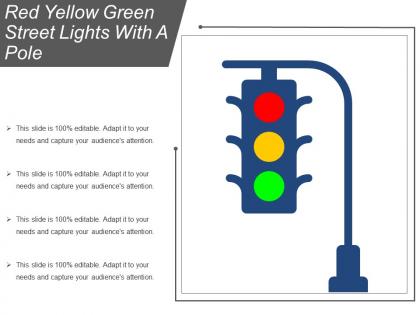
Red yellow green street lights with a pole




Try Before you Buy Download Free Sample Product
 Impress Your
 Audience
 100%
100% Editable
 Save Hours
 of Time


Handle intrigue with our Red Yellow Green Street Lights With A Pole. Expose attempts at dubious deeds.
People who downloaded this PowerPoint presentation also viewed the following :
Red yellow green street lights with a pole with all 5 slides:
Assess the aftermath of the event with our Red Yellow Green Street Lights With A Pole. Be able to judge the fallout.




FAQs for Red yellow green street lights
Traffic signal poles are primarily constructed from steel, aluminum, concrete, fiberglass, and composite materials, each offering distinct durability characteristics. Steel provides exceptional strength and longevity but requires corrosion protection, while aluminum delivers lightweight corrosion resistance, and concrete offers robust stability for heavy installations, with many municipalities finding that material selection significantly impacts maintenance costs and operational lifespan.
Traffic signal pole design varies through height adjustments, mounting configurations, structural materials, and foundation specifications based on local wind loads, seismic requirements, and intersection complexity. High-volume urban intersections typically utilize taller mast arm poles with multiple signal heads, while suburban areas often employ simpler post-mounted designs, with regions like California requiring enhanced seismic engineering and coastal areas demanding corrosion-resistant materials.
Safety considerations for installing traffic signal poles include proper foundation depth for stability, adequate clearance from power lines, compliance with height and visibility standards, strategic placement away from potential vehicle impact zones, and coordination with utility locations. These measures enhance road safety by ensuring reliable signal operation, minimizing accident risks, and protecting both installation crews and drivers, ultimately delivering safer intersections and reduced liability exposure.
Traffic signal poles integrate with smart city technologies by housing IoT sensors, wireless communication systems, edge computing devices, and environmental monitors that collect real-time traffic data. These connected poles enable adaptive signal timing, pedestrian detection, air quality monitoring, and emergency response coordination, with cities like Barcelona and Singapore finding that integrated infrastructure reduces congestion by 25% while enhancing urban mobility management.
Traffic signal poles enhance pedestrian safety by providing clearly visible crossing signals, audible alerts for visually impaired individuals, and push-button activation systems that extend crossing times. These infrastructure elements streamline pedestrian flow while reducing vehicle-pedestrian conflicts, with many urban municipalities finding that well-positioned signal poles ultimately deliver safer crosswalk experiences and improved traffic coordination.
Manufacturing and installing traffic signal poles impacts air quality through steel production emissions, generates construction waste, and requires significant energy consumption during fabrication processes. However, modern poles increasingly use recycled materials and sustainable manufacturing practices, while smart signal systems reduce vehicle idling and emissions, with many cities finding that efficient traffic management ultimately delivers environmental benefits through improved urban flow.
Traffic signal pole designs have evolved through smart technology integration, LED lighting systems, solar power capabilities, modular construction methods, and enhanced durability materials. These advancements streamline urban infrastructure management by reducing energy consumption, enabling remote monitoring, and supporting adaptive traffic control, with many cities finding that modern poles deliver lower maintenance costs and improved traffic flow efficiency.
Best practices for maintaining traffic signal poles include regular structural inspections, corrosion prevention treatments, electrical system testing, foundation assessments, and prompt damage repairs. Transportation departments enhance safety and minimize disruptions by implementing scheduled maintenance protocols, using weather-resistant materials, and conducting quarterly functionality checks, ultimately delivering reliable traffic management and extended infrastructure lifespan.
Traffic signal poles support emergency operations by housing preemption systems that detect approaching ambulances, fire trucks, and police vehicles through strobe lights, GPS signals, or radio frequencies. These technologies automatically adjust signal timing, clear traffic corridors, and prioritize emergency routes, with many municipalities finding that integrated preemption systems reduce emergency response times by 20-50% while enhancing public safety outcomes.
Aesthetic considerations for traffic signal poles include sleek designs, color coordination with surroundings, appropriate height proportions, integrated lighting features, and minimalist hardware placement. These design elements enhance urban landscapes by reducing visual clutter, complementing architectural styles, and creating cohesive streetscapes, with many cities finding that well-designed poles significantly improve public spaces while maintaining essential traffic management functionality.
Traffic signal poles reduce traffic accidents by providing clear visual guidance, establishing right-of-way protocols, and enabling systematic traffic flow management at intersections. Through strategic placement and visibility enhancements, these infrastructure elements help drivers navigate complex intersections more safely, while reducing collision risks by up to 40% in busy urban areas, ultimately delivering smoother traffic operations and enhanced pedestrian safety.
Municipalities face challenges including complex utility coordination, strict regulatory compliance requirements, budget constraints, and community resistance to installations. These obstacles often require strategic planning, extensive permitting processes, and stakeholder engagement, with many cities finding that proactive community involvement and phased implementation approaches ultimately streamline deployment while enhancing public acceptance.
Traffic signal pole height is determined by roadway classification, vehicle mix, sight distance requirements, mounting configuration, and local traffic engineering standards. These factors work together by ensuring adequate clearance over large vehicles, maximizing visibility for approaching drivers, and accommodating pedestrian sight lines, with many municipalities finding that strategic pole placement ultimately delivers safer intersections and improved traffic flow efficiency.
Current innovations for traffic signal poles include smart LED systems with adaptive timing, integrated IoT sensors for real-time traffic monitoring, solar power capabilities, wireless connectivity for centralized control, and embedded cameras for violation detection. These technologies enhance urban traffic management by reducing congestion, minimizing energy consumption, and enabling predictive maintenance, with many cities finding that intelligent signal networks deliver improved traffic flow and operational efficiency.
Traffic signal poles enable systematic traffic flow management during peak hours by providing stable mounting for advanced timing systems, synchronized controls, and adaptive signal technologies. Through strategically positioned poles with smart sensors and coordinated timing algorithms, traffic management authorities streamline intersection efficiency, reduce congestion delays, and optimize vehicle throughput, while enabling real-time adjustments that ultimately deliver smoother commutes and enhanced urban mobility.
-
Enough space for editing and adding your own content.
-
Appreciate the research and its presentable format.