Regulatory Compliance Monitoring Report With Action Plans

Rating:
100%
Regulatory Compliance Monitoring Report With Action Plans
Slide 1 of 6
Favourites Favourites

Try Before you Buy Download Free Sample Product

Audience Impress Your
Audience
Editable 100%
Editable
Time Save Hours
of Time
The Biggest Sale is ending soon in
0
0
:
0
0
:
0
0
Rating:
100%
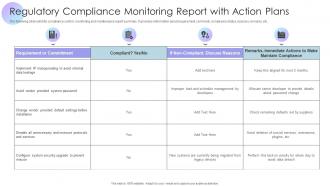
The following slide exhibits compliance control, monitoring and maintenance report summary. It provides information about requirement, comment, compliance status, reasons, remarks, etc. Introducing our Regulatory Compliance Monitoring Report With Action Plans set of slides. The topics discussed in these slides are Regulatory, Compliance Monitoring Report, Action Plans. This is an immediately available PowerPoint presentation that can be conveniently customized. Download it and convince your audience.
People who downloaded this PowerPoint presentation also viewed the following :

FAQs for Regulatory Compliance Monitoring Report

Honestly, start by figuring out which regulations actually hit your business - that's your foundation. Documentation is everything (auditors are obsessed with paper trails, trust me). You'll need solid policies that match what your team actually does, not some generic template. Regular monitoring helps you spot problems before regulators knock on your door. Staff training can't be an afterthought either - everyone needs to know the rules. Oh, and data management? Huge pain but you need clean records of everything. The reporting requirements are brutal but there's no way around them. Build your whole compliance setup around your specific regulatory requirements.

Stop trying to track everything by hand - you'll go crazy. Get on the email lists for whatever agencies regulate your stuff first. Compliance software helps too since it'll ping you when new rules drop. I learned this the hard way after our legal team missed something major last year, honestly was a mess. Split up who watches what so Bob handles safety regs while Sarah covers environmental stuff, you know? Definitely need one central spot where everything gets dumped and reviewed though. Map out your regulators first, then build from there. Way less stressful once you have a system.

Honestly, tech is a game-changer for compliance stuff. RegTech platforms automatically track regulation changes so you're not constantly playing catch-up with new rules. You can automate data collection and monitoring, which beats manually pulling reports every quarter - trust me on that one. AI flags issues before they blow up into expensive headaches. Plus regulators actually prefer the digital audit trails since everything's documented and easy to trace. I'd start by looking at your current processes and figuring out where automation could save you the biggest headache first.

Honestly, treat it like an ongoing conversation, not some dreaded annual thing everyone forgets about. Target the training to what people actually do - nobody cares about generic scenarios. Quarterly check-ins work well, and definitely use real examples from your field. New hires need the full rundown during onboarding, obviously. Here's the key part though: people have to feel comfortable asking questions without worrying they'll look stupid or get written up. I'd throw in some quizzes to see if it's actually sticking. Oh, and document everything because auditors love their paper trails.

Dude, non-compliance is basically financial suicide. You'll get hit with massive fines, lawsuits, maybe even criminal charges if it's bad enough. Your reputation gets destroyed too - honestly that's sometimes worse than the money aspect. Everyone around you suffers: shareholders watch their investments tank, employees worry about layoffs, customers bail. Oh and regulators can literally shut down parts of your operation if they want. It's a nightmare scenario. Start building compliance into everything from the beginning instead of scrambling later. Way less painful that way, trust me.

Yeah it's a nightmare honestly. Every country has totally different rules that'll catch you off guard. GDPR in Europe is all about data privacy, but the US does more industry-specific stuff like SOX for financial companies. Asia-Pacific gets weird about local partnerships and keeping data in-country. Figure out which regulations actually hit your business operations first - not just where your HQ is. And seriously, don't wing this part. Get lawyers in each market you're going into because I've seen companies get burned trying to DIY it.

Look, get leadership to actually walk the walk first - people notice when executives bend their own rules. Training's gotta be specific to what people actually do, not some generic slideshow nobody remembers. Set up ways for folks to report stuff without getting thrown under the bus. Most problems blow up because someone saw red flags early but was too scared to say anything. Oh, and make asking questions feel normal instead of embarrassing. When people catch issues before they explode, celebrate that! It's way cheaper than cleanup later.

Honestly, compliance audits are perfect for catching stuff you're blind to in your own operations. Auditors will call out redundant steps and bottlenecks that you've just gotten used to - it's annoying but super helpful. Think of it as getting brutally honest feedback from outsiders. Take their findings and prioritize the ones that fix both compliance issues AND those daily headaches your team always gripes about. Don't just patch problems either. Use it as an excuse to completely rethink how things flow. Sometimes you need that external push to actually make changes you've been putting off forever.

Honestly, just focus on the regulations that actually affect your business first - I see so many people getting overwhelmed trying to understand everything. Grab some compliance software to automate the boring stuff. Make simple checklists for things you do regularly and set phone reminders. For the complicated tax stuff or industry rules? Just outsource it. Trust me, trying to become a tax expert isn't worth your time when you could be growing your business. Handle the easy day-to-day monitoring yourself, but don't stress about mastering everything.

Honestly? Most companies just check boxes instead of actually building compliance into how they work. Teams end up documenting stuff that doesn't even exist, or creating these fancy policies nobody follows. Training's usually garbage too - people click through without getting why it matters. But the worst part is when compliance sits in some corner office, totally disconnected from real business decisions. Like, how's that supposed to work? I'd start by comparing what you actually do vs what you claim you do. That gap? It'll show you exactly where the problems are.

Honestly, just get your docs organized NOW and keep them that way - it's a lifesaver when inspectors randomly show up. Pick someone on your team who won't freak out and knows where everything lives. I can't tell you how many places I've seen totally lose it because their files were a mess everywhere. Train your people on what to do during inspections, and maybe do some practice runs to catch problems early. When the real thing happens, stay chill and cooperative. Trust me, having a plan ready beats scrambling around like headless chickens when they're already at your door.

So compliance frameworks are finally catching up to reality - they're doing continuous monitoring now instead of those pointless yearly audits. SOC 2 and ISO 27001 have real-time risk stuff built in, plus automated controls that actually work. Privacy-by-design is becoming standard too, which is smart because retrofitting data protection sucks. The whole thing's shifting from "oops we got hacked, better check our boxes" to actually preventing problems. I'd map what you have now against these newer requirements - bet you'll find some holes. Oh, and the automated monitoring part? Total game changer.

Your compliance team? They're actually goldmines for spotting stuff that'll bite you later. Sure, they prevent those nightmare regulatory meltdowns, but here's what most people miss - they catch operational mess-ups and streamline your processes too. It's like having someone constantly scanning for business blind spots you'd never notice. They build trust with stakeholders (which honestly makes everything easier), help dodge those brutal fines that wreck your numbers, and flag risks before they blow up. My advice? Actually listen when they talk. They're seeing problems you're probably walking right past.

Look, compliance isn't just burning money - it's basically insurance for your business. Yeah, the upfront costs suck (those budget meetings are brutal), but getting hit with fines or lawsuits later? Way worse. Start with your biggest risk areas first. Don't try to fix everything at once - that's a recipe for burnout. Figure out what each regulation actually protects you from, then those expenses start making sense. Build processes that can scale up as you grow. Honestly, I've seen too many companies learn this lesson the hard way.

AI governance is going to be massive - regulators can't keep up with how quickly everything's changing. GDPR was just the beginning honestly, because data privacy laws keep expanding with more rules about cross-border stuff and third-party sharing. ESG reporting? Yeah, that's becoming mandatory now instead of optional, which is kinda overwhelming but whatever. Cybersecurity compliance is getting way stricter too. More breach notifications, supply chain security requirements, the whole deal. My advice? Start auditing what you've got now and figure out where the gaps are. Way better than scrambling later when new regulations drop.

Ratings and Reviews

100% of 100
Review Form
Write a review
Most Relevant Reviews
  1. 100%

    by Dirk Kelley

    Nothing beats the well-formatted and professionally designed templates offered. Kudos to SlideTeam for their amazing collection of PPT slides.
  2. 100%

    by Jacob Wilson

    Innovative and creative templates with high-quality designs. Helped me with my presentation as the slides were easy to edit.

2 Item(s)

per page: