


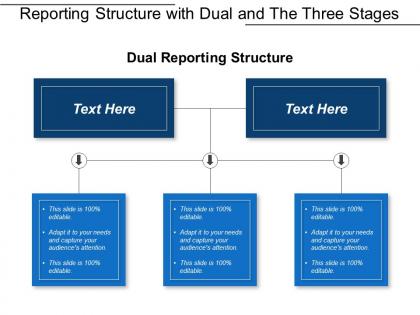
Reporting structure with dual and the three stages




Try Before you Buy Download Free Sample Product
 Impress Your
 Audience
 100%
100% Editable
 Save Hours
 of Time


Get exclusive assistance from our Reporting Structure With Dual And The Three Stages. All the attention is focused on you.
People who downloaded this PowerPoint presentation also viewed the following :
Reporting structure with dual and the three stages with all 5 slides:
Our Reporting Structure With Dual And The Three Stages enable bright ideas to emanate from bright brains. It is essentially all about brightness.




FAQs for Reporting structure with dual and
Key components include clear hierarchical levels, defined reporting relationships, appropriate span of control, communication channels, and accountability frameworks. These elements work together by establishing transparent decision-making pathways, streamlining information flow, and minimizing organizational confusion, with many companies finding that well-designed structures enhance operational efficiency and enable faster strategic responses.
Reporting structure directly influences communication flow by establishing formal channels, determining information hierarchy, and defining decision-making pathways within teams. Clear reporting lines streamline updates, enhance accountability, and minimize miscommunication, with many organizations finding that well-defined structures accelerate project delivery, improve transparency, and ultimately enable faster responses to market changes and operational challenges.
Common reporting structures include functional, divisional, matrix, flat, and hybrid models, each offering different advantages for organizational communication and decision-making. These structures enhance operational efficiency by clarifying accountability, streamlining workflows, and enabling strategic resource allocation, with many organizations finding that the right structure ultimately delivers faster decision-making and improved competitive advantage.
A well-defined reporting structure enhances employee performance by establishing clear accountability, streamlining communication channels, and providing consistent feedback mechanisms. Through transparent hierarchies, employees understand expectations, receive targeted guidance, and access development opportunities more effectively, while managers can identify performance gaps quickly, ultimately delivering improved productivity and employee engagement across growing organizations.
Technology streamlines reporting structures by automating data collection, enabling real-time dashboards, and facilitating cross-functional collaboration through integrated platforms. These digital solutions enhance transparency, reduce manual processes, and accelerate decision-making cycles, with many organizations finding that cloud-based analytics and AI-powered insights ultimately deliver faster reporting and improved strategic agility.
Organizations transition to agile reporting structures by flattening hierarchies, empowering cross-functional teams, implementing digital dashboards for real-time visibility, and establishing outcome-based metrics rather than task-focused measurements. This strategic shift enables faster decision-making, enhanced collaboration, and improved responsiveness to market changes, with many companies finding significantly reduced project timelines and increased innovation capacity.
Companies face resistance to change, role confusion, communication breakdowns, power struggles between departments, and temporary productivity declines during transition periods. These implementation challenges can be minimized through clear communication, comprehensive training, phased rollouts, and strong leadership support, with many organizations finding that involving employees in the design process ultimately delivers smoother transitions and better adoption rates.
Cultural differences significantly impact reporting structures through varying communication styles, hierarchy expectations, decision-making approaches, and feedback preferences across global teams. While some cultures favor direct reporting and flat structures, others require formal hierarchies and indirect communication, with many multinational organizations finding that flexible, culturally-adaptive reporting frameworks ultimately enhance team cohesion and operational efficiency.
Flat reporting structures deliver faster decision-making, enhanced communication flow, reduced operational costs, and increased employee autonomy compared to hierarchical models. While hierarchical structures provide clear oversight, flat organizations enable quicker responses to market changes, streamline project execution, and foster innovation, with many tech companies and startups finding significantly improved agility and employee satisfaction.
Leaders ensure transparency within their reporting structures by implementing clear communication protocols, establishing regular feedback mechanisms, creating open-door policies, and utilizing collaborative reporting tools that provide real-time visibility. These approaches streamline information flow across organizational levels, minimize communication bottlenecks, and foster accountability, with many organizations finding that transparent structures ultimately enhance employee engagement and operational efficiency.
Metrics to assess reporting structure efficiency include span of control ratios, decision-making speed, communication flow times, employee satisfaction scores, and information accuracy rates. These measurements help organizations streamline hierarchies by identifying bottlenecks, reducing redundant layers, and enhancing operational transparency, with many companies finding that optimized structures deliver faster responses and improved productivity.
Reporting structure significantly affects decision-making by determining information flow, approval hierarchies, and response speeds throughout organizations. Flat structures enable faster decisions with fewer approval layers, while hierarchical models provide oversight but can slow processes, with many companies finding that streamlined reporting accelerates strategic initiatives and enhances competitive responsiveness.
Organizations should establish clear reporting lines, define roles and responsibilities, minimize hierarchical layers, ensure balanced span of control, and maintain consistent communication channels. These practices streamline decision-making processes, reduce operational confusion, and enhance accountability, with many companies finding that well-designed structures ultimately deliver improved efficiency and faster strategic execution across all departments.
Feedback loops can be integrated through regular review cycles, cross-departmental input sessions, automated data collection systems, performance dashboards, and structured stakeholder consultations. These mechanisms enable organizations to identify inefficiencies, adapt reporting formats, and enhance decision-making processes, with many companies finding that continuous feedback ultimately streamlines operations and delivers more strategic insights.
Remote work transforms reporting structures by necessitating clearer communication protocols, enhanced digital documentation, and more frequent check-ins to maintain accountability and team cohesion. Organizations increasingly find that traditional hierarchical models evolve toward flatter, more collaborative structures, with managers focusing on outcome-based performance rather than direct supervision, ultimately delivering greater employee autonomy and operational flexibility.
-
Great product with highly impressive and engaging designs.
-
Best Representation of topics, really appreciable.