


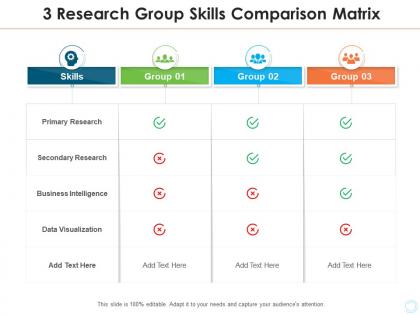
3 research group skills comparison matrix




Try Before you Buy Download Free Sample Product
 Impress Your
 Audience
 100%
100% Editable
 Save Hours
 of Time


Our 3 Research Group Skills Comparison Matrix are topically designed to provide an attractive backdrop to any subject. Use them to look like a presentation pro.
People who downloaded this PowerPoint presentation also viewed the following :
3 research group skills comparison matrix with all 2 slides:
Use our 3 Research Group Skills Comparison Matrix to effectively help you save your valuable time. They are readymade to fit into any presentation structure.

FAQs for 3 research group
An effective research skills matrix includes information literacy, data collection methods, analytical techniques, critical evaluation abilities, and synthesis competencies. These components work together by enabling researchers to identify reliable sources, gather comprehensive data, and draw meaningful conclusions, with many organizations finding that structured skill assessment ultimately enhances research quality and strategic decision-making capabilities.
A research skills matrix improves the process by identifying knowledge gaps, tracking skill development, and providing structured learning pathways for systematic improvement. Through self-assessment and targeted training, students and professionals enhance critical thinking, data analysis, and methodology selection capabilities, while academic institutions and organizations find that standardized competency frameworks deliver more consistent research outcomes and accelerated professional development.
A research skills matrix for scientific fields should include experimental design and methodology, data collection and analysis techniques, statistical software proficiency, literature review capabilities, and scientific writing skills. These competencies enable researchers to design rigorous studies, analyze complex datasets, and communicate findings effectively, with many research institutions finding that structured skill assessment enhances project outcomes and accelerates scientific discovery.
A research skills matrix for interdisciplinary projects requires mapping competencies across multiple domains, integrating methodological approaches from different fields, identifying knowledge gaps between disciplines, and establishing collaboration frameworks that bridge diverse expertise areas. This strategic combination enables teams to leverage complementary strengths while addressing skill overlaps, ultimately delivering more comprehensive research outcomes and fostering innovation through cross-disciplinary knowledge exchange.
Critical thinking serves as the analytical foundation of a research skills matrix, enabling researchers to evaluate source credibility, identify bias, synthesize conflicting information, and draw evidence-based conclusions. This cognitive framework enhances research quality by facilitating objective analysis, logical reasoning, and systematic problem-solving, with many academic institutions and corporate research teams finding that strong critical thinking skills ultimately deliver more reliable insights and strategic decision-making capabilities.
Educators can effectively teach research skills using a matrix framework by mapping specific competencies like source evaluation, citation methods, data analysis, and critical thinking against proficiency levels from beginner to advanced. This structured approach enables systematic skill development across disciplines, with many institutions finding that students progress more efficiently when they can visualize their research capabilities and identify targeted areas for improvement.
Assessment tools that align with research skills matrices include competency-based rubrics, peer evaluation frameworks, portfolio assessments, self-assessment questionnaires, and performance-based project evaluations. These instruments enable organizations to systematically measure research capabilities across different skill levels, with many academic institutions and research organizations finding that combining multiple assessment methods delivers comprehensive competency mapping and targeted development pathways for enhanced research performance.
Technology enhances research skills matrices through automated competency tracking, real-time progress monitoring, interactive skill assessments, data visualization dashboards, and AI-powered gap analysis tools. These digital solutions streamline evaluation processes by enabling dynamic updates, predictive analytics for skill development, and seamless integration with learning management systems, ultimately delivering more accurate assessments and strategic workforce planning capabilities.
A research skills matrix identifies capability gaps by mapping current team competencies against required research methodologies, analytical techniques, and domain expertise across projects. Through systematic assessment, research leaders can pinpoint missing skills like advanced statistical analysis, qualitative interviewing, or sector-specific knowledge, enabling strategic hiring decisions, targeted training programs, and resource allocation that ultimately strengthens research quality and competitive advantage.
Organizations can continuously update their research skills matrix through regular competency assessments, structured feedback sessions, industry benchmarking, and technology trend monitoring. By implementing quarterly skill audits, cross-functional workshops, and partnerships with research institutions, companies enhance their analytical capabilities, identify emerging skill gaps, and maintain competitive advantage in an increasingly data-driven marketplace.
A research skills matrix supports lifelong learning by providing structured self-assessment frameworks, identifying skill gaps, tracking professional development progress, and creating personalized learning pathways tailored to career goals. Through continuous competency mapping, researchers in academia, healthcare, and corporate R&D enhance their capabilities systematically, while enabling strategic career advancement and maintaining competitive expertise in an increasingly dynamic research landscape.
Best practices for integrating a research skills matrix into academic curricula include mapping competencies to course objectives, embedding progressive skill development across semesters, incorporating peer assessment methods, and establishing clear evaluation rubrics. These approaches enhance learning outcomes by creating structured pathways for competency building, enabling faculty to track student progress systematically, and ultimately delivering measurable improvements in research capabilities and academic performance.
Collaborations between institutions enhance research skills matrix development by pooling diverse expertise, sharing best practices across disciplines, and creating standardized competency frameworks that reflect industry needs. Through strategic partnerships, universities, research centers, and corporations can leverage combined resources, validate skill requirements against real-world applications, and ultimately deliver comprehensive matrices that prepare researchers for increasingly complex, interdisciplinary challenges.
Creating a research skills matrix presents challenges including inconsistent skill definitions, subjective self-assessments, resistance to evaluation, and difficulty measuring complex competencies across diverse research areas. Organizations can address these by establishing clear competency frameworks, implementing multi-source feedback systems, providing training on assessment tools, and regularly updating criteria, ultimately delivering more accurate talent development insights and strategic research capabilities.
Cultural differences significantly influence research skills matrices by affecting data collection methods, communication styles, analytical frameworks, and ethical considerations across diverse global contexts. Organizations conducting international research find that cultural competency, language proficiency, and contextual interpretation become essential matrix components, while traditional Western research approaches require adaptation to local customs, values, and regulatory environments, ultimately delivering more accurate insights and culturally sensitive outcomes.
-
The Designed Graphic are very professional and classic.
-
Easily Editable.
-
Unique research projects to present in meeting.
-
Commendable slides with attractive designs. Extremely pleased with the fact that they are easy to modify. Great work!