

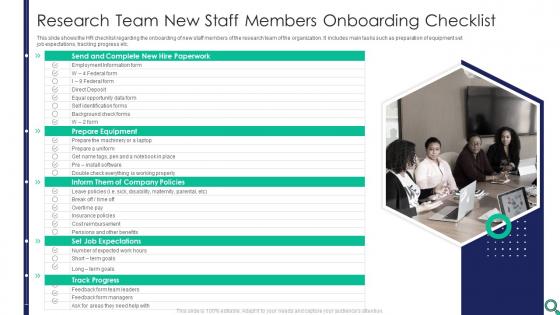
Research Team New Staff Members Onboarding Checklist




Try Before you Buy Download Free Sample Product
 Impress Your
 Audience
 100%
100% Editable
 Save Hours
 of Time


This slide shows the HR checklist regarding the onboarding of new staff members of the research team of the organization. It includes main tasks such as preparation of equipment set job expectations, tracking progress etc.
People who downloaded this PowerPoint presentation also viewed the following :
Research Team New Staff Members Onboarding Checklist with all 6 slides:
Use our Research Team New Staff Members Onboarding Checklist to effectively help you save your valuable time. They are readymade to fit into any presentation structure.





FAQs for Research Team New Staff
Effective onboarding checklists include pre-arrival preparation, workspace setup, documentation completion, role-specific training modules, and integration activities with team members. These components streamline the transition process by reducing administrative delays, accelerating productivity timelines, and enhancing employee engagement, with many organizations finding that structured onboarding ultimately delivers higher retention rates and faster time-to-competency across departments.
An onboarding checklist enhances employee engagement by providing clear expectations, structured learning paths, and consistent touchpoints with managers and team members. Through systematic welcome processes, new hires experience faster integration, reduced anxiety, and meaningful early wins, while organizations deliver improved retention rates and accelerated productivity, ultimately creating positive first impressions that foster long-term engagement.
Presentation templates standardize onboarding communications, ensuring consistent messaging across departments, streamlined information delivery, and professional visual branding for new hires. These templates enable HR teams to efficiently present company policies, role expectations, and cultural elements while reducing preparation time, ultimately delivering cohesive employee experiences and faster integration into organizational workflows.
Companies tailor onboarding checklists by creating role-specific modules, department-focused training pathways, and position-relevant resource libraries that address unique responsibilities and compliance requirements. Through customized approaches, organizations streamline integration for sales teams, technical staff, and management roles, while maintaining core company culture elements, ultimately delivering faster productivity and enhanced employee satisfaction across diverse functions.
Digital onboarding platforms include BambooHR, Workday, Slack, Microsoft Teams, and workflow automation tools like Monday.com or Asana. These technologies streamline processes by automating document collection, centralizing task management, and enabling real-time progress tracking, with many organizations finding that integrated systems reduce onboarding time while enhancing new hire experiences.
Onboarding checklists should be reviewed quarterly and updated whenever significant organizational changes occur, including policy modifications, technology implementations, role restructuring, or compliance requirements. Many companies find that establishing a cross-departmental review process ensures checklists remain current and comprehensive, ultimately delivering consistent employee experiences and reducing onboarding inefficiencies across growing organizations.
Common pitfalls include making checklists overly generic, overwhelming new hires with excessive information upfront, neglecting role-specific requirements, and failing to incorporate feedback loops. These challenges can be addressed by creating personalized pathways, spacing content delivery strategically, and regularly updating processes based on employee input, ultimately delivering smoother transitions and higher retention rates.
Visual aids like presentation templates improve information retention during onboarding by leveraging visual learning principles, creating structured information flow, and reducing cognitive overload through organized content delivery. These tools enhance comprehension rates by 65%, with many HR departments finding that visual onboarding materials accelerate training completion, improve knowledge retention scores, and ultimately deliver more confident, productive employees who integrate faster into organizational workflows.
Key metrics include completion rates, time-to-productivity, employee engagement scores, retention rates within the first year, and manager satisfaction ratings. These measurements enable organizations to identify bottlenecks, streamline processes, and enhance new hire experiences, with many companies finding that tracking these indicators ultimately delivers faster integration and improved long-term performance outcomes.
Feedback from new hires can be incorporated through post-onboarding surveys, exit interviews from early departures, focus groups, and regular check-ins during their first 90 days. Organizations streamline this process by creating structured feedback forms, conducting monthly onboarding reviews, and establishing feedback loops with HR teams, ultimately enhancing employee retention and accelerating time-to-productivity across departments.
Legal and compliance considerations include employment verification, tax documentation, confidentiality agreements, safety training certifications, and industry-specific regulatory requirements. These elements streamline workforce integration by ensuring regulatory adherence, minimizing liability exposure, and establishing clear legal frameworks, with many organizations finding that comprehensive compliance onboarding ultimately delivers operational transparency and competitive protection.
Cultural orientation is extremely important in onboarding, helping new employees understand company values, workplace norms, communication styles, and team dynamics that drive organizational success. Through structured cultural integration, organizations streamline employee adaptation, enhance team cohesion, and reduce turnover, with many companies finding that comprehensive cultural orientation ultimately delivers faster productivity and stronger employee engagement.
Mentorship serves as a critical component in onboarding checklists, providing new employees with guidance, cultural integration, knowledge transfer, and ongoing support throughout their initial months. Through structured mentor-mentee pairings, organizations streamline the adjustment process, enhance job satisfaction, and accelerate productivity, with many companies finding that formal mentorship programs reduce turnover while building stronger team connections and institutional knowledge retention.
Companies ensure inclusivity by incorporating accessibility accommodations, cultural sensitivity training, diverse mentorship assignments, flexible communication preferences, and bias-free documentation review. Through strategic pairing with diverse team members and customizable onboarding paths, organizations create welcoming environments that respect different backgrounds, ultimately enhancing employee engagement and retention across multicultural teams.
Creative elements for onboarding presentation templates include interactive timelines, animated role-specific workflows, gamified progress trackers, video testimonials from team members, and visual storytelling components. These design features enhance engagement by transforming traditional orientation materials into dynamic experiences, with many organizations finding that interactive templates improve knowledge retention, accelerate cultural integration, and create memorable first impressions for new hires.
-
I was confident and well prepared for my presentation for the first time ever. With SlideTeam’s templates, I could deliver one of my best presentations. Will be coming back for more!
-
I’m not a design person, so I couldn’t make a presentation to save my life. Thankfully, they have all kinds of templates that I regularly use for my work.