


Resource matrix table for data warehousing infographic template
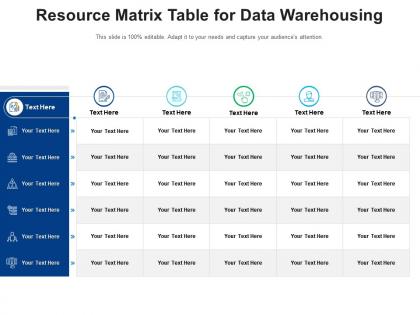




Try Before you Buy Download Free Sample Product
 Impress Your
 Audience
 100%
100% Editable
 Save Hours
 of Time


Our Resource Matrix Table For Data Warehousing Infographic Template are topically designed to provide an attractive backdrop to any subject. Use them to look like a presentation pro.
People who downloaded this PowerPoint presentation also viewed the following :
Resource matrix table for data warehousing infographic template with all 2 slides:
Use our Resource Matrix Table For Data Warehousing Infographic Template to effectively help you save your valuable time. They are readymade to fit into any presentation structure.
FAQs for Resource matrix table for data
A resource matrix table is a comprehensive project management tool that maps team members' skills, availability, and responsibilities against specific data warehousing tasks, timelines, and deliverables. It functions by enabling project managers to optimize resource allocation, identify skill gaps, and ensure balanced workload distribution across ETL development, database design, and testing phases, ultimately delivering more efficient project execution and reduced implementation timelines.
A comprehensive resource matrix table should include hardware specifications, software licenses, personnel roles, storage capacity, processing power, and budget allocations across different warehousing phases. These elements enable organizations to track resource utilization, identify bottlenecks, and optimize capacity planning, with many enterprises finding that systematic resource mapping streamlines deployment timelines and reduces operational costs significantly.
A resource matrix table helps identify data quality issues during ETL by mapping data sources, transformation rules, validation checkpoints, and quality metrics across each pipeline stage. This systematic tracking enables data teams to pinpoint inconsistencies, missing values, and transformation errors in real-time, while establishing clear accountability for data quality ownership, ultimately delivering faster issue resolution and more reliable data warehouse operations.
Resource matrix tables enhance team collaboration in data warehousing projects by clarifying roles, preventing resource conflicts, improving communication flows, and establishing clear accountability structures. These frameworks enable project managers to optimize resource allocation, reduce bottlenecks, and ensure seamless coordination across technical teams, ultimately delivering faster project timelines and improved operational efficiency.
Roles should be assigned based on data ownership, technical expertise, and governance accountability, with data stewards managing quality, architects overseeing infrastructure, and analysts ensuring accessibility. Organizations typically designate executive sponsors for strategic oversight, technical leads for implementation, and cross-functional representatives for business alignment, ultimately delivering clear accountability chains and streamlined decision-making processes across departments.
Key metrics include query response times, storage utilization rates, CPU and memory consumption, data loading speeds, user concurrent sessions, and system availability percentages. These performance indicators enable organizations to optimize resource allocation, identify bottlenecks proactively, and ensure consistent data delivery, with many enterprises finding that systematic monitoring ultimately delivers enhanced operational efficiency and improved decision-making capabilities.
A resource matrix table assists in data warehousing project planning by mapping required skills, personnel, and technologies against specific project phases, timeline requirements, and budget constraints. This strategic approach enables project managers to identify resource gaps, optimize team allocation, and prevent bottlenecks, with many organizations finding that systematic resource mapping accelerates project delivery while minimizing costs.
Creating resource matrix tables for large-scale data warehousing presents challenges including data complexity management, cross-functional team coordination, budget allocation across multiple phases, skill gap identification, and timeline dependencies between interconnected tasks. These initiatives require balancing technical resources with business requirements, while many organizations find that clear stakeholder mapping and phased resource planning ultimately streamlines implementation and minimizes costly delays.
Resource matrix tables should be updated quarterly for structural changes and monthly for resource allocation adjustments, with real-time monitoring for critical performance metrics. In dynamic environments, many organizations find that automated monitoring tools combined with scheduled reviews enables proactive resource optimization, ultimately delivering improved query performance and cost efficiency while maintaining system scalability.
Tools for creating and managing resource matrix tables include Microsoft Excel, Google Sheets, specialized project management platforms like Monday.com, Smartsheet, and enterprise solutions such as Oracle Primavera and Microsoft Project. These platforms streamline resource allocation, capacity planning, and timeline management by providing real-time visibility, automated calculations, and collaborative features, ultimately enabling data warehousing teams to optimize project delivery and minimize resource conflicts across complex implementations.
A resource matrix table facilitates diverse data source integration by mapping data elements, defining transformation rules, establishing quality standards, and documenting lineage relationships across systems. This structured approach enables organizations to streamline ETL processes, maintain consistency across disparate sources like CRM and ERP systems, and ensure data governance, ultimately delivering faster integration cycles and improved data reliability for business intelligence initiatives.
A resource matrix table enhances stakeholder communication by clearly mapping team members, responsibilities, skill sets, and project phases, while providing real-time visibility into resource allocation and project dependencies. This transparency enables stakeholders across IT, business units, and management to quickly identify bottlenecks, track progress against deliverables, and make informed decisions about resource reallocation, ultimately delivering improved project coordination and faster issue resolution.
A resource matrix table supports compliance by tracking data lineage, access permissions, retention policies, and audit trails across all warehouse components. Through systematic documentation of data sources, transformations, and user privileges, organizations ensure regulatory adherence while enabling automated compliance reporting, ultimately delivering transparency and accountability that auditors require in increasingly regulated industries.
A resource matrix table enables comprehensive risk assessment by mapping critical resources, dependencies, and potential failure points across data warehousing infrastructure, team capabilities, and project timelines. This strategic visualization helps organizations identify bottlenecks, anticipate resource conflicts, and develop contingency plans, with many enterprises finding that proactive resource mapping significantly reduces project delays and cost overruns.
Yes, implementing a resource matrix table can deliver significant cost savings in data warehousing through optimized resource allocation, reduced redundant processing, and improved query performance. By systematically mapping compute, storage, and network resources against workload demands, organizations streamline operations, minimize over-provisioning costs, and enhance overall efficiency, with many enterprises finding substantial reductions in infrastructure expenses.
-
Design layout is very impressive.
-
I discovered this website through a google search, the services matched my needs perfectly and the pricing was very reasonable. I was thrilled with the product and the customer service. I will definitely use their slides again for my presentations and recommend them to other colleagues.
-
Understandable and informative presentation.
-
Design layout is very impressive.