


Retail Logistics Powerpoint Ppt Template Bundles




Try Before you Buy Download Free Sample Product
 Impress Your
 Audience
 100%
100% Editable
 Save Hours
 of Time


Our Retail Logistics Powerpoint Ppt Template Bundles are topically designed to provide an attractive backdrop to any subject. Use them to look like a presentation pro.
People who downloaded this PowerPoint presentation also viewed the following :
Retail Logistics Powerpoint Ppt Template Bundles with all 23 slides:
Use our Retail Logistics Powerpoint Ppt Template Bundles to effectively help you save your valuable time. They are readymade to fit into any presentation structure.






FAQs for Retail Logistics Powerpoint
Key components include demand forecasting, inventory management, warehouse optimization, transportation planning, and last-mile delivery solutions. These elements work together by enabling accurate stock levels, streamlined distribution processes, and faster customer fulfillment, with many retailers finding that strategic integration ultimately delivers reduced operational costs and enhanced customer experiences.
Technology and automation revolutionize retail logistics by streamlining inventory management, optimizing warehouse operations, and accelerating order fulfillment through AI-powered forecasting and robotic systems. These innovations enable retailers to reduce operational costs, minimize human error, and deliver faster customer experiences, with many e-commerce companies finding that automated fulfillment centers increase processing speed by 40-60%.
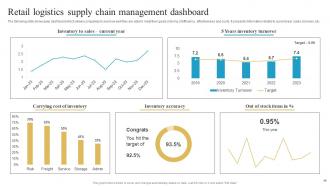
Inventory management serves as the backbone of retail logistics, controlling stock levels, demand forecasting, warehouse operations, order fulfillment, and supply chain coordination. Through automated systems and data analytics, retailers minimize carrying costs, reduce stockouts, and optimize storage space, while ensuring products reach customers efficiently, ultimately delivering improved cash flow and enhanced customer satisfaction.
Retailers optimize supply chains through strategic warehouse placement, advanced inventory management systems, automated sorting technologies, predictive analytics for demand forecasting, and partnerships with multiple logistics providers. These approaches streamline operations by reducing transportation distances, minimizing stockouts, and enabling real-time tracking, with many retailers finding that integrated logistics platforms ultimately deliver faster customer fulfillment and significant competitive advantage.
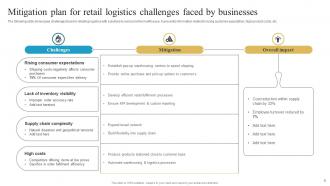
Retailers face challenges including rising customer expectations for faster delivery, escalating transportation costs, urban congestion limiting access, inventory visibility gaps, and managing returns efficiently. These logistics hurdles significantly impact operational costs and customer satisfaction, with many retail organizations finding that strategic technology investments in route optimization, real-time tracking, and automated sorting ultimately deliver competitive advantage.
Customer experience significantly influences logistics decisions by driving faster delivery expectations, flexible return policies, inventory positioning strategies, and omnichannel fulfillment capabilities. Retailers increasingly prioritize last-mile optimization, real-time tracking systems, and strategic warehouse placement to meet consumer demands for same-day delivery and seamless shopping experiences, ultimately enhancing customer satisfaction while maintaining competitive advantage.
Sustainable retail logistics practices include electric delivery vehicles, optimized route planning, eco-friendly packaging materials, warehouse solar installations, and carbon-neutral shipping options. These approaches streamline operations by reducing fuel costs, minimizing waste disposal expenses, and enhancing brand reputation, with many retailers finding that sustainability initiatives ultimately deliver significant cost savings while attracting environmentally conscious consumers.
Data analytics enhances retail logistics decision-making by providing real-time visibility into inventory levels, demand patterns, and supply chain performance metrics. Through predictive modeling and automated insights, retailers can optimize warehouse operations, reduce stockouts, and streamline distribution routes, with many organizations finding that data-driven approaches ultimately deliver faster fulfillment and improved customer satisfaction.
E-commerce fundamentally transforms traditional retail logistics by requiring faster delivery expectations, omnichannel inventory management, last-mile optimization, and flexible fulfillment strategies. While this presents operational challenges, it also creates opportunities for enhanced customer experiences, with many retailers finding that strategic automation and data-driven supply chains ultimately deliver competitive advantage.
Seasonality and demand fluctuations significantly impact retail logistics by requiring flexible inventory management, scalable warehouse operations, and adaptive transportation networks. Retailers must anticipate peak periods like holidays or back-to-school seasons, with many finding that strategic workforce scaling, enhanced forecasting systems, and diversified supplier relationships enable smoother operations while minimizing costs and stockouts.
Third-party logistics providers deliver cost reduction, scalability, specialized expertise, advanced technology access, and enhanced operational flexibility for retailers. These partnerships enable businesses to streamline inventory management, accelerate delivery times, and optimize warehouse operations, with many retail organizations finding that outsourcing logistics ultimately enhances customer experiences while reducing overhead costs.
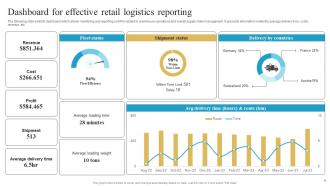
Real-time tracking enables retailers to monitor inventory movement, shipment locations, delivery schedules, and warehouse operations continuously throughout the supply chain. This visibility streamlines decision-making by reducing stockouts, optimizing route planning, and enhancing customer communication, with many retail organizations finding that improved transparency ultimately delivers faster fulfillment and significantly better customer experiences.
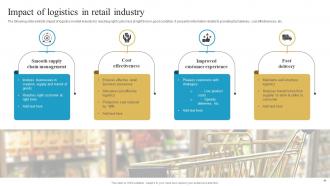
Retailers can reduce logistics costs through inventory optimization, strategic warehouse placement, transportation consolidation, automation technologies, and supplier relationship management. These approaches streamline operations by minimizing storage expenses, reducing delivery distances, and leveraging bulk shipping rates, with many retail organizations finding that strategic combinations of these methods deliver significant cost savings while maintaining customer service levels.
Cross-docking enhances retail logistics efficiency by eliminating warehouse storage, reducing handling costs, and accelerating inventory turnover through direct transfer from inbound to outbound transportation. This streamlined approach enables retailers to minimize storage expenses, reduce product damage, and deliver faster customer fulfillment, with many organizations finding significantly improved supply chain responsiveness and operational cost reduction.
Future trends shaping retail logistics include autonomous delivery vehicles, AI-powered demand forecasting, micro-fulfillment centers, sustainable packaging solutions, and real-time inventory visibility platforms. These innovations streamline supply chain operations by reducing delivery times, minimizing waste, and enhancing customer experiences, with many retailers finding that strategic adoption ultimately delivers competitive advantage in an increasingly dynamic marketplace.
-
Happy to found you SlideTeam. You guys are value for money. Amazing slides.
-
Really like the color and design of the presentation.