

Revenue Recognition Process For IT Sector




Try Before you Buy Download Free Sample Product
 Impress Your
 Audience
 100%
100% Editable
 Save Hours
 of Time


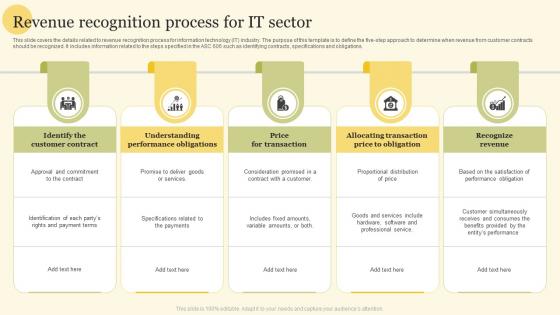
This slide covers the details related to revenue recognition process for information technology IT industry. The purpose of this template is to define the five step approach to determine when revenue from customer contracts should be recognized. It includes information related to the steps specified in the ASC 606 such as identifying contracts, specifications and obligations.
People who downloaded this PowerPoint presentation also viewed the following :
Revenue Recognition Process For IT Sector with all 6 slides:
Use our Revenue Recognition Process For IT Sector to effectively help you save your valuable time. They are readymade to fit into any presentation structure.





FAQs for Revenue Recognition Process
Revenue recognition under IFRS 15 and ASC 606 follows five key principles: identifying contracts, identifying performance obligations, determining transaction price, allocating price to obligations, and recognizing revenue when obligations are satisfied. For IT companies, these standards streamline complex scenarios like software licenses, cloud subscriptions, and bundled services, enabling clearer financial reporting and enhanced investor transparency across technology sectors.
The subscription model requires IT companies to recognize revenue over the contract period rather than upfront, following ASC 606 guidelines through monthly or annual allocation methods. This approach enhances predictable cash flow, improves financial transparency, and enables better resource planning, with many software companies finding that subscription models ultimately deliver stronger investor confidence and sustainable growth trajectories.
Contract modifications significantly impact revenue recognition by requiring reassessment of performance obligations, transaction prices, and delivery timelines throughout the service period. These changes, common in custom software development and enterprise implementations, can accelerate or defer revenue recognition depending on scope adjustments, with many IT firms finding that robust modification tracking ultimately delivers greater compliance accuracy and clearer financial reporting.
IT companies determine performance obligations by identifying distinct goods or services promised to customers, such as software licenses, implementation services, ongoing support, and customization work. These obligations must be separately identifiable and provide standalone value, with many technology firms finding that bundled solutions require careful analysis to distinguish between integrated deliverables versus separate performance components, ultimately ensuring accurate revenue allocation.
IT companies face challenges including complex milestone tracking, varying performance obligations, contract modifications, currency fluctuations, and compliance with evolving accounting standards like ASC 606. These complexities require sophisticated systems for accurate revenue allocation across project phases, with many organizations finding that proper integration of financial and project management systems ultimately delivers better forecasting accuracy and regulatory compliance.
Deferred revenue appears as a liability on balance sheets until services are delivered, significantly impacting cash flow timing and revenue recognition patterns in IT companies. Software firms with subscription models, cloud service providers, and system integrators must carefully manage this liability through precise milestone tracking and service delivery documentation, ultimately ensuring accurate financial reporting and maintaining investor confidence in an increasingly subscription-driven technology landscape.
Cloud computing transforms revenue recognition through subscription models, multi-element arrangements, variable pricing structures, and service-level commitments that require careful contract analysis and timing considerations. These shifts enable IT companies to streamline recurring revenue tracking, enhance customer lifecycle management, and deliver more predictable financial reporting, with many organizations finding that cloud transitions ultimately provide greater revenue visibility and operational efficiency.
IT firms should account for variable consideration by estimating the transaction price using expected value or most likely amount methods, constraining estimates to amounts virtually certain of collection. Performance bonuses, penalties, discounts, and usage-based fees require careful evaluation, with companies like software providers and consulting firms regularly updating estimates as contract conditions change, ultimately ensuring accurate revenue reporting.
IT companies can ensure compliance with revenue recognition standards through robust contract management systems, automated revenue tracking software, regular staff training on ASC 606 and IFRS 15 requirements, and comprehensive audit trails. These practices streamline financial reporting by enhancing data accuracy, reducing manual errors, and providing real-time visibility into contract performance, with many organizations finding that integrated compliance frameworks ultimately deliver greater operational efficiency and regulatory confidence.
Revenue recognition significantly impacts IT financial forecasting by requiring companies to predict contract modifications, project timelines, and performance obligation completions across multi-year agreements. This creates complexity in budgeting cycles, as IT firms must forecast variable considerations, milestone achievements, and subscription renewals, while accounting for deferred revenue timing, ultimately requiring more sophisticated forecasting models and frequent budget revisions.
IT companies should consider contract completion milestones, customer acceptance criteria, performance obligations delivery, and regulatory compliance requirements when evaluating revenue recognition timing. These factors streamline financial reporting by ensuring accurate milestone tracking, minimizing audit risks, and enhancing stakeholder transparency, with many software and consulting firms finding that structured timing protocols ultimately deliver improved cash flow predictability and investor confidence.
Analytics and technology streamline IT sector revenue recognition through automated contract analysis, real-time performance tracking, and intelligent milestone monitoring systems. These solutions enable companies to automatically identify revenue triggers, calculate complex subscription models, and ensure compliance with accounting standards, ultimately reducing manual errors while accelerating month-end closing processes significantly.
Industry benchmarks for IT revenue recognition include monthly recurring revenue (MRR) growth rates of 10-20%, annual contract value (ACV) expansion of 15-25%, customer acquisition cost to lifetime value ratios of 1:3, and subscription revenue predictability scores above 85%. These metrics enable IT companies to streamline financial forecasting, enhance investor confidence, and optimize pricing strategies, with many SaaS organizations finding that consistent benchmark tracking ultimately delivers improved operational efficiency and competitive positioning.
Licensing agreements significantly influence software revenue recognition by determining timing, allocation methods, and compliance requirements across subscription, perpetual, and usage-based models. These agreements enable companies to optimize cash flow through strategic pricing structures, milestone-based recognition, and multi-element arrangements, while ensuring ASC 606 compliance, ultimately delivering predictable revenue streams and enhanced investor confidence.
IT firms face audit challenges including complex contract interpretations, performance obligation identification across multiple deliverables, transaction price allocation, and timing recognition for subscription versus perpetual licenses. These complexities arise particularly in software development, cloud services, and multi-element arrangements, with auditors scrutinizing revenue cut-off procedures, contract modifications, and compliance documentation, ultimately requiring robust internal controls and comprehensive audit trails to demonstrate accurate financial reporting.
-
Editable templates with innovative design and color combination.
-
If you are looking for satisfactory PowerPoint services, SlideTeam is your go-to place. I am fully contented with their research and development team.