

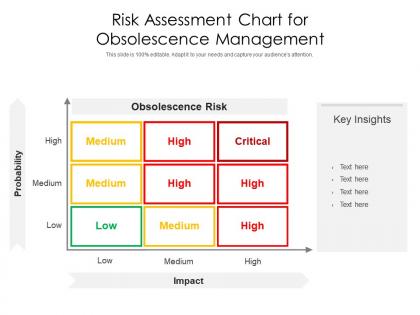
Risk assessment chart for obsolescence management




Try Before you Buy Download Free Sample Product
 Impress Your
 Audience
 100%
100% Editable
 Save Hours
 of Time


Our Risk Assessment Chart For Obsolescence Management are topically designed to provide an attractive backdrop to any subject. Use them to look like a presentation pro.
People who downloaded this PowerPoint presentation also viewed the following :
Risk assessment chart for obsolescence management with all 2 slides:
Use our Risk Assessment Chart For Obsolescence Management to effectively help you save your valuable time. They are readymade to fit into any presentation structure.

FAQs for Risk assessment chart
Key indicators of obsolescence include declining market demand, reduced vendor support, compatibility issues with newer systems, increasing maintenance costs, and emergence of superior alternatives. These warning signs help organizations proactively plan replacements, with many companies in manufacturing and technology sectors finding that early detection enables smoother transitions, minimized disruptions, and sustained competitive advantage.
Organizations effectively identify and assess obsolescence risk through comprehensive lifecycle monitoring, vendor stability analysis, technology roadmap tracking, supply chain visibility assessments, and performance benchmarking against industry standards. By implementing predictive analytics and regular asset audits, companies can proactively identify at-risk components, evaluate replacement timelines, and develop strategic mitigation plans, ultimately reducing unexpected downtime and maintenance costs.
Lifecycle management serves as the foundation of obsolescence management by tracking products, components, and technologies from introduction through discontinuation, enabling proactive identification of potential obsolescence risks. Through systematic monitoring and planning, organizations in aerospace, defense, and manufacturing can anticipate component end-of-life scenarios, secure alternative suppliers, and implement strategic redesigns, ultimately minimizing disruptions while maintaining operational continuity.
Businesses leverage data analytics in obsolescence management through predictive modeling, demand forecasting, inventory optimization, supplier risk assessment, and lifecycle analysis. These analytics capabilities enable organizations to anticipate component shortages, optimize procurement timing, and reduce carrying costs, with many manufacturing and aerospace companies finding that data-driven strategies ultimately deliver significant cost savings and supply chain resilience.
Best practices for communicating obsolescence issues to stakeholders include early notification systems, clear risk assessments, detailed mitigation plans, regular status updates, and transparent cost implications. These communication strategies enhance decision-making by providing comprehensive timelines, alternative sourcing options, and business impact analyses, with many organizations finding that proactive stakeholder engagement minimizes disruptions and enables strategic planning.
Planned obsolescence involves deliberately designing products with limited lifespans to encourage frequent replacements, while unintentional obsolescence occurs naturally through technological advancement, changing consumer preferences, or market evolution. While planned obsolescence presents strategic revenue opportunities through predictable replacement cycles, it also raises sustainability concerns, with many companies increasingly finding that balancing profitability with environmental responsibility delivers stronger long-term competitive advantage.
Obsolescence significantly impacts supply chain management through increased carrying costs, excess inventory write-offs, and disrupted procurement cycles, while forcing companies to balance stock levels against rapid product lifecycle changes. Organizations across manufacturing, technology, and retail sectors increasingly adopt demand forecasting analytics and agile inventory strategies to minimize waste, reduce storage costs, and maintain competitive responsiveness in fast-evolving markets.
Companies can extend product life through proactive design for longevity, strategic component sourcing, predictive maintenance programs, modular architecture enabling upgrades, and lifecycle monitoring systems. These approaches streamline operations by reducing replacement costs, minimizing downtime, and enhancing customer satisfaction, with many manufacturing and technology organizations finding that systematic obsolescence planning ultimately delivers competitive advantage and improved resource allocation.
Organizations can anticipate regulatory changes by establishing monitoring systems, engaging with regulatory bodies, conducting regular compliance audits, and maintaining flexible design architectures that accommodate updates. Through proactive regulatory intelligence and cross-functional teams, companies in sectors like pharmaceuticals, automotive, and financial services streamline compliance processes, minimize redesign costs, and ensure continuous market access, ultimately delivering competitive advantage and operational resilience.
Ethical considerations include consumer transparency, environmental sustainability, fair pricing practices, resource waste reduction, and long-term product durability expectations. While planned obsolescence can drive innovation and economic growth, it also raises concerns about corporate responsibility and environmental impact, with many manufacturers increasingly balancing profitability with sustainable design practices and enhanced customer trust.
Sustainability drives obsolescence management by extending product lifecycles through refurbishment, component reuse, and circular design principles, reducing environmental impact while minimizing waste. Through sustainable practices, manufacturers in electronics, automotive, and aerospace industries enhance resource efficiency, lower disposal costs, and meet regulatory requirements, while ultimately delivering competitive advantage and improved brand reputation in an increasingly environmentally-conscious marketplace.
Failing to manage obsolescence effectively can result in increased procurement costs, unexpected downtime expenses, inventory write-offs, emergency sourcing premiums, and extended system maintenance fees. These financial impacts compound over time, with many organizations finding that reactive obsolescence management costs 3-5 times more than proactive strategies, ultimately affecting competitiveness and operational margins.
Collaboration with suppliers minimizes obsolescence risks by enabling early visibility into product lifecycle changes, joint forecasting for demand planning, and coordinated inventory management strategies. Through strategic partnerships, organizations streamline component sourcing, reduce excess stock levels, and access alternative solutions when parts become unavailable, ultimately delivering enhanced supply chain resilience and cost optimization.
Technological advancements include predictive analytics, digital twins, IoT sensors, artificial intelligence, and cloud-based asset management platforms. These technologies streamline obsolescence management by enabling proactive component monitoring, automated lifecycle tracking, and real-time supply chain visibility, with manufacturers and aerospace companies finding that strategic implementation ultimately delivers reduced downtime and enhanced operational efficiency.
Organizations should prioritize technology investments by assessing critical business functions, system vulnerabilities, and potential operational disruptions while evaluating scalability, integration capabilities, and long-term strategic value. Through phased implementation approaches, companies in manufacturing, healthcare, and financial services can minimize risks, optimize resource allocation, and ensure seamless transitions, ultimately delivering enhanced operational efficiency and competitive advantage.
-
Enough space for editing and adding your own content.