


Risk Management Plan Framework For Construction Industry




Try Before you Buy Download Free Sample Product
 Impress Your
 Audience
 100%
100% Editable
 Save Hours
 of Time


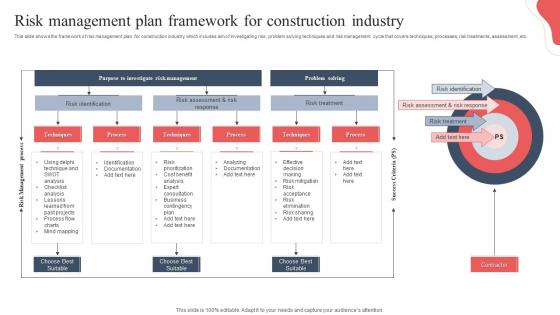
This slide shows the framework of risk management plan for construction industry which includes aim of investigating risk, problem solving techniques and risk management cycle that covers techniques, processes, risk treatments, assessment, etc.
People who downloaded this PowerPoint presentation also viewed the following :
Risk Management Plan Framework For Construction Industry with all 6 slides:
Use our Risk Management Plan Framework For Construction Industry to effectively help you save your valuable time. They are readymade to fit into any presentation structure.





FAQs for Risk Management Plan Framework
**INPUT**: What are the core components of a Risk Management Plan Framework? **OUTPUT**: Core components include risk identification processes, assessment methodologies, mitigation strategies, monitoring systems, and response protocols. These frameworks streamline organizational resilience by establishing clear accountability structures, defining escalation procedures, and creating systematic evaluation processes, with many financial services and healthcare institutions finding that comprehensive frameworks ultimately deliver enhanced operational efficiency and competitive advantage. **Word count: 54 words**
Organizations identify and assess project risks through systematic risk identification workshops, stakeholder interviews, historical data analysis, SWOT analysis, and expert consultation sessions. These methodologies enable project teams to categorize risks by probability and impact, create comprehensive risk registers, and develop mitigation strategies, with many enterprises finding that proactive risk assessment reduces project delays by 30-40% while enhancing stakeholder confidence.
Stakeholder engagement ensures comprehensive risk identification, validates mitigation strategies, and secures buy-in for implementation across organizational levels. Through collaborative workshops and feedback sessions, organizations capture diverse perspectives from departments like finance, operations, and compliance, while establishing clear communication channels that enhance accountability, improve resource allocation, and ultimately deliver more effective risk management outcomes.
Integration combines qualitative methods like expert judgment, risk matrices, and probability assessments with quantitative techniques including Monte Carlo simulations, sensitivity analysis, and statistical modeling. This strategic combination enables organizations to prioritize risks through scoring while calculating precise financial impacts, ultimately delivering comprehensive risk profiles that enhance decision-making and resource allocation across sectors.
Risk avoidance eliminates threats entirely, mitigation reduces probability or impact, transfer shifts responsibility through insurance or outsourcing, and acceptance acknowledges manageable risks without action. These strategies work strategically together, with financial institutions using transfer for cyber threats, manufacturers employing mitigation for supply chains, and healthcare organizations balancing acceptance with avoidance, ultimately delivering comprehensive protection and optimized resource allocation.
Effective risk management plan communication involves multi-channel approaches including structured presentations, visual dashboards, regular briefings, documented protocols, and interactive training sessions. Through clear documentation and consistent updates, organizations streamline stakeholder alignment, enhance team preparedness, and minimize response delays, with many finding that regular communication cycles ultimately deliver improved risk awareness and faster mitigation across all organizational levels.
Technology enhances Risk Management Plan Frameworks through automated monitoring systems, predictive analytics, real-time reporting dashboards, AI-powered threat detection, and integrated compliance platforms. These digital solutions streamline risk identification and assessment processes while enabling faster response times, with many financial institutions and healthcare organizations finding that automated frameworks reduce operational risks by 40% and significantly improve regulatory compliance efficiency.
Risk Management Plans should be reviewed quarterly as a baseline, with immediate updates triggered by significant organizational changes, new project phases, regulatory shifts, or emerging threats. Many organizations in sectors like financial services, healthcare, and manufacturing find that combining scheduled quarterly assessments with event-driven reviews ensures comprehensive risk coverage while maintaining operational agility and regulatory compliance.
Common pitfalls include inadequate risk assessment, poor stakeholder communication, insufficient resource allocation, lack of regular monitoring, and failure to integrate risk management into daily operations. These challenges often stem from treating risk management as a one-time project rather than an ongoing process, with many organizations finding that successful implementation requires continuous engagement, clear accountability structures, and adaptive frameworks that evolve with changing business environments.
Lessons learned from past projects enhance current risk management by identifying recurring risk patterns, successful mitigation strategies, and early warning indicators that teams might otherwise overlook. Through systematic documentation and analysis, organizations streamline risk assessment processes, accelerate response times, and minimize project disruptions, with many finding that historical insights ultimately deliver more accurate risk predictions and improved project outcomes.
Risk management plan effectiveness metrics include risk mitigation rates, incident frequency reduction, financial impact assessments, compliance adherence levels, and response time measurements. These metrics enable organizations by tracking cost savings from prevented losses, measuring improved operational continuity, and demonstrating enhanced stakeholder confidence, with many financial institutions and healthcare systems finding that comprehensive measurement frameworks ultimately deliver measurable competitive advantage.
Regulatory requirements significantly shape Risk Management Plans by mandating specific compliance frameworks, reporting standards, documentation protocols, and governance structures across industries. Financial services, healthcare, and manufacturing sectors must integrate regulatory obligations into their risk assessment processes, ensuring plans address legal compliance, audit requirements, and penalty avoidance while maintaining operational efficiency and competitive positioning.
Organizations can foster risk-aware culture through comprehensive training programs, clear communication channels, leadership modeling, regular risk assessments, and integrated decision-making processes. These strategies work by embedding risk considerations into daily operations, encouraging open dialogue about potential threats, and rewarding proactive risk identification, with many companies finding that employees become natural risk advocates, ultimately delivering enhanced organizational resilience and competitive advantage.
Organizations can prioritize risks by conducting risk assessments that evaluate probability, potential impact, regulatory requirements, and strategic alignment with business objectives. Through risk matrices and scoring systems, companies across sectors like banking, healthcare, and manufacturing streamline resource allocation, focusing on high-impact vulnerabilities while maintaining operational efficiency and regulatory compliance.
Failing to adhere to a Risk Management Plan can result in increased operational disruptions, regulatory penalties, financial losses, compromised project timelines, and damaged stakeholder confidence. Organizations across sectors like healthcare, finance, and manufacturing often find that poor risk adherence leads to cascading failures, ultimately undermining competitive advantage and long-term sustainability.
-
Great experience, I would definitely use your services further.
-
You guys are life-saver when it comes to presentations. Honestly I cannot do much without your services. Thank you!!!