

Risk mitigation strategies powerpoint presentation slides





Try Before you Buy Download Free Sample Product
 Impress Your
 Audience
 100%
100% Editable
 Save Hours
 of Time


Introducing Risk Mitigation Strategies PowerPoint Presentation Slides to foresee risk, estimate impacts, and define responses to risk. Prepare a strategy to lessen the effects of threats with the help of this professionally designed hazard awareness process presentation deck. Showcase the different ways of dealing with risks using the self-explanatory threat management plan PPT deck. The topic-specific risk evaluation & mitigation strategy PowerPoint complete deck comprises of ready-to-use templates such as risk identification, risk register, risk assessment, risk analysis, risk response plan, risk response matrix, risk control matrix, risk items tracking, tools and practices, risk impact & profitability analysis, risk mitigations strategies, plans, qualitative and quantitative risk analysis, etc. Furthermore, users can also utilize the visually appealing contingency plan PPT slides to develop an action plan to identify, assess and control risk. Download the high-quality risk management plan PowerPoint presentation template to avoid or minimize risk and increase safety. Acquire the authority to decide the course with our Risk Mitigation Strategies Powerpoint Presentation Slides. Be in control at the helm of affairs.
People who downloaded this PowerPoint presentation also viewed the following :
Content of this Powerpoint Presentation
Slide 1: This slide introduces Risk Mitigation Strategies. State Your Company Name and begin.
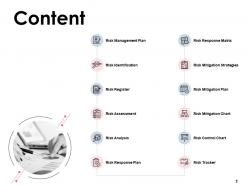
Slide 2: This slide shows content of the presentation.
Slide 3: This slide presents Risk Management Plan describing- Type of Risk, Outcome, Existing Risk Treatment Actions in Place, Rating, Proposed Risk Treatment Actions to Mitigate risk, Additional Resources, Target Date and Person Responsible.
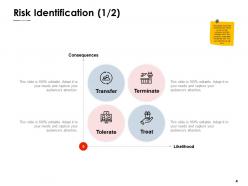
Slide 4: This slide represents Risk Identification with a graph that shows the likelihood and impact of risk on the company and the strategy which the company might opt to mange the risk.
Slide 5: This is another slide on Risk Identification describing factors like cost, time, resources etc.
Slide 6: This slide showcases Risk Identification- Example describing Time period, Impact of Doing, Vulnerabilities and Contingency in case of a disaster.
Slide 7: This slide shows Risk register to keep a close track of all the risks faced by the company and their impact on the company performance.
Slide 8: This slide shows Risk Assessment describing Risk Rating Guide with probability and impact along with Risk scoring system describing Consequences, Likelihood of Occurrence and Likelihood of detection.
Slide 9: This is another slide continuing Risk Assessment, with this you can obtain the risk score and determine its likelihood of occurrence.
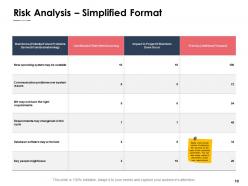
Slide 10: This slide presents Risk Analysis – Simplified Format with related table and text boxes. You can alter these values & parameters as per your requirements.
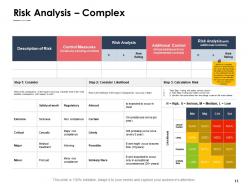
Slide 11: This slide displays Risk Analysis- Complex. This is a complex version of analysing the risk level. Follow the described steps to calculate risk.
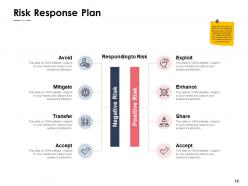
Slide 12: This slide represents Risk Response plan describing positive and negative ways of responding to the risk levels.
Slide 13: This slide showcases Risk Response Matrix with the help of graph describing the probability of risk and the risk response associated with it.
Slide 14: This slide presents Risk Mitigation Strategies describing Technical, cost and scheduled risks.
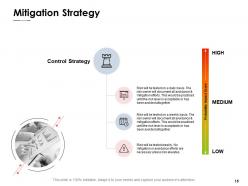
Slide 15: This slide shows Mitigation Strategy with related imagery and text.
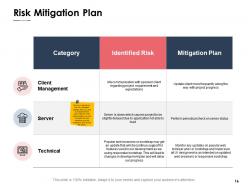
Slide 16: This slide displays Risk Mitigation Plan in a tabular form.
Slide 17: This slide showcases Risk Mitigation Chart with likelihood and impact of risk.
Slide 18: This slide shows Risk Control Matrix. This matrix helps you to keep a log of the control measures you have decided to take to manage the risk levels.
Slide 19: This slide presents Risk Tracker which could be used to track the risk factors and how we are planning to overcome the same.
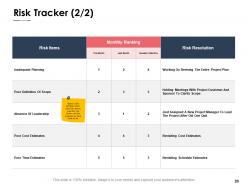
Slide 20: This is another slide presenting Risk Tracker which could be used to track the risk factors and the progress we have made so far.
Slide 21: This slide displays Risk Mitigation Strategies Icons.
Slide 22: This slide is titled as Additional slides for moving forward.
Slide 23: This is Our Mission slide with related imagery and text.
Slide 24: This is Our Team slide with names and designation.
Slide 25: This is About us slide to show company specifications etc.
Slide 26: This slide displays Pie Chart with data in percentage.
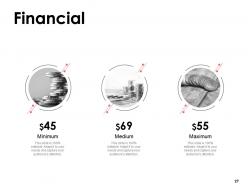
Slide 27: This is a Financial slide. Show your finance related stuff here.
Slide 28: This is a SWOT slide. Show your firm's Strength, Weakness, Opportunities, and Threats here.
Slide 29: This is an Idea Generation slide to state a new idea or highlight information, specifications etc.
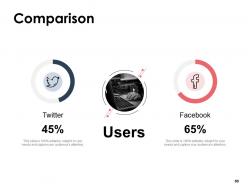
Slide 30: This is a Comparison slide to state comparison between commodities, entities etc.
Slide 31: This is a Thank You slide with address, contact numbers and email address.
Risk mitigation strategies powerpoint presentation slides with all 31 slides:
Use our Risk Mitigation Strategies Powerpoint Presentation Slides to effectively help you save your valuable time. They are readymade to fit into any presentation structure.














FAQs for Risk mitigation strategies
Key elements include risk identification and assessment, impact analysis, mitigation planning, resource allocation, and continuous monitoring protocols. These components work together by establishing comprehensive threat landscapes, prioritizing critical vulnerabilities, and implementing layered defenses, with many organizations finding that systematic approaches ultimately deliver enhanced operational resilience and competitive advantage.
Organizations identify industry-specific risks through comprehensive risk assessments, stakeholder consultations, regulatory analysis, competitor monitoring, and historical data review. Financial services firms, for example, focus on credit and compliance risks, while manufacturing companies prioritize supply chain and operational hazards, with many organizations finding that systematic risk identification ultimately delivers better preparedness and competitive resilience.
Risk assessment serves as the foundation for effective mitigation strategies by identifying potential threats, evaluating their likelihood and impact, prioritizing risks based on severity, and determining resource allocation needs. Through comprehensive risk assessment, organizations across sectors like healthcare, financial services, and manufacturing can develop targeted mitigation approaches, streamline their risk management processes, and ultimately deliver enhanced operational resilience while maintaining competitive advantage.
Common risk mitigation techniques in project management include risk avoidance, risk transfer, risk reduction, contingency planning, and regular monitoring protocols. These strategies work by identifying potential threats early, implementing preventive measures, and establishing backup plans, with many organizations finding that combining multiple approaches across complex projects ultimately delivers greater operational resilience and project success rates.
Technology enhances risk mitigation through automated monitoring systems, predictive analytics, real-time threat detection, artificial intelligence, and integrated reporting platforms. These solutions streamline risk assessment by identifying vulnerabilities early, analyzing patterns across operations, and enabling proactive responses, with many financial institutions and healthcare organizations finding that automated systems deliver faster incident response and significantly improved operational resilience.
Organizations face challenges including resource constraints, resistance to change, inadequate risk assessment capabilities, siloed communication, and difficulty measuring strategy effectiveness. These obstacles can be overcome through phased implementation approaches, comprehensive stakeholder training, and integrated technology solutions, with many companies finding that systematic change management and cross-departmental collaboration ultimately deliver stronger risk resilience and operational efficiency.
Businesses can prioritize risks by conducting comprehensive risk assessments that evaluate probability, potential impact, regulatory requirements, and strategic alignment with organizational objectives. Through risk matrices and scoring methodologies, companies across sectors like financial services, healthcare, and manufacturing identify high-priority threats, ultimately enabling focused resource allocation and more effective mitigation strategies that protect critical operations.
Key metrics for evaluating risk mitigation effectiveness include risk reduction percentages, incident frequency rates, financial impact assessments, compliance scores, and recovery time measurements. These indicators enable organizations across sectors like banking, healthcare, and manufacturing to quantify their security improvements, optimize resource allocation, and demonstrate measurable returns on risk management investments.
Organizations foster risk awareness culture through comprehensive training programs, regular communication about potential threats, clear escalation procedures, and incentive systems that reward proactive risk identification. By implementing cross-departmental risk workshops, scenario-based simulations, and transparent reporting mechanisms, companies create environments where employees actively participate in risk management, ultimately delivering enhanced organizational resilience and competitive advantage.
Regulatory compliance significantly shapes risk mitigation strategies by establishing mandatory frameworks, reporting requirements, and operational standards that vary across industries. Financial services face stringent capital adequacy rules, healthcare organizations navigate patient privacy regulations, and manufacturing companies address environmental compliance, with many organizations finding that proactive regulatory alignment ultimately delivers competitive advantage and operational efficiency.
Scenario planning strengthens risk mitigation frameworks by modeling multiple future possibilities, identifying potential vulnerabilities before they materialize, and enabling proactive response strategies across various risk scenarios. Through systematic what-if analysis, organizations in sectors like financial services and manufacturing develop contingency plans, stress-test their operations, and build adaptive capacity, ultimately delivering greater resilience and competitive advantage in uncertain environments.
Successful risk mitigation strategies include diversified supply chains in manufacturing, cybersecurity protocols in banking, predictive maintenance in aviation, regulatory compliance frameworks in pharmaceuticals, and disaster recovery planning in hospitality. These approaches streamline operations by reducing vulnerabilities, enhancing operational resilience, and ensuring business continuity, with many organizations finding that proactive risk management delivers competitive advantage and sustained growth.
Stakeholder engagement significantly enhances risk mitigation plans by providing diverse perspectives, identifying blind spots, ensuring practical implementation feasibility, and securing organizational buy-in across departments. Through collaborative input from operations, finance, and frontline teams, organizations develop more comprehensive strategies that address real-world challenges, ultimately delivering stronger risk coverage and smoother execution with stakeholders invested in successful outcomes.
Global supply chain risks require comprehensive mitigation techniques including diversification strategies, real-time monitoring systems, supplier relationship management, scenario planning, and contingency protocols. These approaches enable organizations to minimize disruptions, reduce dependency vulnerabilities, and maintain operational continuity, with many manufacturing and retail companies finding that strategic supplier diversification ultimately delivers enhanced resilience and competitive advantage.
Organizations ensure adaptability in their risk mitigation strategies by implementing dynamic risk assessment frameworks, establishing cross-functional response teams, diversifying operational approaches, and maintaining flexible resource allocation systems. Through continuous monitoring and scenario planning, companies across sectors like financial services, manufacturing, and retail can rapidly adjust their strategies, ultimately delivering enhanced resilience and competitive advantage in increasingly volatile market environments.
-
Very unique, user-friendly presentation interface.