


Robotic process automation adoption in various industries powerpoint presentation slides




Try Before you Buy Download Free Sample Product
 Impress Your
 Audience
 100%
100% Editable
 Save Hours
 of Time


Robotic process automation RPA, also named software robotics, utilizes automation technologies to simulate back-office tasks of human employees like extracting data, filling documents, transferring files, etc. This deck Robotic process automation adoption in various industries incorporates APIs and user interface UI relations to integrate and execute redundant tasks between enterprise and productivity applications. By deploying scripts that simulate human processes, RPA tools meet the autonomous implementation of diverse activities and transactions across unrelated software techniques. This deck covers the adoption techniques of robotic process automation in various industries and their processes. It includes the implementation of automation in customer service, the retail industry, marketing and sales, healthcare, banking, finance, human resources, and the information technology sector. It also includes recent trends and techniques used in automotive industries, types of RPA, and the center of excellence team structure. Further things that are covered are strategies of RPA implementation, RPA implementation timeline, the impact of RPA implementation on various processes, major challenges of implementation, organizational impact and performance measurement dashboard, etc. Download our ready-to-use content and fully editable Robotic process automation powerpoint presentation slides now.
People who downloaded this PowerPoint presentation also viewed the following :
Content of this Powerpoint Presentation
Slide 1: This slide displays the title Robotic Process Automation Adoption in Various Industries.
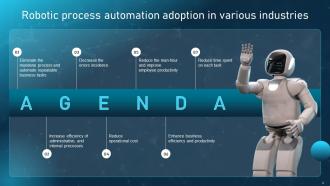
Slide 2: This slide displays the title Agenda.
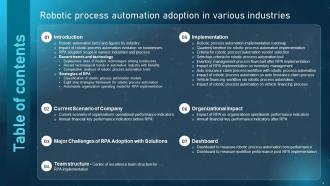
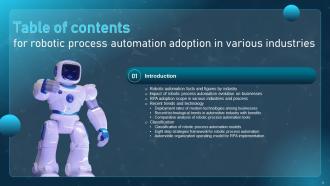
Slide 3: This slide exhibit table of content.
Slide 4: This slide exhibit table of content.
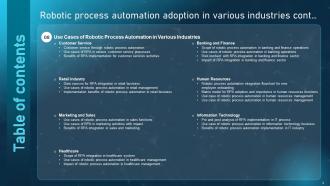
Slide 5: This slide showcase table of content that is to be discuss further.
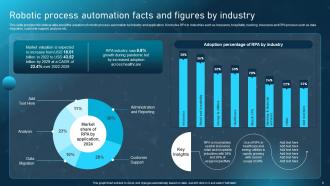
Slide 6: This slide provides the statical data about the adoption of robotic process automation by industry and application.
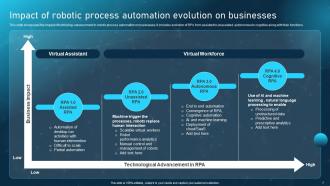
Slide 7: This slide showcases the impact of technology advancement in robotic process automation on businesses.
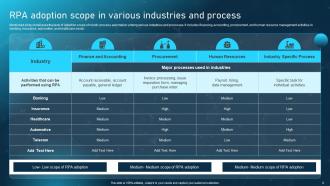
Slide 8: Mentioned slide showcases the level of adoption scope of robotic process automation among various industries and processes.
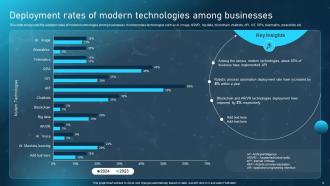
Slide 9: This slide showcases the adoption rates of modern technologies among businesses.
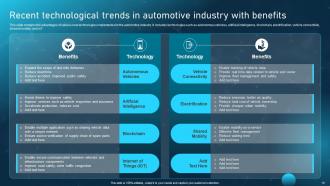
Slide 10: This slide contains the advantages of various new technologies implemented in the automotive industry.
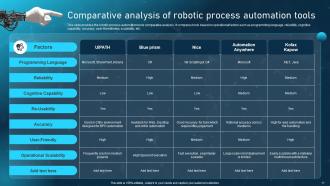
Slide 11: This slide provides the robotic process automation tools comparative analysis.
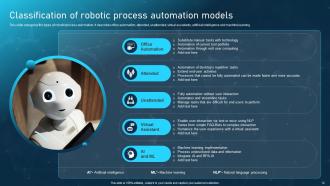
Slide 12: This slide categorize the types of robotic process automation.
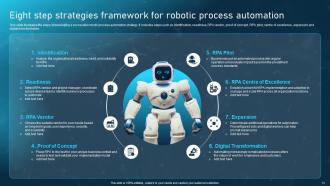
Slide 13: This slide illustrates the steps of developing a successful robotic process automation strategy.
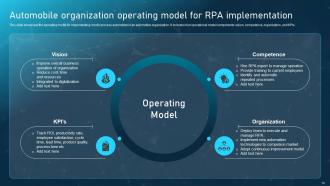
Slide 14: This slide showcase the operating model for implementing robotic process automation in an automotive organization.
Slide 15: This slide showcase table of content that is to be discuss further.
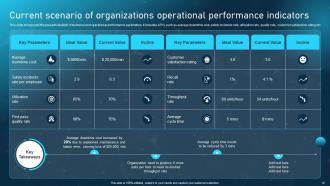
Slide 16: This slide showcases the present situation of technical and operational performance parameters.
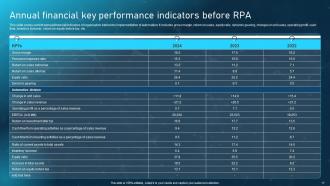
Slide 17: This slide covers current annual financial indicators of organization before the implementation of automation.
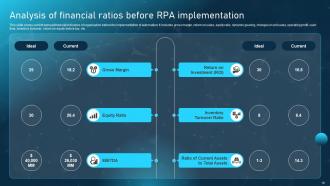
Slide 18: This slide covers current annual financial indicators of organization before the implementation of automation.
Slide 19: This slide showcase table of content that is to be discuss further.
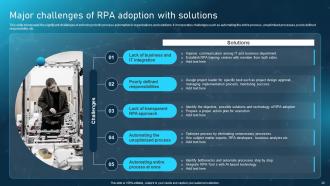
Slide 20: This slide showcases the significant challenges of enforcing robotic process automation in organizations and solutions.
Slide 21: This slide showcase table of content that is to be discuss further.
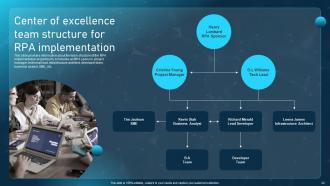
Slide 22: This slide provides information about the team structure of the RPA implementation project team.
Slide 23: This slide showcase table of content that is to be discuss further.
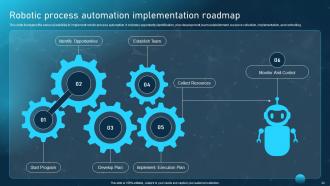
Slide 24: This slide illustrates the series of activities to implement robotic process automation.
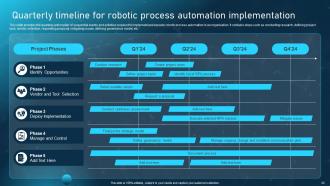
Slide 25: This slide provides the quarterly action plan of sequential events and activities required to implement and execute robotic process automation in an organization.
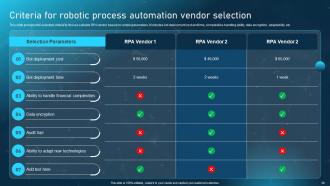
Slide 26: This slide provides the selection criteria to choose suitable RPA vendor based on certain parameters.
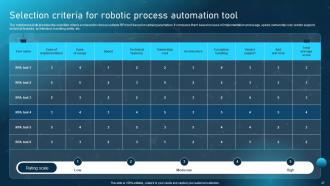
Slide 27: The mentioned slide provides the selection criteria scorecard to choose suitable RPA tool based on certain parameters.
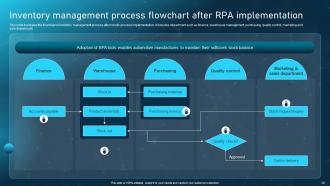
Slide 28: This slide illustrates the flowchart of inventory management process after robotic process implementation.
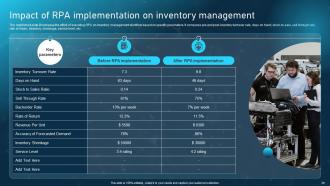
Slide 29: The mentioned slide showcases the effect of executing RPA on inventory management workflow based on specific parameters.
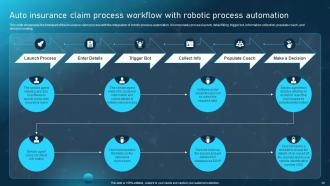
Slide 30: This slide showcases the flowchart of the insurance claim process with the integration of robotic process automation.
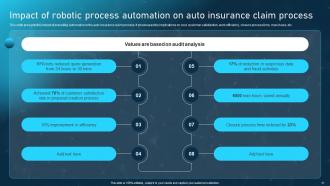
Slide 31: This slide presents the impact of executing automation in the auto insurance claim process.
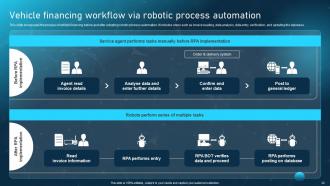
Slide 32: This slide showcases the process of vehicle financing before and after adopting robotic process automation.
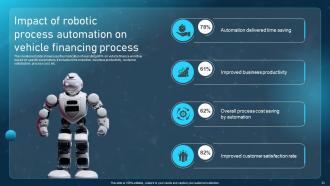
Slide 33: The mentioned slide showcases the implication of executing RPA on vehicle finance workflow based on specific parameters.
Slide 34: This slide showcase table of content that is to be discuss further.
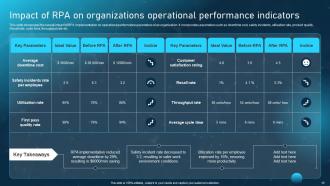
Slide 35: This slide showcases the overall impact of RPA implementation on operational performance parameters of an organization.
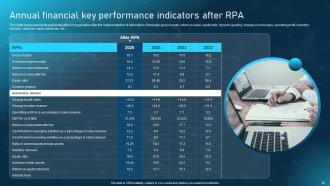
Slide 36: This slide covers annual financial indicators of organization after the implementation of automation.
Slide 37: This slide showcase table of content that is to be discuss further.
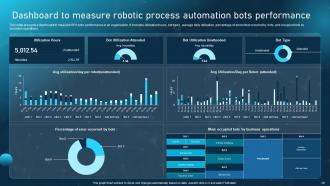
Slide 38: This slide presents a dashboard to measure RPA bots' performance in an organization.
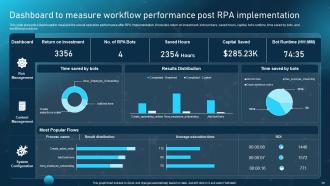
Slide 39: This slide presents a dashboard to measure the overall operation performance after RPA implementation.
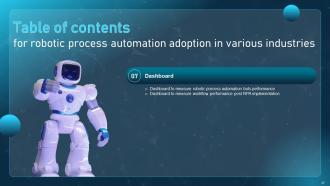
Slide 40: This slide showcase table of content that is to be discuss further.
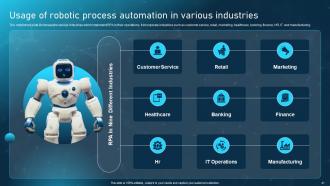
Slide 41: The mentioned slide showcase the various industries which implement RPA in their operations.
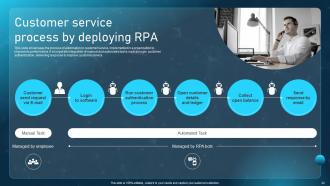
Slide 42: This slide showcases the process of automation in customer service, implemented in a organization to improve its performance.
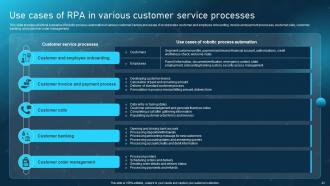
Slide 43: This slide provides practical scenarios of robotic process automation in various customer service processes.
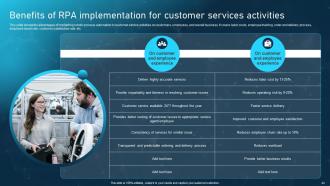
Slide 44: This slide shows the advantages of implanting robotic process automation in customer service activities on customers, employees, and overall business.
Slide 45: This slide showcase table of content that is to be discuss further.
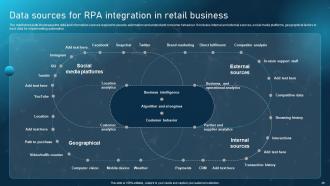
Slide 46: The mentioned slide showcases the data and information sources required to execute automation and understand consumer behaviour.
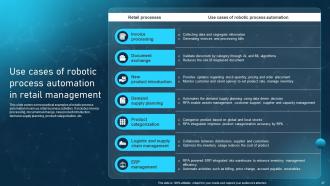
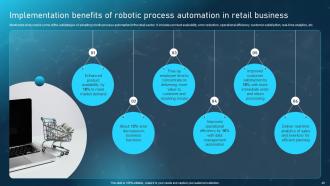
Slide 47: This slide covers some practical examples of robotic process automation in various retail business activities.
Slide 48: Mentioned slide covers some of the advantages of adopting robotic process automation in the retail sector.
Slide 49: This slide showcase table of content that is to be discuss further.
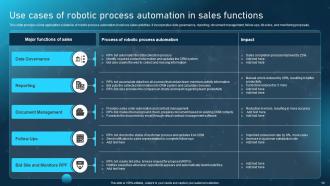
Slide 50: This slide provides some application scenarios of robotic process automation in various sales activities.
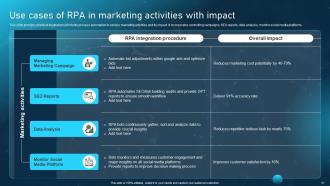
Slide 51: This slide provides practical illustrations of robotic process automation in various marketing activities and its impact.
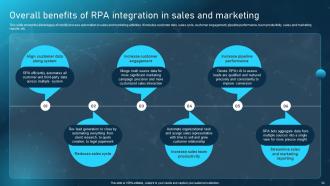
Slide 52: This slide shows the advantages of robotic process automation in sales and marketing activities.
Slide 53: This slide showcase table of content that is to be discuss further.
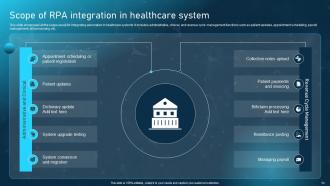
Slide 54: This slide showcases all the scope areas for integrating automation in healthcare systems.
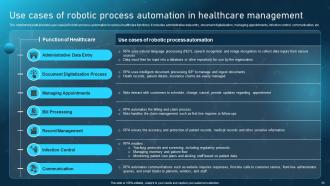
Slide 55: The mentioned slide provides use cases of robotic process automation in various healthcare functions.
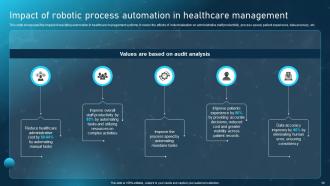
Slide 56: This slide showcases the impact of executing automation in healthcare management systems.
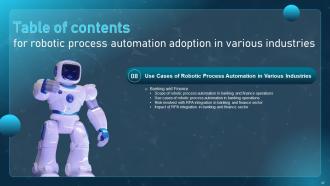
Slide 57: This slide showcase table of content that is to be discuss further.
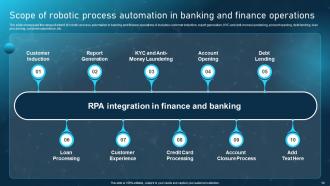
Slide 58: The slide showcases the range of extent of robotic process automation in banking and finance operations.
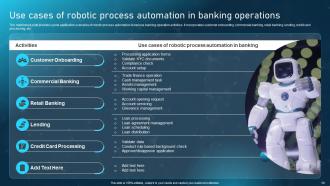
Slide 59: The mentioned slide provides some application scenarios of robotic process automation in various banking operation activities.
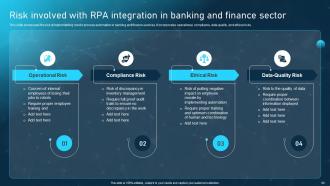
Slide 60: This slide showcases the risk of implementing robotic process automation in banking and finance services.
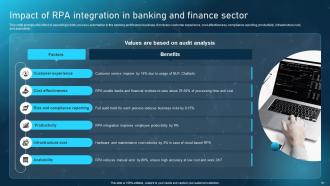
Slide 61: This slide provides the effect of executing robotic process automation in the banking and finance business.
Slide 62: This slide showcase table of content that is to be discuss further.
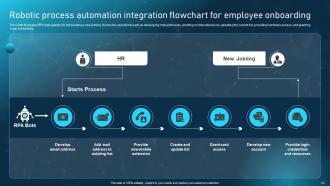
Slide 63: This slide illustrates RPA bots events for onboarding a new joining.
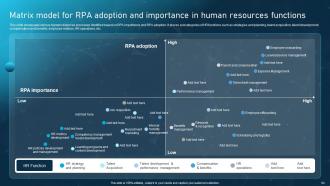
Slide 64: This slide showcases various human resources processes identified based on RPA importance and RPA adoption.
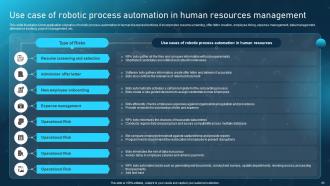
Slide 65: This slide illustrates some application scenarios of robotic process automation in human resources functions.
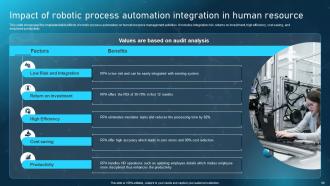
Slide 66: This slide showcases the implementation effects of robotic process automation on human resource management activities.
Slide 67: This slide showcase table of content that is to be discuss further.
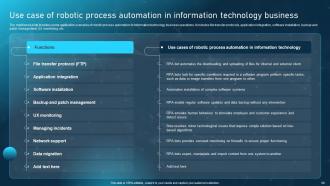
Slide 68: The mentioned slide provides some application scenarios of robotic process automation in information technology business operations.
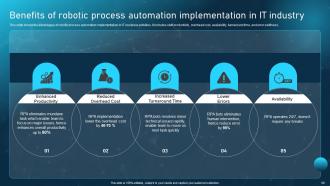
Slide 69: This slide shows the advantages of robotic process automation implementation in IT business activities.
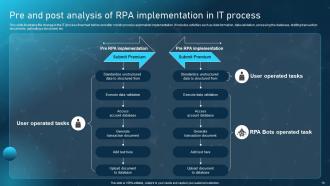
Slide 70: This slide illustrates the change in the IT process flowchart before and after robotic process automation implementation.
Slide 71: This is the icons slide.
Slide 72: This slide presents title for additional slides.
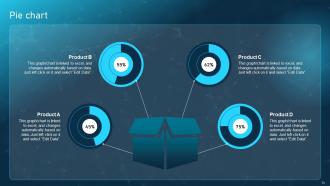
Slide 73: This slide display Pie chart.
Slide 74: This slide exhibit yearly Timeline.
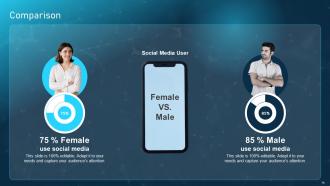
Slide 75: This slide showcase Comparison.
Slide 76: This slide showcase Magnifying glass.
Slide 77: This slide exhibit Idea generation.
Slide 78: This slide depicts posts for past experiences of clients.
Slide 79: This slide display Location.
Slide 80: This is thank you slide & contains contact details of company like office address, phone no., etc.
Robotic process automation adoption in various industries powerpoint presentation slides with all 85 slides:
Use our Robotic process automation adoption in various industries powerpoint presentation slides to effectively help you save your valuable time. They are readymade to fit into any presentation structure.









FAQs for Robotic process automation adoption in various industries
Honestly, you'll save so much time it's crazy - bots just crush those boring repetitive tasks without breaks or screw-ups. Your team gets to do actual meaningful work instead of mindless data entry (which obviously makes everyone less miserable). Plus everything gets documented automatically so compliance becomes way easier. Cost-wise it's a no-brainer since bots cost way less than hiring people for grunt work. ROI comes pretty fast too. Oh and definitely start small with just one process to test it out, then expand once you see how well it works.
So RPA basically sits on top of whatever systems you already have - no need to rip anything out or rebuild stuff. It's like having a robot that literally clicks and types the same way you would. Traditional automation is more about actually coding integrations or building new workflows from scratch, which honestly takes forever. The cool thing about RPA is you can set it up pretty quickly since you're not messing with your existing tech. Just look for those mind-numbing repetitive tasks you do every day - that's where RPA really shines.
Banking and financial services are absolutely killing it with RPA right now. They're automating everything - transaction processing, compliance checks, loan apps. Healthcare's doing the same thing with claims and patient records. Manufacturing companies love it for supply chain management too. Pretty much any industry buried in repetitive paperwork is all over this tech. Insurance and telecom are huge adopters as well. Oh, and retail's getting into it more lately. If you're trying to sell RPA solutions, I'd definitely target those sectors first. They already get why it's valuable and actually have money set aside for automation projects.
Honestly, the people stuff is usually the worst part - employees get freaked out about losing their jobs or having to learn new systems. Can't really blame them. Your old tech systems probably won't cooperate either, which is super fun to deal with. Data's always messier than you expect too. Finding someone who actually gets both the technical side AND how your business works? Good luck with that. Oh, and don't automate everything at once - you'll just create more problems. Pick something simple first, show it works, then expand from there.
So basically, RPA bots just follow their programming exactly every time - no typos, no fat-finger mistakes, none of that stuff. They don't get tired or have bad days like we do. I've seen companies cut their data errors by like 90% because bots don't zone out during repetitive tasks. The whole 24/7 thing is pretty sweet too. Honestly? Look at whatever processes your team screws up most often - that's where you want to start. Those boring data entry tasks where someone always messes up a number or copies the wrong cell.
So regular RPA bots are pretty dumb - they just follow scripts and click stuff. But when you add AI? Game changer. Now they can actually read messy documents, understand emails, even handle handwritten forms. Makes decisions too, which is huge because you won't get those annoying midnight alerts when something goes wrong. The fancy term is "intelligent automation" but whatever you call it, you can automate way more complex stuff now. I'd look at where your current bots keep failing first - probably anywhere they need to interpret data that's not perfectly formatted.
Look, start with the obvious stuff - ROI and how much time you're actually saving. Multiply those saved hours by what you pay people, then add in the money you're not losing to mistakes anymore. Process completion time and error rates are pretty straightforward to track too. Here's what most people miss though: employee satisfaction scores. I know it sounds touchy-feely, but happy employees = way better results. Also measure your bot throughput and accuracy improvements. If you're in a regulated industry, compliance rates matter big time. Get these basics down in your first 90 days, then you can get fancy with more detailed metrics later.
So basically RPA takes all the boring backend work that slows everything down and automates it. Customers get way faster response times - like instant order confirmations, quicker refunds, that kind of stuff. Fewer mistakes too since humans aren't doing the mindless data entry anymore. Your support team can actually solve real problems instead of drowning in paperwork, which honestly makes their jobs way less soul-crushing. The bots work 24/7 too, so customers don't have to wait around. I'd start by looking at whatever processes eat up the most time and see where automation makes sense.
Honestly, start with figuring out what you actually need before getting distracted by all the fancy marketing stuff. Been down that road and it's not fun. Pick something that plays nice with whatever systems you're already using. Security matters too, obviously. The learning curve thing is huge - some tools are super intuitive while others require you to basically become a developer overnight. Test out like 2-3 options with small projects first. Their support better be decent because you'll definitely hit roadblocks. Oh, and make sure it can grow with you instead of becoming a nightmare later.
Honestly, most companies I've seen handle this pretty well by retraining people instead of just firing everyone. They teach employees to work with the bots or move them into jobs that need actual human thinking. RPA can actually help with retention - I mean, who wants to do boring data entry forever? Companies that get it right are upfront about their automation plans from day one and get their teams involved in rolling it out. Oh, and they look for people who could manage the bots or improve processes. Being transparent early makes all the difference.
Dude, RPA is everywhere in finance right now. Invoice processing and AP/AR are obvious wins. Bank reconciliations too - they're mind-numbing but perfect for bots. Expense reports, payroll, regulatory stuff... basically anything where you're copying data between systems. Credit assessments work well if they're straightforward. The trick is finding high-volume tasks that don't need much thinking. Oh, and financial reporting - forgot that one. Look at whatever your team dreads doing every month. Those repetitive, rule-heavy processes? That's your goldmine right there.
RPA bots are getting crazy smart now with AI built in. They don't just follow scripts anymore - they can actually make decisions and learn patterns. Mine processes emails and messy documents without breaking down constantly. The "intelligent automation" label is kinda cheesy but whatever, it works. Your bots can adapt when things change, understand regular language, and even spot problems before they happen. I'd say think bigger than basic task stuff. Which workflows need real decision-making? That's where this tech shines. Way less reprogramming headaches too.
So it really depends on what you're doing - developers definitely need to pick up tools like UiPath or Blue Prism. Get certified too since companies eat that stuff up. Business analysts should focus more on process mapping and workflow stuff. Honestly, everyone benefits from understanding basic programming logic even if you're not actually writing code. Oh, and if you're managing projects, you'll want change management experience because people get weird about automation at first. I'd start with the free vendor training courses and find a couple small processes to mess around with.
Build security right into your RPA from the start - trust me on this one. Role-based access controls are a must so random people can't mess with your bots. Encrypt everything the bots touch, and for the love of all that's holy, don't hardcode passwords! I've watched that bite people so hard. Use credential vaults instead. Log absolutely everything for audit trails - you'll thank yourself later when someone asks what happened. Document your processes well for compliance stuff. Oh, and set up monitoring alerts because bots can go rogue in weird ways. Regular reviews help catch any regulatory slip-ups too.
So the big thing happening right now is RPA getting smarter - like, bots can actually make decisions instead of just robotically following steps. Companies are going all-in on automating entire workflows rather than piecemeal stuff. Cloud platforms are everywhere now, which thank god because setting up the old systems was such a pain. Oh, and they're making tools simple enough that regular employees can build automations without bugging IT constantly. Honestly? Just pick one small process and test out the intelligent stuff first. Way easier to scale from there.
-
Keep doing the good work guys. Surpass the needs and expectations always!!
-
“Love it! I was able to grab an exciting proposal because of SlideTeam.”