


Role and responsibilities in diversity council edu ppt




Try Before you Buy Download Free Sample Product
 Impress Your
 Audience
 100%
100% Editable
 Save Hours
 of Time


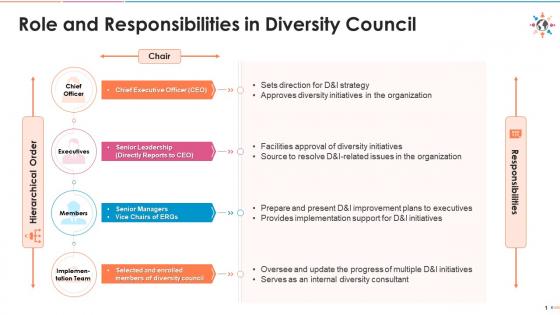
This slide showcases the major role and responsibilities in diversity council. It also provides information regarding hierarchical order such as chief officer, executives, members, and implementation team.
People who downloaded this PowerPoint presentation also viewed the following :
Role and responsibilities in diversity council edu ppt with all 16 slides:
Use our Role And Responsibilities In Diversity Council Edu Ppt to effectively help you save your valuable time. They are readymade to fit into any presentation structure.









FAQs for Role and responsibilities in diversity
The primary objectives include fostering inclusive workplace culture, developing comprehensive diversity strategies, ensuring equitable hiring and promotion practices, monitoring progress through measurable metrics, and driving organizational accountability. These councils streamline diversity initiatives by establishing clear governance, facilitating cross-departmental collaboration, and implementing systematic approaches to inclusion, with many organizations finding that structured diversity leadership ultimately delivers enhanced innovation, employee engagement, and competitive market advantage.
The Diversity Council aligns its goals with organizational mission by integrating diversity metrics into strategic planning, embedding inclusive practices within core business objectives, and ensuring diversity initiatives support broader company values and outcomes. Through regular leadership collaboration and data-driven assessments, many organizations find that this strategic alignment enhances employee engagement, drives innovation, and ultimately delivers competitive advantage while strengthening brand reputation and market reach.
A Diversity Council should include senior leadership, HR representatives, employee resource group leaders, middle management, frontline employees, and external diversity experts to ensure comprehensive organizational representation. This strategic combination enables councils to address systemic barriers, implement inclusive policies, and drive cultural transformation across all levels, with many organizations finding that diverse stakeholder representation ultimately delivers more effective diversity initiatives and sustainable competitive advantage.
A Diversity Council can effectively measure success through quantitative metrics like representation data, retention rates, and promotion statistics, alongside qualitative assessments including employee surveys, focus groups, and engagement scores. These measurement approaches enable organizations to track progress comprehensively, identify areas needing improvement, and demonstrate tangible outcomes, with many companies finding that regular assessment cycles ultimately deliver enhanced workplace culture and stronger business performance.
The Diversity Council serves as a strategic advisory body that develops comprehensive inclusion frameworks, reviews existing policies for bias elimination, conducts organizational assessments, and creates actionable diversity initiatives across departments. These councils drive measurable change by establishing accountability metrics, facilitating cross-functional collaboration, and embedding inclusive practices into recruitment, performance management, and leadership development, ultimately delivering enhanced innovation and competitive advantage.
The Diversity Council can facilitate open discussions by creating safe spaces for dialogue, hosting regular forums and workshops, implementing anonymous feedback systems, and organizing cross-departmental listening sessions. These structured approaches enable meaningful conversations while building trust, with many organizations finding that consistent facilitation breaks down barriers, encourages authentic sharing, and ultimately delivers stronger workplace relationships and enhanced cultural understanding.
Diversity Council members should receive unconscious bias training, cultural competency development, inclusive leadership workshops, data analysis skills, and conflict resolution techniques. These comprehensive resources enable councils to identify systemic barriers, facilitate productive discussions across different perspectives, and implement measurable diversity initiatives, with many organizations finding that well-trained council members drive significantly better outcomes in retention and workplace inclusion.
The Diversity Council addresses unconscious bias through comprehensive training programs, bias-interruption workshops, structured decision-making processes, and regular assessment of hiring and promotion practices. These initiatives enable organizations to identify systemic patterns, implement objective evaluation criteria, and create accountability mechanisms, with many companies finding that structured approaches ultimately deliver more equitable outcomes and enhanced organizational performance.
The Diversity Council can collaborate with HR on inclusive recruitment and bias training, with Marketing on diverse representation campaigns, with Operations on accessible workplace policies, and with Leadership on strategic diversity metrics. Through cross-departmental partnerships, organizations streamline diversity integration across all business functions, enhance employee engagement, and deliver measurable cultural transformation, with many companies finding that these collaborative approaches ultimately accelerate both inclusion goals and competitive advantage.
Diversity Councils should establish confidential reporting mechanisms, implement bias-free policies, provide inclusive leadership training, and create employee resource groups with dedicated funding and executive sponsorship. These initiatives streamline support systems by fostering psychological safety, enhancing cross-cultural communication, and delivering measurable inclusion outcomes, with many organizations finding that strategic diversity frameworks ultimately improve employee retention and competitive market positioning.
Diversity Councils can leverage data analytics by collecting workforce demographics, tracking recruitment and retention metrics, analyzing pay equity gaps, measuring employee engagement scores, and monitoring promotion patterns across different groups. Through predictive analytics and dashboard reporting, organizations streamline decision-making processes, identify systemic barriers more effectively, and measure program impact with greater precision, ultimately delivering data-driven diversity strategies and enhanced organizational accountability.
Diversity Councils should adopt multi-channel communication strategies including regular town halls, interactive workshops, digital storytelling campaigns, employee resource group partnerships, and transparent progress reporting through dashboards and newsletters. These approaches enhance engagement by creating dialogue opportunities, sharing authentic employee experiences, and demonstrating measurable outcomes, with many organizations finding that consistent, inclusive messaging ultimately drives cultural transformation and employee participation.
Diversity Councils drive community engagement by partnering with local organizations, supporting minority-owned businesses, sponsoring educational programs, and participating in social justice initiatives that align with organizational values. These councils enable companies to build meaningful community relationships, enhance brand reputation, and demonstrate authentic commitment to social responsibility, while creating pathways for employee volunteerism and civic participation that strengthen both community ties and internal culture.
Diversity Councils foster inclusive cultures by establishing clear diversity metrics, implementing bias-free recruitment practices, creating employee resource groups, mandating inclusive leadership training, and integrating equity principles into performance evaluations. Through strategic partnerships with department heads, these councils drive cultural transformation across organizations, with many companies finding that systematic approaches to inclusion enhance employee engagement, reduce turnover, and ultimately deliver stronger innovation and competitive market positioning.
Effective accountability processes include regular progress tracking against diversity metrics, quarterly stakeholder reporting, executive sponsor oversight, and clear implementation timelines with designated ownership. These mechanisms ensure transparency through measurable outcomes, milestone reviews, and feedback loops, with many organizations finding that combining data-driven assessments with leadership accountability ultimately delivers sustained cultural transformation and competitive advantage.
-
Much better than the original! Thanks for the quick turnaround.
-
Top Quality presentations that are easily editable.
-
Unique research projects to present in meeting.
-
Innovative and attractive designs.
-
Visually stunning presentation, love the content.