


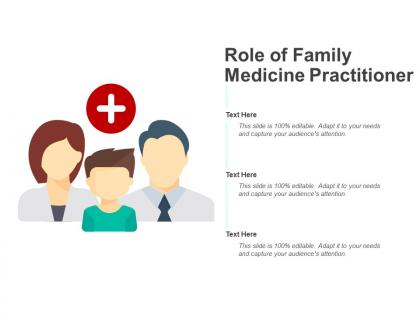
Role of family medicine practitioner




Try Before you Buy Download Free Sample Product
 Impress Your
 Audience
 100%
100% Editable
 Save Hours
 of Time


Finish with a flourish with our Role Of Family Medicine Practitioner. You will achieve a fitting finale.
People who downloaded this PowerPoint presentation also viewed the following :
Role of family medicine practitioner with all 5 slides:
Give your thoughts extra flourish. Our Role Of Family Medicine Practitioner add to the drama.



FAQs for Role of
Family medicine practitioners play crucial roles in preventive care through routine screenings, immunizations, health risk assessments, lifestyle counseling, and chronic disease management. These healthcare professionals enhance patient outcomes by identifying potential health issues early, educating families about wellness strategies, and coordinating comprehensive care plans, ultimately delivering improved community health and reduced healthcare costs.
Family medicine fosters long-term, comprehensive relationships spanning entire families and multiple generations, unlike specialty medicine which typically focuses on specific conditions or body systems. These physicians serve as primary care coordinators, building deep understanding of patients' medical histories, family dynamics, and social contexts, ultimately delivering continuity of care and personalized treatment approaches that many healthcare systems find enhances patient outcomes.
Family physicians can manage chronic diseases through comprehensive care planning, regular monitoring protocols, patient education programs, medication management systems, and coordinated referrals to specialists. These strategies enhance patient outcomes by promoting self-management, preventing complications, and ensuring continuity of care, with many practices finding that integrated approaches significantly improve quality of life while reducing healthcare costs and hospital readmissions.
Family medicine practices can integrate mental health services through collaborative care models, co-located therapists, screening protocols, care coordination systems, and provider cross-training. These approaches streamline patient access by eliminating referral delays, reducing stigma through familiar settings, and enabling comprehensive treatment plans, with many primary care practices finding that integrated models deliver better health outcomes while reducing costs and improving patient satisfaction across diverse populations.
Family medicine practitioners face distinct challenges including resource limitations, patient access barriers, technology gaps, workforce shortages, and varying disease patterns. Rural practitioners often struggle with isolation, limited specialist referrals, and broader scope demands, while urban counterparts navigate higher patient volumes, complex social determinants, and competitive pressures, with many finding that telehealth and collaborative care models help bridge these geographic disparities.
Family medicine training emphasizes comprehensive, longitudinal patient care across all ages and health conditions, requiring rotations in internal medicine, pediatrics, obstetrics, surgery, and psychiatry. Unlike specialty-focused residencies that concentrate on specific organ systems or patient populations, family medicine residents develop broad clinical skills for preventive care, chronic disease management, and acute treatments, ultimately delivering continuity of care that many healthcare systems find reduces costs while improving patient outcomes.
Family physicians serve as central care coordinators for multi-specialty patients, managing referrals, synthesizing treatment plans, monitoring medication interactions, and maintaining comprehensive health records across all specialties. Through integrated care management, these physicians streamline communication between specialists, ensure treatment consistency, and provide holistic oversight, with many healthcare systems finding that coordinated primary care reduces redundant testing, minimizes care gaps, and ultimately delivers more efficient patient outcomes.
Technology enhances patient engagement in family medicine through patient portals, telemedicine platforms, mobile health apps, automated appointment reminders, and wearable device integration. These digital tools streamline communication between patients and providers, enable real-time health monitoring, and facilitate proactive care management, ultimately delivering improved health outcomes and stronger patient-provider relationships across diverse family practice settings.
Family medicine ethical considerations include maintaining confidentiality across multiple family members, navigating dual relationships, managing conflicts of interest when treating relatives, ensuring informed consent for all ages, and balancing individual patient autonomy with family dynamics. These challenges require careful boundary management, clear communication protocols, and structured decision-making frameworks, with many practitioners finding that transparent policies and regular ethics training ultimately enhance trust and deliver more comprehensive, ethically sound patient care.
Cultural competence significantly enhances family medicine effectiveness by improving patient-provider communication, increasing treatment adherence, and reducing health disparities across diverse populations. Healthcare providers who understand cultural backgrounds, language preferences, and health beliefs deliver more personalized care, with many community health centers finding that culturally competent approaches ultimately improve patient outcomes and satisfaction.
Common misconceptions include that family doctors lack specialization depth, only treat minor ailments, and can't handle complex conditions requiring specialist referrals exclusively. However, family physicians receive comprehensive training across multiple medical disciplines, manage chronic diseases like diabetes and hypertension effectively, and coordinate specialized care while maintaining continuity, with many patients finding this integrated approach delivers more personalized healthcare experiences.
Emerging trends in family medicine include telehealth integration, personalized treatment plans, shared decision-making protocols, comprehensive care coordination, and enhanced patient engagement technologies. These approaches streamline healthcare delivery by improving accessibility, reducing appointment wait times, and fostering stronger patient-provider relationships, with many practices finding that this strategic combination ultimately delivers better health outcomes and increased patient satisfaction.
Family physicians address health disparities by implementing culturally competent care, expanding access through community clinics and telemedicine, and building trust through diverse staffing and language services. Through targeted screening programs, social determinants assessment, and partnerships with community organizations, practices can deliver more equitable care, with many finding that proactive outreach and culturally tailored interventions significantly improve health outcomes across populations.
Continuity of care in family medicine establishes long-term patient-provider relationships that enhance diagnostic accuracy, treatment adherence, and preventive care effectiveness. This approach enables physicians to track health patterns, identify early warning signs, and coordinate comprehensive care across multiple conditions, ultimately reducing healthcare costs while improving patient satisfaction and clinical outcomes through personalized, relationship-based medicine.
Family medicine practitioners approach end-of-life care through comprehensive patient-centered discussions, advanced care planning, symptom management, and coordination with hospice services. These physicians facilitate honest conversations about prognosis and treatment options while providing emotional support, with many families finding that early, compassionate dialogue ultimately delivers peace of mind and dignified care transitions.
No Reviews