


Role Of Islamic Financial Institutions For Economic Growth Ethical Banking Fin SS V




Try Before you Buy Download Free Sample Product
 Impress Your
 Audience
 100%
100% Editable
 Save Hours
 of Time


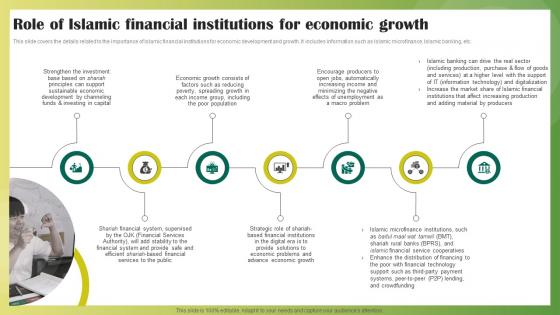
This slide covers the details related to the importance of Islamic financial institutions for economic development and growth. It includes information such as Islamic microfinance, Islamic banking, etc.
People who downloaded this PowerPoint presentation also viewed the following :
Role Of Islamic Financial Institutions For Economic Growth Ethical Banking Fin SS V with all 10 slides:
Use our Role Of Islamic Financial Institutions For Economic Growth Ethical Banking Fin SS V to effectively help you save your valuable time. They are readymade to fit into any presentation structure.








FAQs for Role Of Islamic Financial Institutions For Economic Growth Ethical Banking
**INPUT**: What are the fundamental principles that govern Islamic finance? **OUTPUT**: Islamic finance operates on core principles including prohibition of riba (interest), gharar (excessive uncertainty), haram investments, and requirements for asset-backing and risk-sharing. These principles enable financial institutions to offer Sharia-compliant products like sukuk bonds and murabaha financing, with many banks finding that these ethical frameworks enhance customer trust while delivering competitive returns in increasingly diverse markets. **Word count**: 58 words
Islamic finance emphasizes shared risk and profit distribution between lenders and borrowers, contrasting with conventional finance's fixed interest structures that transfer risk primarily to borrowers. Through partnerships like mudarabah and musharakah, Islamic banks become stakeholders in ventures, creating collaborative relationships that distribute both potential gains and losses, ultimately fostering more sustainable business partnerships.
Sharia law serves as the foundational framework for evaluating Islamic financial products, prohibiting interest (riba), excessive uncertainty (gharar), and gambling (maysir) while requiring asset-backed transactions. Islamic scholars and Sharia boards review each financial instrument's structure and underlying mechanisms, ensuring compliance with these principles while enabling banks and financial institutions to offer competitive, ethical alternatives that ultimately deliver both religious adherence and commercial viability.
Riba refers to interest or usury, which is strictly prohibited in Islamic finance as it represents unearned profit and exploitation. This prohibition fundamentally reshapes financial transactions by requiring asset-backed financing, profit-sharing arrangements, and risk-sharing partnerships instead of interest-based lending, with many Islamic banks finding that these structures promote ethical commerce while delivering competitive returns and enhanced financial stability.
The most common Islamic financial instruments include Murabaha (cost-plus financing), Ijara (leasing), Musharaka (joint ventures), Mudaraba (profit-sharing partnerships), and Sukuk (Islamic bonds). These Sharia-compliant instruments enable banks, corporations, and investment firms to deliver financing solutions while adhering to Islamic principles, with many financial institutions finding that these alternatives streamline capital allocation and enhance customer trust across diverse markets.
Sukuk represent ownership in tangible assets or business activities, while traditional bonds are debt instruments with interest payments. These Islamic securities comply with Sharia principles by providing profit-sharing from underlying assets like real estate, infrastructure, or commodities, ultimately delivering ethical investment opportunities and asset-backed returns for institutions seeking compliant financing solutions.
Islamic financial institutions face regulatory compliance complexities, limited Shariah-compliant investment options, higher operational costs, talent shortages in Islamic finance expertise, and competition from conventional banks. These challenges present both obstacles and opportunities, with many institutions finding that strategic partnerships, technology adoption, and expanded product development ultimately enhance their competitive positioning in increasingly diverse global markets.
Islamic finance promotes social responsibility through Sharia-compliant principles that prohibit investments in harmful industries like alcohol, gambling, and tobacco, while encouraging asset-backed transactions and risk-sharing partnerships. These ethical frameworks enable financial institutions to support sustainable development projects, community-based investments, and socially beneficial enterprises, ultimately delivering transparent financial practices and fostering economic justice across diverse markets.
Islamic financial institutions implement comprehensive Sharia compliance through dedicated Sharia supervisory boards, rigorous contract structuring that avoids interest-based transactions, and continuous monitoring systems that ensure adherence to Islamic principles. These measures include pre-transaction screening, ongoing audits, and certification processes, with banks, investment firms, and insurance companies finding that robust compliance frameworks ultimately deliver customer trust, regulatory approval, and competitive advantage in increasingly diverse financial markets.
Islamic microfinance initiatives contribute to poverty alleviation by providing Sharia-compliant financial services, asset-backed financing, and profit-sharing arrangements that enable entrepreneurial development while adhering to religious principles. These programs enhance economic inclusion through murabaha contracts, musharaka partnerships, and skill development training, with many rural communities and women entrepreneurs finding that faith-based financing delivers sustainable income generation and improved living standards.
Profit and loss sharing in Mudarabah and Musharakah represents Islamic finance's core principle of equitable risk distribution, where all parties share both potential returns and losses based on their contributions and agreed ratios. This approach enhances transparency and partnership accountability while eliminating guaranteed returns, with many Islamic banks and investment firms finding that these structures deliver stronger stakeholder alignment, reduced moral hazard, and ultimately more sustainable business relationships than conventional financing models.
Islamic financial institutions assess credit risk through Sharia-compliant methods emphasizing asset-backed financing, borrower cash flow analysis, and underlying asset quality evaluation, rather than purely interest-based calculations. These institutions focus on tangible business fundamentals, industry-specific risk factors, and collateral assessment, ultimately delivering more conservative lending approaches and enhanced portfolio stability compared to conventional banking models.
Islamic finance innovations include digital sukuk platforms, blockchain-based shariah compliance verification, mobile banking solutions, microfinance cooperatives, and AI-powered risk assessment tools. These technologies streamline access by reducing costs, automating compliance monitoring, and enabling remote services, with many institutions finding that mobile-first approaches significantly expand reach to underbanked communities while maintaining religious principles.
Islamic finance is embracing digital transformation through Sharia-compliant fintech solutions, blockchain-based smart contracts for transparent compliance, digital Islamic banking platforms, and AI-powered risk assessment tools. These technologies streamline Sharia verification processes, enhance customer experiences through mobile Islamic banking apps, and enable automated compliance monitoring, with many Islamic banks finding that digital solutions reduce operational costs while maintaining religious principles and expanding market reach globally.
Geopolitical stability significantly influences Islamic finance growth, with regions experiencing political uncertainty often seeing slower adoption while stable markets like the Gulf states, Malaysia, and parts of Africa demonstrate robust expansion. Through supportive regulatory frameworks and government backing, countries leverage Islamic finance to diversify economies, attract investment, and reduce dependence on conventional Western financial systems, ultimately delivering strategic financial sovereignty and enhanced regional economic resilience.
-
The templates you provide are great! They have saved me tons of time and made my presentations come alive. Thank you for this awesome product. Keep up the good work!
-
The designs are super attractive. Me and my team love using SlideTeam’s presentations.