

RPA And Hyper Automation Road Of Transformation With Hyperautomation Ppt Infographics Deck




Try Before you Buy Download Free Sample Product
 Impress Your
 Audience
 100%
100% Editable
 Save Hours
 of Time


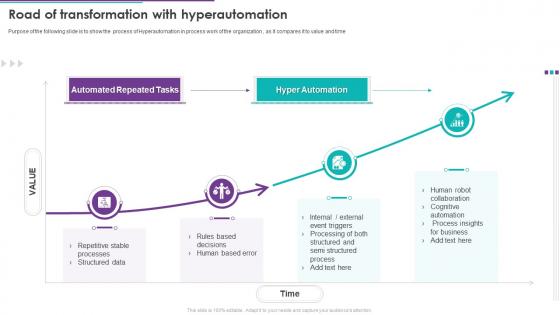
Purpose of the following slide is to show the process of Hyperautomation in process work of the organization, as it compares it to value and time
People who downloaded this PowerPoint presentation also viewed the following :
RPA And Hyper Automation Road Of Transformation With Hyperautomation Ppt Infographics Deck with all 6 slides:
Use our RPA And Hyper Automation Road Of Transformation With Hyperautomation Ppt Infographics Deck to effectively help you save your valuable time. They are readymade to fit into any presentation structure.





FAQs for RPA And Hyper Automation Road Of Transformation With Hyperautomation
RPA focuses on automating individual, rule-based tasks using software bots, while hyperautomation combines RPA with AI, machine learning, and analytics to automate entire business processes end-to-end. Hyperautomation enables organizations to scale automation strategically across departments, with companies in banking and healthcare finding that this comprehensive approach delivers greater operational efficiency and competitive advantage than standalone RPA implementations.
Organizations assess hyperautomation readiness by evaluating their current automation maturity, data infrastructure quality, change management capabilities, and available technical resources. Through comprehensive audits of existing processes, technology stack assessments, and stakeholder readiness surveys, companies can identify automation opportunities while addressing skill gaps, ultimately enabling strategic roadmap development that delivers measurable ROI and competitive advantage.
Artificial intelligence enhances RPA solutions by enabling cognitive capabilities like natural language processing, machine learning, and computer vision, transforming basic automation into intelligent decision-making systems. Through AI integration, organizations can automate complex processes requiring judgment, handle unstructured data, and adapt to exceptions dynamically, with financial services and healthcare finding that AI-powered RPA delivers significantly faster processing and improved accuracy.
RPA use cases include invoice processing, customer onboarding, data entry, claims processing, and regulatory reporting across industries. Financial services leverage RPA for loan approvals and fraud detection, while healthcare organizations automate patient scheduling and insurance verification, and manufacturing companies streamline inventory management, ultimately delivering faster processing times and improved operational efficiency.
Businesses can measure RPA ROI effectively by tracking cost savings from reduced manual labor, improved processing speed, enhanced accuracy rates, and decreased operational overhead. Through comprehensive metrics like time-to-completion reductions, error elimination percentages, and resource reallocation benefits, organizations streamline financial analysis while demonstrating clear value propositions, ultimately delivering measurable competitive advantages and strategic cost optimization.
Organizations face challenges including integration complexity across multiple AI technologies, skill gaps requiring specialized talent, higher implementation costs, and cultural resistance to broader automation. While transitioning from simple RPA to comprehensive hyperautomation presents these hurdles, companies in manufacturing, finance, and healthcare find that strategic planning, phased rollouts, and employee training ultimately deliver enhanced operational efficiency and competitive advantage.
Hyperautomation improves customer experience by integrating AI, RPA, and analytics to streamline service delivery, reduce response times, and personalize interactions across touchpoints. Through intelligent process automation, service businesses achieve faster query resolution, 24/7 availability, and consistent service quality, while minimizing human errors, ultimately delivering enhanced satisfaction and competitive advantage.
Essential Hyperautomation tools include RPA platforms, AI and machine learning algorithms, process mining software, intelligent document processing systems, and API integration technologies. These technologies streamline operations by automating complex workflows, enhancing data analysis, and enabling seamless system connectivity, with many organizations finding that this strategic combination ultimately delivers significant operational efficiency and competitive advantage.
Hyperautomation transforms workforce dynamics by automating routine tasks, creating new roles in automation management, and shifting employees toward strategic, creative, and analytical responsibilities. While some traditional positions evolve, organizations increasingly find that workers become automation collaborators and process innovators, ultimately delivering enhanced productivity and enabling teams to focus on higher-value customer interactions and business growth initiatives.
RPA and hyperautomation present both security opportunities and challenges, including data protection concerns, access control complexities, audit trail requirements, and potential vulnerabilities in automated processes. While these technologies enhance security through consistent compliance and reduced human error, organizations must implement robust governance frameworks, encryption protocols, and monitoring systems to mitigate risks while delivering operational efficiency.
RPA and Hyperautomation enable small and medium enterprises to streamline repetitive tasks, reduce operational costs, and compete with larger organizations through automated workflows, data processing, and customer service functions. These technologies help SMEs allocate resources more strategically, minimize manual errors, and deliver faster services, with many finding that automated invoice processing, inventory management, and customer communications significantly enhance their operational efficiency.
Effective RPA governance frameworks include establishing clear ownership structures, defining standardized development methodologies, implementing robust security protocols, creating comprehensive documentation standards, and maintaining continuous monitoring processes. These practices enable organizations to scale automation initiatives systematically while ensuring compliance, reducing operational risks, and delivering consistent ROI, with many enterprises finding that structured governance accelerates deployment timelines significantly.
Data integration enables hyperautomation success by connecting disparate systems, ensuring consistent data flow across automated processes, and providing unified visibility for intelligent decision-making. Through seamless integration, organizations streamline operations, reduce data silos, and enhance process efficiency, with many enterprises finding that integrated data ecosystems ultimately deliver faster insights and competitive advantage.
Hyperautomation significantly enhances operational efficiency by streamlining repetitive processes, reducing manual intervention, and accelerating task completion across multiple business functions. Through intelligent automation technologies, organizations achieve 30-50% cost reductions in areas like invoice processing, customer service, and data management, while enabling faster decision-making and improved resource allocation, ultimately delivering competitive advantage in increasingly complex markets.
Financial services, healthcare, manufacturing, retail, and telecommunications are experiencing the fastest hyperautomation adoption, driven by high-volume transaction processing and regulatory compliance needs. These industries leverage intelligent automation to streamline operations, reduce processing times, and enhance customer experiences, with many banks and hospitals finding 40-60% efficiency improvements in core processes.
-
Professional and unique presentations.
-
Editable, diversified, compatible with MS PPT and Google Slides, and on top of that finest graphics!! I mean in the words of the famous Ross Geller, “What more do you want!”