


RPA And Hyper Automation RPA Dashboard With Automated Process And Productivity





Try Before you Buy Download Free Sample Product
 Impress Your
 Audience
 100%
100% Editable
 Save Hours
 of Time


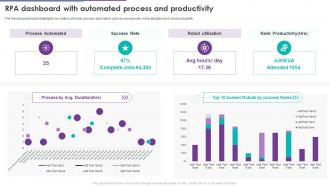
The following dashboard highlights key metrics of robotic process automation such as success rate, robot utilization and robot productivity
People who downloaded this PowerPoint presentation also viewed the following :
RPA And Hyper Automation RPA Dashboard With Automated Process And Productivity with all 7 slides:
Use our RPA And Hyper Automation RPA Dashboard With Automated Process And Productivity to effectively help you save your valuable time. They are readymade to fit into any presentation structure.





FAQs for RPA And Hyper Automation RPA Dashboard With Automated
RPA delivers significant benefits including enhanced operational efficiency, reduced processing costs, improved accuracy, faster task completion, and increased employee productivity. These automation technologies streamline repetitive workflows by eliminating manual errors, accelerating data processing, and enabling 24/7 operations, with many organizations finding substantial cost savings and enhanced competitive advantage across departments.
RPA differs from traditional automation by requiring minimal IT infrastructure changes, operating through user interfaces rather than deep system integration, and enabling business users to configure processes without extensive programming knowledge. Unlike rigid traditional methods, RPA adapts quickly to changing workflows, with many organizations finding that deployment times decrease from months to weeks while maintaining greater flexibility.
Processes most suitable for RPA implementation include rule-based data entry, invoice processing, customer onboarding, report generation, and compliance monitoring tasks. These high-volume, repetitive processes with structured data enable organizations to achieve significant cost reductions and faster processing times, with many financial services and healthcare institutions finding that automation delivers improved accuracy and enhanced operational efficiency.
Organizations face challenges including legacy system integration complexities, employee resistance to automation changes, initial implementation costs, skill gaps in RPA management, and process standardization requirements. While these hurdles can slow deployment, many companies find that strategic planning, comprehensive training programs, and phased rollouts ultimately deliver significant operational efficiency gains and competitive advantages.
Companies measure RPA ROI by tracking cost savings from reduced manual labor, faster processing times, and decreased error rates, alongside revenue gains from improved customer service and operational efficiency. Through metrics like process cycle time, accuracy improvements, and employee redeployment costs, organizations typically see 25-50% ROI within the first year, ultimately delivering measurable competitive advantages.
Artificial intelligence enhances RPA capabilities by enabling cognitive automation, intelligent decision-making, natural language processing, machine learning adaptability, and predictive analytics integration. Through AI-powered bots, organizations streamline complex workflows, automate document processing, and handle unstructured data more effectively, while financial services and healthcare institutions find that intelligent automation delivers faster processing and improved accuracy.
RPA improves customer service by automating routine inquiries, processing requests faster, and providing 24/7 availability through chatbots and automated response systems. Banks use RPA for instant account updates, while retail companies automate order tracking and returns processing, ultimately delivering faster response times, reduced wait periods, and more consistent customer interactions across all touchpoints.
Key considerations for choosing an RPA vendor include scalability capabilities, integration compatibility, security features, vendor support quality, and total cost of ownership. Organizations should evaluate technical requirements alongside business needs, with many enterprises finding that vendors offering comprehensive training, robust analytics, and seamless API connectivity ultimately deliver greater operational efficiency and faster implementation timelines.
RPA transforms workforce dynamics by automating repetitive tasks, enabling employees to focus on strategic activities, and creating demand for new technical skills like bot management and process optimization. While automation eliminates some routine positions, it simultaneously generates opportunities in RPA development, system maintenance, and enhanced customer service roles, with many organizations finding their workforce becomes more skilled and strategically valuable.
Organizations should establish clear governance frameworks, conduct thorough process assessments, prioritize standardized workflows, invest in comprehensive training, and implement robust change management strategies. These practices enable companies to minimize deployment risks, accelerate automation adoption, and maximize ROI, with many enterprises finding that strategic planning and stakeholder alignment ultimately deliver sustainable operational efficiency and competitive advantage.
Healthcare, financial services, manufacturing, retail, and telecommunications are experiencing the most significant RPA adoption due to their high-volume, rule-based processes and regulatory requirements. These industries leverage RPA to streamline operations like claims processing, invoice management, and customer onboarding, while reducing costs and improving compliance, ultimately delivering faster services and enhanced competitive advantage.
RPA is evolving from simple task automation to intelligent process automation by integrating machine learning for decision-making, predictive analytics, and adaptive learning capabilities, alongside natural language processing for document understanding and conversational interfaces. These advancements enable organizations to automate complex workflows, enhance customer interactions through chatbots, and process unstructured data, ultimately delivering greater operational efficiency and competitive advantage.
Essential RPA skills include process analysis, programming knowledge in Python or C
-
Extremely professional slides with attractive designs. I especially appreciate how easily they can be modified and come in different colors, shapes, and sizes!
-
Thanks to SlideTeam, we have an ideal template to present all the info we need to cover. Their slides give our numbers and projections a more clear and enchanting look.