


Rpa opportunity assessment approach and framework





Try Before you Buy Download Free Sample Product
 Impress Your
 Audience
 100%
100% Editable
 Save Hours
 of Time


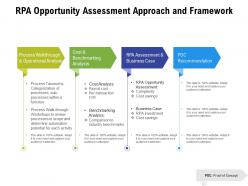
Our RPA Opportunity Assessment Approach And Framework are explicit and effective. They combine clarity and concise expression.
People who downloaded this PowerPoint presentation also viewed the following :
Rpa opportunity assessment approach and framework with all 2 slides:
Give your audience a fulfilling experience. They will find our RPA Opportunity Assessment Approach And Framework elevating.

FAQs for Rpa opportunity assessment
Key business processes ripe for RPA implementation include data entry and validation, invoice processing, customer onboarding, report generation, and inventory management across departments. These repetitive, rule-based activities typically consume significant manual effort in sectors like banking, healthcare, and retail, with many organizations finding that automating these processes reduces operational costs by 25-40% while improving accuracy and employee satisfaction.
Determining automation feasibility involves analyzing process complexity, data standardization, transaction volumes, regulatory requirements, and existing technology infrastructure across departments. Organizations typically find that finance and HR departments offer high automation potential through invoice processing and employee onboarding, while customer service and operations benefit from streamlined workflows, ultimately delivering cost reduction and enhanced operational efficiency.
Key ROI metrics for RPA projects include cost savings through labor reduction, processing time improvements, error reduction rates, compliance enhancement, and scalability potential. Financial services and manufacturing organizations typically measure cycle time decreases, transaction volume increases, and operational cost reductions, with many finding that combining these quantitative metrics with qualitative benefits like employee satisfaction ultimately delivers comprehensive ROI visibility.
Organizations can assess RPA readiness by evaluating their current IT infrastructure compatibility, data quality standards, process documentation maturity, and existing automation capabilities alongside available technical talent and change management resources. Through comprehensive readiness audits, companies across manufacturing, finance, and healthcare identify infrastructure gaps, skill requirements, and training needs, ultimately enabling strategic implementation planning that maximizes automation success while minimizing operational disruption.
Common pitfalls in RPA opportunity assessments include overestimating automation potential, underestimating process complexity, ignoring change management requirements, and focusing solely on cost reduction rather than strategic value. These challenges can be avoided by conducting thorough process mapping, engaging stakeholders early, prioritizing high-volume repetitive tasks with clear rules, and establishing realistic timelines with pilot programs that demonstrate measurable outcomes before full-scale implementation.
Varying digital maturity levels require tailored RPA implementation strategies, with advanced departments enabling complex automation while less mature areas need foundational system upgrades and change management support. Organizations typically adopt phased approaches, starting with digitally ready departments like finance or HR for quick wins, then gradually expanding to manufacturing or customer service departments, ultimately creating standardized processes and shared learning that accelerates enterprise-wide digital transformation.
Employee training plays a critical role in RPA deployment by ensuring smooth adoption, minimizing resistance to change, and maximizing operational efficiency. Through comprehensive upskilling programs, organizations enable their workforce to collaborate effectively with automated systems, manage exceptions, and focus on higher-value tasks, ultimately delivering enhanced productivity and sustained competitive advantage.
Organizations can prioritize automation by evaluating processes based on volume, rule-based nature, frequency, error rates, and strategic value to business outcomes. Through comprehensive process mapping and ROI analysis, companies across manufacturing, finance, and healthcare identify high-impact candidates like invoice processing, data entry, and customer onboarding, ultimately delivering faster implementation timelines and measurable efficiency gains.
RPA opportunity assessment tools include process mining software like Celonis, automation platforms with built-in analytics such as UiPath Process Mining, Microsoft Power Automate insights, and frameworks like Blue Prism's ROM methodology. These technologies streamline identification by analyzing workflow data, measuring task complexity, and calculating ROI potential, with many organizations finding that comprehensive assessments reduce implementation risks while maximizing automation returns.
Stakeholder input enhances RPA opportunity assessment by providing comprehensive process insights, identifying pain points, uncovering automation priorities, and revealing operational bottlenecks across departments. Through collaborative workshops and structured interviews, organizations streamline assessment accuracy, minimize implementation risks, and ensure strategic alignment, with many finding that cross-functional perspectives ultimately deliver higher ROI and sustainable automation success.
Regulatory compliance implications include data privacy requirements, audit trail maintenance, process standardization mandates, risk management protocols, and documentation standards. While compliance presents implementation challenges, it also drives strategic RPA adoption by automating regulatory reporting, ensuring consistent adherence, and reducing human error risks, with financial services and healthcare organizations finding significant operational efficiency gains.
Customer satisfaction and user experience significantly influence RPA opportunity evaluations by identifying processes that directly impact customer interactions, response times, and service quality. Organizations prioritize automating customer-facing activities like order processing, account inquiries, and support ticket resolution, with many financial services and retail companies finding that streamlined operations deliver faster response times, reduced errors, and enhanced customer experiences, ultimately creating competitive advantage.
Change management strategy is crucial during RPA opportunity assessments because it addresses employee concerns, ensures smooth technology adoption, and maximizes implementation success rates. This strategic combination enables organizations to identify not only technical automation opportunities but also cultural readiness factors, ultimately delivering higher ROI and sustainable transformation across departments.
Organizations measure post-RPA success through key performance indicators like processing time reduction, error rate decreases, cost savings per process, and employee productivity improvements. These metrics enable data-driven future assessments, with many companies finding that successful automation in areas like invoice processing or customer onboarding provides blueprints for identifying similar high-impact opportunities across departments.
Industry-specific regulations significantly shape RPA opportunities by creating both compliance requirements and automation potential across sectors like healthcare, financial services, and manufacturing. While heavily regulated industries like banking and pharmaceuticals face stricter implementation constraints, they also benefit from RPA's ability to ensure consistent regulatory adherence, reduce human error in compliance processes, and maintain detailed audit trails, ultimately delivering enhanced operational efficiency and reduced regulatory risk.
No Reviews