


RPA Workflow Powerpoint Ppt Template Bundles





Try Before you Buy Download Free Sample Product
 Impress Your
 Audience
 100%
100% Editable
 Save Hours
 of Time


Our RPA Workflow Powerpoint Ppt Template Bundles are topically designed to provide an attractive backdrop to any subject. Use them to look like a presentation pro.
People who downloaded this PowerPoint presentation also viewed the following :
RPA Workflow Powerpoint Ppt Template Bundles with all 22 slides:
Use our RPA Workflow Powerpoint Ppt Template Bundles to effectively help you save your valuable time. They are readymade to fit into any presentation structure.


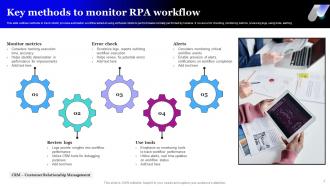

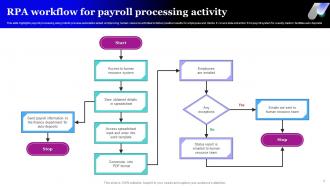
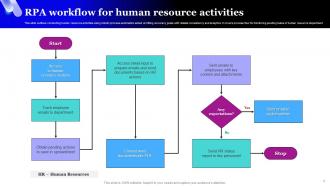

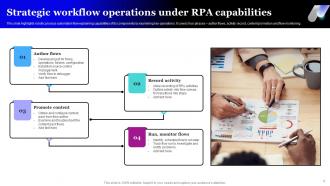









FAQs for RPA Workflow Powerpoint
**INPUT**: What are the key components of an effective RPA workflow template? **OUTPUT**: Effective RPA workflow templates include process mapping, trigger definitions, decision logic, exception handling protocols, and validation checkpoints. These components streamline automation by establishing clear execution paths, minimizing errors, and ensuring consistent outcomes, with many organizations finding that well-structured templates accelerate deployment while enhancing operational efficiency across departments. [Word count: 51 words]
Businesses can identify ideal RPA processes by evaluating rule-based tasks, high transaction volumes, minimal human judgment requirements, and standardized data inputs. Manufacturing companies automate inventory tracking, while financial institutions streamline loan processing and compliance reporting, with many organizations finding that processes involving repetitive data entry, predictable outcomes, and clear business rules deliver the highest ROI and operational efficiency gains.
Documentation serves as the foundation for RPA workflow templates by capturing process steps, business rules, exception handling procedures, and system integration requirements. Comprehensive documentation enables developers to create accurate templates, facilitates easier maintenance and updates, and ensures knowledge transfer across teams, with many organizations finding that well-documented workflows reduce development time and improve template reusability.
RPA workflow templates ensure compliance by embedding predefined regulatory rules, automated audit trails, and standardized approval processes directly into automated workflows. These templates enable organizations across banking, healthcare, and manufacturing to maintain consistent regulatory adherence, reduce human error, and generate comprehensive documentation, ultimately delivering enhanced transparency and significantly lower compliance risks.
Common challenges when designing RPA workflow templates include handling exceptions and error scenarios, managing dynamic data variations, ensuring scalability across different systems, and maintaining template flexibility for diverse use cases. These complexities require careful planning around data validation, system integrations, and user access controls, with many organizations finding that iterative testing and stakeholder collaboration ultimately streamline template effectiveness and adoption.
Organizations measure RPA workflow template effectiveness through key performance indicators like processing time reduction, error rate decreases, cost savings per transaction, and employee productivity improvements. Financial services and healthcare institutions typically track metrics such as transaction throughput, compliance accuracy, and resource allocation efficiency, with many finding that comprehensive analytics dashboards ultimately deliver measurable ROI and operational transparency.
When customizing RPA workflow templates for specific industries, consider regulatory compliance requirements, data security protocols, integration capabilities with existing systems, scalability needs, and industry-specific process variations. Financial services require stringent audit trails, healthcare demands HIPAA compliance, and manufacturing needs real-time production integration, with organizations finding that tailored templates deliver faster deployment and improved operational efficiency.
RPA workflow templates integrate with existing IT systems through APIs, database connections, screen scraping technologies, web service protocols, and middleware platforms. These templates enable seamless data exchange between legacy systems, cloud applications, and enterprise software, with many organizations finding that proper integration streamlines operations, reduces manual handoffs, and delivers enhanced system interoperability across their entire technology infrastructure.
Organizations should follow standardized documentation protocols, modular design principles, comprehensive error handling mechanisms, scalable architecture frameworks, and rigorous testing procedures when developing RPA workflow templates. These practices streamline deployment across departments, enhance maintainability through reusable components, and minimize operational disruptions, with many enterprises finding that well-structured templates reduce development time by 40-60% while ensuring consistent automation quality.
RPA workflow templates improve employee productivity by automating repetitive tasks, reducing manual errors, and enabling faster process completion, while freeing staff to focus on strategic, creative work that enhances job satisfaction. Through standardized automation frameworks, organizations streamline operations, minimize training time, and deliver consistent results, with many companies finding that employees become more engaged when handling higher-value activities rather than mundane tasks.
RPA workflow templates must address data encryption, access controls, audit trails, credential management, and compliance frameworks to protect sensitive information. These security measures streamline operations by ensuring regulatory adherence, minimizing breach risks, and maintaining customer trust, with many financial institutions and healthcare organizations finding that robust security protocols ultimately deliver competitive advantage while enabling scalable automation.
RPA workflow templates should be reviewed quarterly and updated whenever business processes change, regulatory requirements shift, or system integrations are modified. Through regular assessments, organizations in banking, healthcare, and manufacturing maintain optimal automation efficiency, minimize errors, and ensure compliance, while proactive updates deliver sustained competitive advantage and operational excellence.
RPA workflow templates support scalability by providing standardized, reusable automation frameworks that can be rapidly deployed across multiple departments, processes, and geographic locations. These templates enable organizations to maintain consistency while expanding operations, reduce implementation time from months to weeks, and ensure quality control across scaled processes, with many enterprises finding that template-based approaches deliver faster growth and operational efficiency.
User feedback incorporates into RPA workflow template design through user surveys, performance analytics, error reporting, and continuous iteration cycles. Organizations enhance their automation effectiveness by collecting insights from end-users, monitoring workflow performance metrics, and implementing regular template updates, with many enterprises finding that feedback-driven improvements significantly reduce processing errors and boost user adoption rates.
Successful RPA workflow template implementations include invoice processing at financial institutions, customer onboarding at banks, inventory management in retail, payroll processing across organizations, and claims handling in insurance. These templates streamline operations by reducing processing times, minimizing errors, and enabling 24/7 automation, with many companies achieving 70-80% efficiency gains while reallocating human resources to strategic initiatives.
-
Satisfied with the way SlideTeam resolved my query regarding the right business PPTs that I was having difficulty finding. I found the perfect match with their assistance.
-
Professionally designed slides with color coordinated themes and icons. Perfect for enhancing the style of the presentations.