


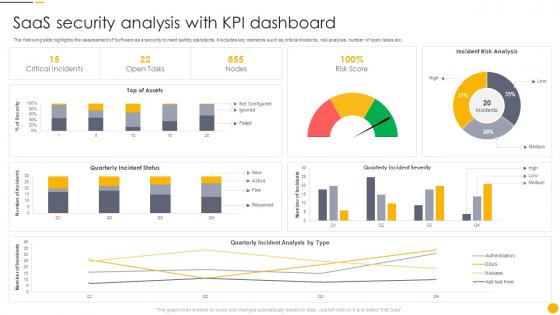
Saas Security Analysis With Kpi Dashboard




Try Before you Buy Download Free Sample Product
 Impress Your
 Audience
 100%
100% Editable
 Save Hours
 of Time


The following slide highlights the assessment of Software as a security to meet safety standards. It includes key elements such as critical incidents, risk analysis, number of open tasks etc.
People who downloaded this PowerPoint presentation also viewed the following :
Saas Security Analysis With Kpi Dashboard with all 7 slides:
Use our Saas Security Analysis With Kpi Dashboard to effectively help you save your valuable time. They are readymade to fit into any presentation structure.





FAQs for Saas Security Analysis
An effective SaaS security analytics framework includes real-time monitoring systems, behavioral analytics engines, threat intelligence integration, automated response mechanisms, and comprehensive audit trails. These components work together by detecting anomalies across user activities, applications, and data flows, enabling organizations to identify potential breaches faster, reduce response times, and maintain regulatory compliance while scaling securely.
SaaS security analytics differs from traditional on-premises solutions by offering cloud-based deployment, automatic updates, scalable infrastructure, and subscription-based pricing models. These cloud-native platforms enable organizations to access advanced threat detection capabilities without significant hardware investments, while delivering faster implementation, seamless integration across distributed environments, and ultimately reducing operational overhead for security teams.
Machine learning enhances SaaS security analytics by enabling automated threat detection, predictive risk assessment, behavioral pattern analysis, and real-time anomaly identification across cloud environments. Through advanced algorithms, organizations can streamline incident response, minimize false positives, and accelerate threat remediation, while delivering proactive security insights that traditional rule-based systems cannot achieve.
Organizations ensure data compliance and privacy in SaaS security analytics through comprehensive data governance frameworks, encryption protocols, access controls, audit trails, and regulatory alignment strategies. These approaches enable seamless compliance with GDPR, HIPAA, and industry standards while maintaining robust security monitoring, with many financial services and healthcare institutions finding that strategic vendor partnerships ultimately deliver enhanced protection and regulatory confidence.
SaaS security analytics tools commonly identify unauthorized access attempts, data exfiltration activities, insider threats, account compromises, and suspicious API usage patterns. These platforms enhance organizational security by detecting anomalous user behaviors, flagging potential compliance violations, and monitoring third-party integrations, with many enterprises finding that proactive threat identification significantly reduces breach risks and strengthens overall data protection strategies.
SaaS security analytics detects insider threats by monitoring user behavior patterns, analyzing access anomalies, and tracking data movement across cloud applications. These platforms leverage machine learning algorithms to identify suspicious activities like unusual file downloads, privilege escalations, and off-hours access, with many organizations finding that automated threat detection significantly reduces response times and minimizes potential data breaches.
Key SaaS security analytics metrics include threat detection rates, mean time to response, false positive percentages, user behavior anomalies, and compliance adherence scores. These measurements enable organizations to streamline incident response, enhance security posture, and minimize operational disruptions, with many financial services and healthcare institutions finding that comprehensive metric tracking ultimately delivers faster threat resolution and improved regulatory compliance.
Third-party integrations significantly expand SaaS attack surfaces by creating additional data access points, authentication pathways, and potential vulnerabilities that require enhanced monitoring and analytics capabilities. These integrations enable comprehensive security visibility across connected applications, with many organizations finding that integrated analytics platforms streamline threat detection, automate compliance reporting, and ultimately deliver faster incident response while maintaining operational efficiency.
SaaS security analytics in multi-cloud environments face challenges including data fragmentation across platforms, inconsistent security policies, complex integration requirements, and limited visibility into cross-cloud activities. Organizations implementing these solutions often encounter difficulties with standardizing monitoring protocols, correlating threat data from diverse cloud providers, and maintaining consistent compliance frameworks, while balancing operational efficiency with comprehensive security coverage across their distributed infrastructure.
Real-time data processing dramatically enhances incident response by enabling immediate threat detection, automated alert generation, faster investigation workflows, and rapid containment measures. Through continuous monitoring and instant analysis, security teams can identify breaches within minutes rather than hours, automatically trigger response protocols, and minimize damage across cloud environments, with many organizations finding that real-time capabilities reduce incident resolution time by up to 75%.
Organizations can utilize SaaS security analytics to enhance cybersecurity through real-time threat detection, automated incident response, comprehensive user behavior monitoring, and integrated compliance reporting. These cloud-based solutions streamline security operations by identifying anomalies faster, reducing manual oversight, and providing centralized visibility across multiple platforms, with many enterprises finding that this approach significantly improves response times while lowering operational costs.
IoT device connectivity significantly expands SaaS security analytics scope by introducing massive data volumes, diverse device vulnerabilities, and complex network interactions that require enhanced monitoring capabilities. These connected environments enable organizations to detect anomalous behaviors across distributed systems while presenting challenges in data integration and threat correlation, ultimately delivering comprehensive security visibility and faster incident response.
Companies ensure SaaS security analytics scalability by selecting cloud-native platforms with elastic infrastructure, implementing modular architectures, establishing automated scaling policies, and choosing vendor-agnostic solutions that integrate seamlessly across environments. These approaches enable organizations to handle growing data volumes, evolving threat landscapes, and expanding user bases, while maintaining consistent performance and cost efficiency as their security requirements mature.
SaaS security analytics visualization best practices include creating real-time dashboards, implementing role-based access views, using heat maps for threat patterns, establishing clear alert hierarchies, and integrating cross-platform data feeds. These approaches streamline threat identification by centralizing disparate security signals, enabling faster incident response, and providing executives with strategic oversight, ultimately delivering enhanced operational security and reduced mean time to resolution.
SaaS security analytics streamlines regulatory compliance audits by automatically collecting, monitoring, and reporting security events, access controls, data handling practices, and user activities across cloud environments. These platforms enable organizations to generate comprehensive audit trails, demonstrate continuous monitoring capabilities, and quickly respond to compliance inquiries, ultimately reducing audit preparation time while ensuring consistent adherence to regulatory frameworks.
-
“I've always gotten excellent slides from them and the customer service is up to the mark.”
-
They had the topic I was looking for in a readymade presentation…helped me meet my deadline.