


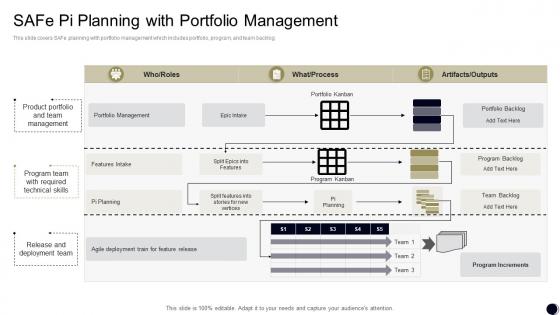
Safe PI Planning With Portfolio Management




Try Before you Buy Download Free Sample Product
 Impress Your
 Audience
 100%
100% Editable
 Save Hours
 of Time


This slide covers SAFe planning with portfolio management which includes portfolio, program, and team backlog
People who downloaded this PowerPoint presentation also viewed the following :
Safe PI Planning With Portfolio Management with all 6 slides:
Use our Safe PI Planning With Portfolio Management to effectively help you save your valuable time. They are readymade to fit into any presentation structure.





FAQs for Safe PI Planning
Key components of a successful PI Planning session include team preparation, clear vision alignment, feature prioritization, dependency mapping, and risk identification. These elements work together by ensuring cross-functional collaboration, establishing realistic commitments, and creating transparent communication channels, with many organizations finding that structured preparation and stakeholder engagement ultimately deliver faster execution and reduced implementation risks.
Teams ensure effective stakeholder engagement during PI Planning through early involvement in pre-planning activities, clear communication of objectives and constraints, and structured feedback sessions throughout the event. By establishing dedicated stakeholder touchpoints, providing real-time visibility into planning progress, and creating collaborative spaces for input and decision-making, organizations streamline alignment while enhancing commitment to program objectives.
Virtual PI Planning sessions benefit from collaborative platforms like Miro or Mural for visual boards, video conferencing tools with breakout rooms, digital estimation tools, and real-time polling software. These technologies streamline remote coordination by enabling simultaneous team interactions, maintaining visual program increment roadmaps, and facilitating cross-team dependencies mapping, with many organizations finding that structured digital workflows ultimately deliver faster alignment and enhanced stakeholder engagement.
Aligning PI Planning with organizational goals improves outcomes by ensuring development efforts directly support strategic priorities, eliminating resource waste on misaligned initiatives, and creating transparent visibility across teams. This strategic alignment enables faster delivery of business-critical features, enhanced cross-functional collaboration, and measurable progress toward company objectives, ultimately delivering improved ROI and competitive advantage.
Common PI Planning challenges include unclear objectives, inadequate preparation, resource conflicts, unrealistic commitments, and poor cross-team coordination. These obstacles can be mitigated by establishing clear business context upfront, conducting thorough pre-planning sessions, and implementing structured dependency mapping, with many organizations finding that dedicated facilitation and realistic capacity planning ultimately deliver more achievable program increments and stronger team alignment.
Feedback loops can be incorporated through retrospectives after each planning session, real-time adjustments during team breakouts, and structured check-ins between planning increments. Many organizations enhance their PI Planning by implementing continuous feedback mechanisms, post-increment reviews, and adaptive planning sessions, ultimately delivering more responsive development cycles and improved team alignment across scaling agile frameworks.
Key PI Planning success metrics include team confidence votes, objective completion rates, dependency identification accuracy, commitment reliability scores, and velocity predictability measures. These metrics enable organizations to assess planning effectiveness by tracking team alignment, delivery predictability, and risk mitigation success, with many enterprises finding that consistent measurement ultimately drives higher program increment success rates and improved cross-team coordination.
Cross-team collaboration enhances PI Planning effectiveness by aligning objectives across departments, identifying dependencies early, and ensuring shared understanding of priorities and constraints. Through integrated planning sessions, teams coordinate deliverables, resolve potential conflicts, and optimize resource allocation, while fostering transparency and collective ownership, ultimately delivering more cohesive solutions and accelerated project outcomes.
Cultural differences impact PI Planning through varying communication styles, decision-making approaches, conflict resolution methods, time orientations, and hierarchy expectations across global teams. These variations can create challenges in consensus building and timeline alignment, while also presenting opportunities for diverse perspectives and innovative solutions, with many organizations finding that structured facilitation and cultural awareness training ultimately enhance collaboration and deliver more comprehensive planning outcomes.
A facilitator guides PI Planning by managing meeting dynamics, ensuring balanced participation, resolving conflicts, and keeping teams focused on objectives while maintaining psychological safety for open dialogue. Through structured agenda management, active listening, and conflict mediation, facilitators enable cross-functional collaboration, streamline decision-making processes, and ultimately deliver aligned planning outcomes that enhance team productivity and organizational efficiency.
Risk management integrates into PI Planning through dedicated risk identification sessions, team risk assessments during breakout planning, and transparent risk boards that track dependencies and impediments. This strategic combination enables teams to proactively address technical debt, resource constraints, and cross-team dependencies, ultimately delivering more predictable outcomes and enhanced program-level visibility.
Best practices for documenting PI Planning decisions include creating real-time digital records, capturing rationale behind scope changes, maintaining accessible decision logs, documenting dependency agreements, and recording risk mitigation strategies. These practices enhance transparency and accountability by ensuring all stakeholders understand commitments made, enabling smoother execution tracking, and providing valuable insights for future planning cycles, ultimately delivering improved predictability and organizational alignment.
Continuous improvement manifests in PI Planning through retrospectives, metrics analysis, team feedback sessions, and iterative refinement of planning processes. Teams systematically evaluate velocity trends, identify bottlenecks, and adjust estimation techniques, with many organizations finding that each planning increment becomes more accurate and efficient, ultimately delivering faster alignment and enhanced predictability across development cycles.
Effective strategies include establishing clear timelines with structured breaks, designating dedicated facilitators for each team, implementing parking lot techniques for off-topic discussions, and maintaining visual progress tracking through digital boards. These approaches streamline collaboration by minimizing distractions, enhancing team engagement, and ensuring objective completion, with many organizations finding that structured facilitation ultimately delivers faster consensus and higher-quality planning outcomes.
Leaders foster safe communication during PI Planning by establishing psychological safety, encouraging diverse perspectives, actively listening without judgment, and creating structured forums for honest feedback. Through transparent dialogue frameworks and empowerment approaches, teams across industries like healthcare and financial services find that open communication ultimately delivers better risk identification, improved collaboration, and enhanced strategic alignment.
-
Helpful product design for delivering presentation.
-
I didn’t expect such a good service for the money I am paying. But, they exceed my expectations. Great work SlideTeam.