


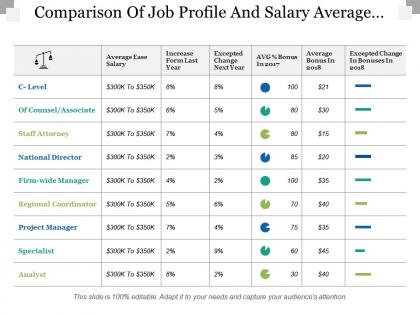
Comparison of job profile and salary average base salary




Try Before you Buy Download Free Sample Product
 Impress Your
 Audience
 100%
100% Editable
 Save Hours
 of Time


Build faith in your buyers with our Comparison Of Job Profile And Salary Average Base Salary. They will believe your goods are classy.
People who downloaded this PowerPoint presentation also viewed the following :
Comparison of job profile and salary average base salary with all 5 slides:
Get your companions to accept your choice with our Comparison Of Job Profile And Salary Average Base Salary. Influence them to express agreement.
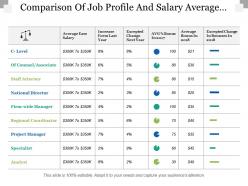




FAQs for Comparison of job profile and salary
Key factors influencing salary differences include industry sector, experience level, geographic location, educational qualifications, and specialized skills demand. These variables work together to create significant compensation variations, with technology and finance roles typically commanding premium salaries, while emerging markets increasingly reward digital expertise, data analytics capabilities, and leadership experience across organizations.
Industry sector significantly impacts salary ranges through market dynamics, revenue potential, and competition for talent, with technology and finance typically offering premium compensation compared to education or nonprofit sectors. For example, a software engineer in Silicon Valley tech companies earns substantially more than similar roles in manufacturing, while financial analysts in investment banking command higher salaries than those in retail banking, ultimately reflecting each sector's profitability and strategic talent priorities.
Geographical location significantly influences salary offers through cost of living variations, local market demand, talent supply, and regional economic conditions. Organizations in major metropolitan areas like San Francisco, New York, or London typically offer higher compensation packages to attract talent, while companies increasingly adopt location-based pay scales that balance competitive positioning with operational efficiency, ultimately enabling strategic resource allocation across diverse markets.
Educational qualifications significantly impact salary expectations by establishing baseline requirements, specialized expertise levels, and career advancement potential across various industries. Higher degrees typically command premium compensation in fields like healthcare, finance, and technology, with many organizations finding that advanced certifications and specialized training directly correlate with enhanced performance capabilities and strategic value delivery.
Experience level can be quantified through years in role, project complexity, team leadership scope, industry certifications, and measurable achievements like revenue impact or cost savings. These metrics provide concrete negotiation leverage, with many professionals finding that documenting specific accomplishments, skill progressions, and increasing responsibilities creates compelling salary discussions that ultimately deliver compensation aligned with demonstrated value and market positioning.
Remote work flexibility, AI automation impact, skills-based compensation models, equity participation growth, and cross-functional role premiums are reshaping tech salary structures significantly. These trends enable companies to access global talent pools, reward specialized expertise like machine learning and cybersecurity, while many organizations finding that flexible compensation packages ultimately deliver competitive advantage in attracting top-tier technical professionals.
Company size significantly influences salary packages through budget capacity, market positioning, and compensation structure complexity. Larger corporations typically offer higher base salaries and comprehensive benefits, while smaller companies may provide equity opportunities, faster advancement, and flexible arrangements, with many professionals finding that mid-sized organizations often deliver the optimal balance between competitive compensation and growth potential.
**INPUT**: What tools and resources can be used for accurate salary benchmarking across industries? **OUTPUT**: Salary benchmarking tools include compensation databases like PayScale and Glassdoor, industry surveys from consulting firms, HR analytics platforms, government labor statistics, and professional association reports. These resources enable organizations to compare compensation across sectors like healthcare, technology, and financial services, ultimately delivering competitive pay structures, improved talent retention, and strategic workforce planning that enhances recruitment effectiveness. [Word count: 60 words]
Employee performance typically correlates with salary increases through merit-based reviews, goal achievement metrics, and skill development milestones, though correlation strength varies significantly across industries and roles. While technical positions like software engineering often see direct performance-to-compensation links, creative roles face more subjective evaluations, with many organizations finding that transparent performance frameworks ultimately deliver better retention and competitive positioning.
Compensation packages beyond salary include health insurance, retirement contributions, stock options, flexible work arrangements, and professional development funding. These benefits enhance employee satisfaction and retention while reducing operational costs, with many organizations finding that comprehensive packages attract top talent, improve productivity, and ultimately deliver competitive advantage in tight labor markets.
Remote work options significantly affect compensation comparisons by introducing geographic pay differentials, cost-of-living adjustments, and varying benefit structures across different locations and companies. While remote roles often offer salary flexibility and reduced overhead costs, they also present challenges in benchmarking against local markets, with many organizations finding that strategic remote compensation models ultimately deliver broader talent access and enhanced employee satisfaction.
Certifications validate specialized skills and industry knowledge, significantly enhancing salary prospects by demonstrating expertise to employers, increasing marketability across sectors, and qualifying professionals for advanced roles. These credentials enable career advancement, command premium compensation, and provide competitive advantage, with many professionals in technology, finance, and healthcare finding that relevant certifications boost earning potential by 10-25%.
Salary negotiation tactics for entry-level positions focus on demonstrating potential, researching market rates, and emphasizing educational qualifications, while senior-level negotiations leverage proven track records, leadership experience, and strategic value delivery. Entry-level candidates typically negotiate base salary and learning opportunities, whereas senior professionals negotiate comprehensive packages including equity, bonuses, and strategic responsibilities, ultimately positioning themselves through measurable achievements and industry expertise.
Salary expectations for niche, high-demand job profiles include data scientists ($95,000-$165,000), cybersecurity specialists ($85,000-$150,000), cloud architects ($120,000-$180,000), AI/ML engineers ($110,000-$170,000), and blockchain developers ($90,000-$160,000). These specialized roles command premium compensation by addressing critical business needs, driving digital transformation initiatives, and delivering competitive advantages, with many organizations finding that strategic investment in these talents ultimately streamlines operations and accelerates growth.
Part-time and freelance roles typically offer higher hourly rates than full-time positions but lack comprehensive benefits, paid time off, and job security that full-time employees receive. While freelancers in fields like consulting, web development, and graphic design can command premium rates for specialized skills, they must account for irregular income streams, self-funded healthcare, and business expenses, with many finding that annual earnings require consistent client acquisition.
-
Best Representation of topics, really appreciable.
-
Best Representation of topics, really appreciable.