

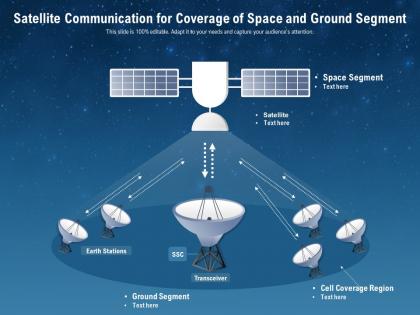
Satellite communication for coverage of space and ground segment




Try Before you Buy Download Free Sample Product
 Impress Your
 Audience
 100%
100% Editable
 Save Hours
 of Time


Our Satellite Communication For Coverage Of Space And Ground Segment are explicit and effective. They combine clarity and concise expression.
People who downloaded this PowerPoint presentation also viewed the following :
Satellite communication for coverage of space and ground segment with all 2 slides:
Give your audience a fulfilling experience. They will find our Satellite Communication For Coverage Of Space And Ground Segment elevating.

FAQs for Satellite communication for coverage of space
So basically satellites are like super high radio towers floating 22,000+ miles up - which is honestly insane when you picture it. Your signal gets beamed up to the satellite, then it amplifies everything and shoots it back down to whoever needs to receive it. Pretty straightforward relay system. The tricky part is dealing with that distance though. Line-of-sight matters big time, and there's always gonna be signal delay because physics doesn't care about your schedule. If you're messing with satcom gear, just build that delay into your expectations from day one.
So basically satellites stay up because there's this constant tug-of-war happening - gravity wants to yank them down while their forward speed keeps trying to fling them into deep space. But tons of stuff screws with that balance. Atmospheric drag is a big one, especially if they're flying low. The moon and sun mess with them too, plus solar wind pressure. Earth's not even a perfect sphere which makes things weird. Most satellites have little thrusters they fire occasionally to correct their path, but eventually they run out of fuel. That's honestly the main reason most missions end - they just can't stay in position anymore.
So there's basically three types you'll run into: GEO, MEO, and LEO satellites. The GEO ones are way up there at 22,236 miles and don't move - that's your standard TV and internet stuff. MEO satellites are lower and handle regional coverage. LEO is where it gets interesting though - Starlink and those guys orbit just a few hundred miles up. You get way better latency with LEO but they need tons more satellites since they're always zipping around. For your project, just think about whether you need global reach or regional is fine, and how much that delay time matters. Oh, and LEO is definitely more expensive to set up initially.
So satellites can reach literally anywhere on Earth - even places where cell towers don't exist. Pretty cool, right? But you'll deal with that annoying delay on calls and way higher costs. Terrestrial stuff like fiber and cell networks are faster and cheaper, just limited to where the infrastructure actually is. Honestly, satellites are clutch for remote operations or when disasters wipe out ground networks. If you're planning something in the middle of nowhere or need solid backup systems, definitely throw satellite into the mix. The coverage is unmatched.
So frequency allocation is like highway lanes - you need your own band so satellites don't interfere with each other. Higher frequencies give more bandwidth but rain screws them up badly. Lower ones are reliable but super crowded these days. The ITU handles coordination globally, which honestly can be a pain, but you've got to apply before launch. My advice? Figure out your frequency needs early because the good spectrum gets grabbed fast. Oh and different bands behave totally differently, so that'll affect your whole system design.
Honestly, satellites can't really fix latency - it's just basic physics. Your data has to travel like 44,000 miles roundtrip to those geostationary ones, so you're stuck with 500-600ms minimum. Ever notice that awkward pause in news interviews from remote locations? Yeah, that's satellite lag. Starlink and other low-orbit ones are way better though - only 20-40ms since they're closer to Earth. If you're building something real-time, design around it. Use UDP instead of TCP when you can, add some prediction stuff, or just be upfront with users about the delay.
Dude, LEO satellites like Starlink are totally changing the game right now. Way less lag since they're actually close to Earth instead of those old-school ones way out in space. Phased array antennas don't need to physically move anymore to track them, which is pretty cool. Plus satellites keep getting smaller and cheaper to launch - honestly feels like we're in some sci-fi movie sometimes. The 5G integration is massive too, you get this hybrid coverage that works everywhere. If you're doing anything remote, definitely check out LEO options. Performance is getting scary close to fiber speeds.
Yeah so rain and snow totally mess with satellite signals - they call it "rain fade." Water basically absorbs and scatters the radio waves traveling between your dish and the satellite. Higher frequencies like Ka-band get hit the worst. I've personally seen 30+ dB signal loss during nasty storms, which honestly sucks. Your options are using lower frequencies if you can, cranking up transmitter power, or getting adaptive coding that adjusts based on signal quality. Site diversity helps too - backup stations in different spots. Most people aim for 99.5% availability and just have automatic failover ready to go.
Oh man, the latency is gonna drive you nuts - your signal bounces all the way to space and back so there's this annoying delay. Weather's brutal too, especially rain and snow which just kills your connection. Remote areas make troubleshooting a nightmare since you can't just call a tech guy. The upfront costs are insane because you need all this specialized gear plus backup power (trust me on this one). When storms hit, you're basically screwed until it passes. I'd definitely go with redundant systems and weatherproof everything you can.
So satellite internet just cuts out all the usual stuff - no need for fiber cables, cell towers, any of that ground-based mess. Just beams straight down from space to your dish. It's perfect for places where regular ISPs would never bother going. Rural Alaska, middle-of-nowhere Africa, disaster areas - you know, anywhere laying cables would cost a fortune or be totally impossible. Starlink and those guys have made it way cheaper than those old clunky satellites too. Honestly, if you're planning any connectivity stuff, you should definitely look at satellite options for the really tough spots. Game changer.
So satellite security has gotten pretty decent - they use encryption to scramble everything during transmission, plus this frequency hopping thing where it constantly switches channels to avoid getting picked up. Beam forming is cool too, it aims signals at specific areas instead of just blasting them everywhere. Anti-jamming tech has improved a lot recently. Ground stations have physical security and regular audits, which helps. But honestly? I'd still assume anything you send could theoretically be intercepted. Better to add your own security layers on top just in case.
Honestly, 5G is making satellite companies pivot hard. They can't compete directly anymore, so they're doubling down on backhaul services and rural areas where 5G towers just don't exist yet. IoT stuff too. The new LEO satellites are actually pretty decent now - way better than those old geostationary ones that felt like you were talking to the moon. Smart operators are building hybrid networks where everything works together. Oh, and if you're doing any satellite planning? Build it to play nice with 5G from the start or you'll regret it later.
Dude, these mega-constellations are crazy - companies like Starlink are launching thousands of satellites into low orbit. Way better than the old geostationary ones that had terrible lag. Remote areas that never had decent internet can finally get broadband, which is huge for work and school opportunities. The redundancy means if some satellites fail, others pick up the slack. Honestly didn't think we'd see this tech so soon. It's gonna force traditional telecom companies to step up their game too, especially in rural spots they've ignored forever.
Oh man, regulatory stuff is such a pain but you can't ignore it. Every country has different rules for satellite projects, plus the ITU handles the international coordination - total bureaucratic nightmare honestly. They control everything: what frequencies you get, orbital positions, ground station permits, the works. Your launch schedule and costs depend entirely on navigating this mess correctly. I learned this the hard way on a project once - we didn't factor in compliance time and it pushed everything back like 8 months. Start dealing with regulators super early or you'll regret it later.
So there's two big issues with satellites - rocket fuel pollution when they launch, and all the dead satellites floating around creating a massive debris field. It's honestly pretty crazy how much junk is up there now. Manufacturing and ground stations also eat up tons of energy. But here's the thing - newer satellites can actually deorbit themselves when they die, which is smart. Some companies are even working on space cleanup tech (sounds like sci-fi but it's real). When you're looking at providers, definitely ask about their disposal plans and what they're doing sustainability-wise.
No Reviews