


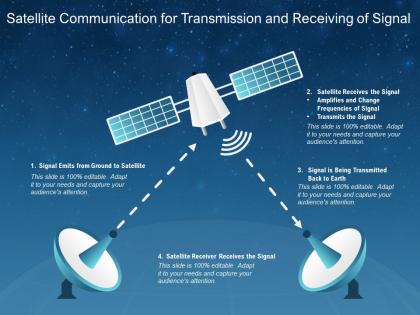
Satellite communication for transmission and receiving of signal




Try Before you Buy Download Free Sample Product
 Impress Your
 Audience
 100%
100% Editable
 Save Hours
 of Time


Our Satellite Communication For Transmission And Receiving Of Signal are explicit and effective. They combine clarity and concise expression.
People who downloaded this PowerPoint presentation also viewed the following :
Satellite communication for transmission and receiving of signal with all 2 slides:
Give your audience a fulfilling experience. They will find our Satellite Communication For Transmission And Receiving Of Signal elevating.

FAQs for Satellite communication for transmission and
So satellites are basically relay stations floating up there - they catch signals from one spot and beam them somewhere else. You've got voice stuff like satellite phones, data transmission for internet and GPS, plus TV and radio broadcasting. They're super useful for covering huge distances or getting to remote places where you can't just run cables everywhere. I mean, you can't exactly string fiber optic cables across the entire Pacific, right? Really though, they're what make true global communication work when regular ground networks just can't reach.
So basically, the higher up your satellite is, the weaker the signal gets but you cover way more area. LEO satellites like Starlink are closer so they have strong signals but smaller footprints - kinda like the difference between a spotlight and a floodlight. MEO and GEO are much farther out so they need way more power, but honestly they can cover entire continents which is pretty cool. Higher orbits also mean more delay though. What's your project focusing on? Strong signals for heavy data stuff, or do you need that wide coverage for monitoring large areas?
So geostationary satellites hang out at 35,786 km above Earth - they stay put over one spot which is pretty cool for coverage, but you get that annoying delay like in news interviews. LEO satellites are way closer at 160-2,000 km, so data's faster and no awkward pauses, but they're zipping around constantly. You'd need a bunch of them working together. Starlink's basically betting everything on LEO right now. Really depends what you need more - rock solid coverage or snappy response times? Both have their place honestly.
Physics is just a pain here - signals literally travel to space and back, so you can't escape latency entirely. Modern systems try to work around it with data compression, buffering, and predictive algorithms though. LEO satellites like Starlink are honestly pretty impressive since they orbit way closer than the old geostationary ones. For LEO you're looking at maybe 20-50ms delay, but traditional satellite tech is much worse. Oh, and definitely build in error correction if you're designing anything - satellite connections can be finicky. Data compression helps squeeze more through too.
So frequency spectrum is like having separate highway lanes for your satellite signals - each frequency handles different data without everything crashing into each other. L-band works great for mobile stuff, C-band is your go-to for reliable long-distance connections, and Ku/Ka-band handles the high-speed internet and TV broadcasts. Higher frequencies give you more bandwidth but honestly, they're kind of wimpy when it rains. Lower ones don't have that problem but you'll get less capacity. Pick based on what you actually need - speed or reliability.
So satellites avoid stepping on each other through frequency coordination - operators basically plan who gets what spectrum where. Orbital spacing is huge too, they maintain specific slots between each other. Power control helps since you only transmit what's needed instead of full blast (honestly saves them money on power costs). Different polarization lets multiple signals share frequencies by orienting them at different angles. Oh and if you're working on a new deployment, coordinate with the ITU early. Trust me, frequency conflicts are way easier to prevent than fix after you've already launched the thing.
Dude, small satellites have totally changed the game. Instead of building one massive satellite that costs a fortune and takes forever, companies can now launch hundreds of tiny ones super quickly. Way cheaper too. SpaceX and Planet Labs are basically shooting these things up every month now - it's kinda nuts how fast this all happened. Coverage is way better since you've got swarms of them instead of just a few big ones. For your stuff, satellite services are actually affordable now. Plus there's tons more backup options if you're doing any remote work or IoT things.
So basically, high-throughput satellites are where it's at now - they use spot beams that can reuse the same frequencies in different areas, kinda like cell towers but way up there. Digital signal processing has gotten crazy good too, plus these new modulation schemes like DVB-S2X pack way more data into the same spectrum. The coolest part though? Software-defined payloads let you actually shift bandwidth around in real-time depending on what people need. Honestly, if you're doing anything satellite-related, I'd start with HTS tech first. It's just so much more efficient than the old stuff.
Dude, weather totally screws with satellite signals more than people realize. Rain and snow absorb the radio waves - they call it "rain fade" but it'll straight up kill your connection during bad storms. Snow's actually worse than rain because of how the ice crystals mess things up. Thick clouds hurt signal strength too, just not as much. Oh, and temperature changes can make your equipment wonky and less sensitive. Honestly learned this the hard way during a camping trip last year. Always check the forecast if you need reliable satellite internet and have a backup plan ready.
Honestly, satellite security is pretty rough. Signal interception is your biggest headache - anyone with decent equipment can listen in since everything's traveling through open space. Jamming attacks are even worse though, they'll kill your whole connection instantly. Authentication gets tricky too because satellites can't always tell real signals from fake ones. Oh, and don't forget ground stations are hackable just like any other network infrastructure. I'd definitely encrypt everything heavily and maybe set up some backup comms just in case. It's wild how exposed satellite links actually are.
Dude, satellites are basically lifesavers when disasters hit. Cell towers get wiped out by hurricanes or earthquakes, right? That's when satellite phones become your only way to reach the outside world. Emergency teams use them to coordinate rescues, and relief groups can actually see damage from space to figure out where help's needed most. They work everywhere too - even in the middle of nowhere. Honestly, any organization doing emergency planning should have satellite backup ready. Trust me, you'll be thanking yourself later when regular networks are toast and you can still communicate.
Satellites are filling gaps where normal internet just can't reach - remote areas, ships, disaster zones, places where running cables would be insane. Starlink and similar companies changed the game with low orbit satellites that actually work pretty well now. Way better than those old slow ones anyway. Coverage can be spotty and storms will mess with your signal, but honestly it's a game changer for people in the middle of nowhere. If you're managing remote teams globally, satellite internet is definitely worth considering these days. Just don't expect fiber-level reliability yet.
So ground station upgrades are seriously worth it - they'll boost your data speeds and cut down latency like crazy. Better antennas and signal processing handle those higher frequencies way better. Software-defined radios are where it's at though, you can just reconfigure everything without swapping hardware. Modern stations can juggle multiple satellites at once too, which is honestly pretty sweet. My advice? Plan your ground station setup early in any satellite project. Trust me, you don't want to be scrambling to fix connectivity issues later when everything else is already locked in.
Ugh, spectrum allocation is gonna be your worst nightmare. You're basically fighting with everyone else for frequency bands, and the approval process drags on forever. Then there's the ITU orbital slot coordination - that's a whole other mess. Plus you'll need licenses in every single country you want to serve, and they all have random rules about foreign ownership and data stuff. Oh, and each place handles encryption differently too which is super fun. Honestly? Start your paperwork like 3 years early and triple whatever you budgeted for lawyers. Trust me on this one.
So satellites are basically becoming 5G's backup plan now. They're filling in those dead zones where cell towers can't reach - or where it'd cost way too much to build them. Low earth orbit satellites have way better latency than the old ones, which honestly makes this whole thing actually work. You've got satellites doing backhaul for remote towers and even connecting directly to phones. It's moving crazy fast. The cool part is you'll finally get real global 5G coverage, especially for all that IoT stuff in the middle of nowhere. Pretty game-changing if you ask me.
No Reviews