


0814 telecommunications satellite network over international gateway ppt slides




Try Before you Buy Download Free Sample Product
 Impress Your
 Audience
 100%
100% Editable
 Save Hours
 of Time


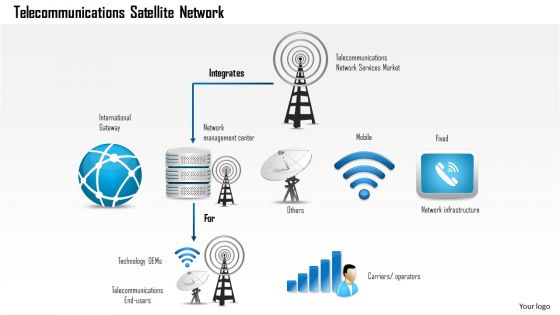
Design an outstanding presentation template using this 0814 Telecommunications Satellite Network over International gateway PPT Slides. The PPT icon discusses the concept of telecommunications, network and satellites with the use of innovative and catchy graphics. It includes an image of globe and other technical or social media images in the slide design. Various signs of telecommunication like satellite, Wifi and other such social media signs make this PPT concept versatile while widening the usage of this design for users. When broadened the concept and design, this telecommunication satellite Network PPT design can also work well in representing the advancement in technical sector. Since technology and internet is the base of every organization, this PPT template can be brought in use for various telecommunication and network related presentations. Additionally the feature of editing and setting the design as per one’s requirement make it even more valuable. Therefore this graphic rich presentation icon is a ready to use design for the presenters and there is surety to win the hearts and minds of viewers with this innovative telecommunication satellite Presentation design. Our 0814 Telecommunications Satellite Network Over International Gateway Ppt Slides are greatly enlightening. Convince them that you are a good guru.
People who downloaded this PowerPoint presentation also viewed the following :
0814 telecommunications satellite network over international gateway ppt slides with all 6 slides:
Figure out the hard facts with our 0814 Telecommunications Satellite Network Over International Gateway Ppt Slides. The actual events will come to the fore.




FAQs for 0814 telecommunications satellite network over international
Telecommunications satellite networks provide voice and data transmission, internet connectivity, broadcasting services, mobile communications, and emergency communications across vast distances. These systems enable global connectivity by relaying signals between ground stations, facilitating international business operations, remote area access, and disaster recovery communications, ultimately delivering seamless worldwide communication capabilities and competitive advantages for organizations operating across multiple regions.
Geostationary satellites orbit at 35,786 kilometers above Earth, providing constant coverage over fixed regions but with higher latency, while low Earth orbit satellites operate at 160-2,000 kilometers, offering lower latency and stronger signals. Telecommunications companies increasingly leverage LEO satellites for real-time applications like video calls and financial trading, while GEO satellites excel in broadcasting and weather monitoring, with many providers combining both for comprehensive global coverage.
Ground stations serve as critical terrestrial interfaces that control satellite operations, transmit and receive data signals, monitor system performance, and manage network traffic routing. These facilities enable telecommunications providers, broadcasting companies, and government agencies to establish reliable global communications, coordinate satellite positioning and orbital adjustments, while ensuring seamless connectivity for internet services, television broadcasts, and emergency communications across remote regions.
The frequency spectrum determines satellite communication quality, capacity, and coverage by dictating signal strength, interference levels, and atmospheric penetration capabilities. Different frequency bands enable specific applications, with C-band supporting reliable long-distance transmissions, Ku-band delivering direct broadcast services, and Ka-band facilitating high-speed internet, ultimately allowing telecommunications providers to optimize network performance and service delivery.
Advancements enhancing satellite network throughput and latency include high-throughput satellites (HTS), Low Earth Orbit (LEO) constellations, advanced beamforming, software-defined networking, and inter-satellite links. These technologies streamline data transmission by reducing signal travel distance, optimizing frequency reuse, and enabling dynamic bandwidth allocation, with telecommunications providers increasingly delivering faster services and improved global connectivity for enterprise communications.
Weather conditions significantly impact telecommunications satellite performance through rain fade, atmospheric absorption, snow accumulation on ground equipment, and ionospheric disturbances that degrade signal quality and transmission reliability. These challenges present both operational considerations and opportunities for enhanced system design, with many telecommunications providers implementing adaptive power control, signal diversity techniques, and advanced weather monitoring to maintain service quality, ultimately delivering more resilient networks and improved customer experiences even during adverse weather events.
Satellite communication networks face cybersecurity threats, signal interception risks, jamming attacks, physical infrastructure vulnerabilities, and authentication complexities across distributed systems. While these challenges require robust encryption protocols, secure ground station operations, and multi-layered defense strategies, telecommunications providers increasingly find that proactive security investments ultimately deliver enhanced network resilience and competitive advantage.
Satellite networks integrate with terrestrial systems through ground stations, gateways, and hybrid infrastructure that seamlessly route data between space and earth-based networks. This strategic combination enables telecommunications providers to extend coverage to remote areas, enhance network redundancy, and deliver uninterrupted connectivity, with many operators finding that integrated approaches significantly reduce infrastructure costs while improving service reliability.
Environmental impacts include rocket emissions contributing to atmospheric pollution, space debris from defunct satellites, radio frequency interference with wildlife, and carbon footprints from ground infrastructure and manufacturing processes. While these challenges are significant, many telecommunications companies are increasingly adopting sustainable practices like reusable launch vehicles, satellite deorbiting protocols, and renewable energy for ground stations, ultimately balancing connectivity needs with environmental responsibility.
Regulatory frameworks for satellite operations vary significantly across regions, with differences in spectrum allocation, licensing requirements, orbital coordination procedures, and compliance standards. While the US emphasizes commercial flexibility through the FCC, Europe prioritizes harmonized standards via ETSI, and developing nations often focus on technology transfer requirements, ultimately creating complex compliance landscapes that satellite operators must navigate strategically.
Satellite constellations enable unprecedented global internet coverage by providing broadband access to remote areas, reducing latency through low Earth orbit positioning, and creating redundant network pathways for enhanced reliability. These networks revolutionize connectivity for rural communities, maritime operations, and developing regions, while delivering competitive alternatives to traditional ISPs and ultimately bridging the digital divide across underserved markets worldwide.
Satellite networks provide critical disaster recovery support by bypassing damaged terrestrial infrastructure, enabling rapid deployment of emergency communications, and delivering connectivity to remote affected areas. During natural disasters, emergency responders, hospitals, and government agencies rely on satellite links to coordinate rescue operations, maintain command centers, and restore essential services, ultimately ensuring public safety when traditional networks fail.
Innovations driving smaller, cost-effective satellites include miniaturized electronics, advanced materials, standardized CubeSat platforms, commercial launch services, and software-defined radio technologies. These advancements enable telecommunications companies, government agencies, and startups to deploy constellation networks more affordably, reducing mission costs by up to 90% while delivering faster global connectivity and enhanced coverage capabilities.
Telecommunications satellites facilitate broadcasting and media distribution by receiving signals from ground stations, amplifying them, and retransmitting to wide geographic areas simultaneously. Through geostationary positioning and powerful transponders, broadcasters can deliver television programming, radio content, and digital media to millions of viewers across continents, while significantly reducing distribution costs and enabling real-time global communications.
Future trends for telecommunications satellite networks include Low Earth Orbit (LEO) constellations, 5G integration, enhanced broadband coverage, AI-powered network management, and inter-satellite laser communications. These technologies streamline global connectivity by reducing latency, expanding rural access, and automating operations, with many telecommunications providers finding that strategic satellite deployment ultimately delivers competitive advantage in increasingly connected markets.
-
Excellent template with unique design.
-
Perfect template with attractive color combination.