


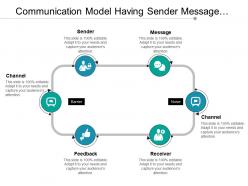
Communication model having sender message channel and receiver





Try Before you Buy Download Free Sample Product
 Impress Your
 Audience
 100%
100% Editable
 Save Hours
 of Time


Guests are grateful for your attention due to our Communication Model Having Sender Message Channel And Receiver. They definitely feel duly honored.
People who downloaded this PowerPoint presentation also viewed the following :
Communication model having sender message channel and receiver with all 5 slides:
Discover a new you with our Communication Model Having Sender Message Channel And Receiver. They will help you hone your talents.



FAQs for Communication model having sender message
Key components of a communication model include sender, message, encoding, channel, receiver, decoding, feedback, and noise. These elements work together by establishing clear message transmission pathways, enabling effective information exchange, and minimizing communication barriers, with many organizations finding that understanding these components significantly enhances their internal communications, customer interactions, and ultimately delivers improved operational efficiency.
Noise disrupts message clarity by introducing distractions, technical interference, or misunderstandings, while feedback enables continuous improvement by allowing senders to gauge reception and adjust their approach accordingly. Organizations leveraging structured feedback mechanisms, particularly in customer service, team collaboration, and training programs, find they significantly enhance message accuracy, reduce miscommunication costs, and ultimately deliver more effective stakeholder engagement.
Cultural differences influence communication models through varying directness levels, nonverbal interpretation, hierarchy respect, context dependence, and time orientation approaches. These variations significantly impact business interactions, with organizations in multicultural environments finding that adapting communication strategies enhances cross-cultural collaboration, reduces misunderstandings, and ultimately delivers more effective global partnerships and competitive advantage.
Linear communication models follow a one-way path from sender to receiver through channels with minimal feedback, while interactive models emphasize two-way exchanges with continuous feedback loops, shared meaning creation, and dynamic role switching. Interactive approaches enable more effective organizational communication, enhanced customer relationships, and improved team collaboration, with many businesses finding that bidirectional communication ultimately delivers stronger engagement and competitive advantage.
Communication models apply to digital platforms by establishing clear sender-receiver pathways, feedback mechanisms, and noise reduction protocols across email, social media, and messaging systems. These frameworks enhance user engagement, streamline information flow, and minimize miscommunication barriers, with organizations like banks and hospitals finding that structured digital communication models ultimately deliver faster response times and improved customer experiences.
Context significantly influences communication models by determining message interpretation, channel selection, cultural considerations, timing factors, and environmental constraints. Different contexts, such as corporate boardrooms versus informal team meetings, require adapted communication approaches that account for hierarchical structures, cultural norms, and situational demands, ultimately enabling more effective message delivery and stakeholder engagement.
Understanding communication models improves workplace collaboration by identifying potential barriers, clarifying message flow, and establishing feedback loops that ensure mutual understanding. Through structured communication frameworks, teams streamline information sharing, reduce misunderstandings, and enhance decision-making processes, with many organizations finding that deliberate communication strategies ultimately deliver faster project completion and stronger cross-departmental relationships.
Traditional communication models face significant limitations including linear information flow, lack of real-time feedback mechanisms, limited multimedia integration, reduced personalization capabilities, and insufficient data analytics features. While these models served organizations well historically, they struggle with today's demand for instant engagement, cross-platform consistency, and measurable outcomes, with many businesses finding that outdated approaches hinder customer experiences and competitive positioning.
Communication models adapt to each field's specific requirements, with marketing emphasizing persuasion and brand messaging, healthcare focusing on accuracy and patient comprehension, and education prioritizing knowledge transfer and engagement. While marketing models leverage emotional appeals and targeted segmentation, healthcare relies on clear protocols and feedback loops, and education incorporates interactive elements, ultimately delivering field-specific outcomes that enhance effectiveness.
Sender-receiver relationships form the foundation of effective communication by establishing mutual understanding, trust, and message clarity between parties. Strong relationships enable more accurate message encoding and decoding, reduce communication barriers, and enhance feedback quality, with many organizations finding that investing in these interpersonal dynamics significantly improves collaboration, reduces misunderstandings, and ultimately delivers better business outcomes.
Visualization techniques enhance communication model understanding by transforming abstract concepts into clear diagrams, flowcharts, and interactive representations that illustrate sender-receiver relationships, feedback loops, and message flow patterns. Through visual mapping, organizations streamline training processes, improve team comprehension of communication channels, and enable faster knowledge transfer, with many businesses finding that visual communication frameworks ultimately deliver enhanced collaboration and reduced miscommunication across departments.
Effective communication models include Toyota's lean manufacturing feedback loops, Apple's streamlined product launch messaging, Southwest Airlines' transparent customer communications, and Microsoft's cross-functional team collaboration frameworks. These approaches enhance operational efficiency by establishing clear channels, reducing information silos, and ensuring consistent messaging, with many organizations finding that structured communication models ultimately deliver faster decision-making and improved stakeholder alignment.
Interpersonal communication theories integrate into established models by emphasizing relational dynamics, feedback loops, and contextual factors that influence message exchange between individuals. These theories enhance traditional linear models with concepts like empathy, trust-building, and emotional intelligence, enabling organizations to improve team collaboration, customer relationships, and internal communications, ultimately delivering stronger workplace culture and more effective business outcomes.
Communication models contribute to conflict resolution by identifying communication barriers, clarifying message transmission processes, providing feedback mechanisms, analyzing nonverbal cues, and establishing structured dialogue frameworks. Through systematic communication analysis, organizations can streamline conflict mediation, enhance stakeholder understanding, and minimize misinterpretation risks, with many HR departments and legal teams finding that structured communication approaches ultimately deliver faster resolutions and improved workplace relationships.
**INPUT**: What emerging technologies are influencing the evolution of communication models? **OUTPUT**: Emerging technologies reshaping communication models include artificial intelligence, 5G networks, augmented reality, blockchain, and Internet of Things devices. These innovations streamline organizational communication by enabling real-time data sharing, immersive virtual collaboration, and automated messaging workflows, with many enterprises finding that integrated communication platforms ultimately deliver faster decision-making and enhanced operational efficiency. **Word count: 55 words**
-
Use of different colors is good. It's simple and attractive.
-
Top Quality presentations that are easily editable.