


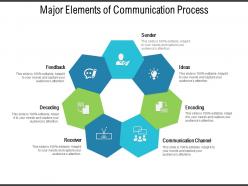
Major elements of communication process





Try Before you Buy Download Free Sample Product
 Impress Your
 Audience
 100%
100% Editable
 Save Hours
 of Time


Change the game with our Major Elements Of Communication Process. Gain control with your fresh approach.
People who downloaded this PowerPoint presentation also viewed the following :
Major elements of communication process with all 5 slides:
Get the correct context with our Major Elements Of Communication Process. They will accurately establish the background.

FAQs for Major elements
So there's five main parts: sender, message, channel, receiver, and feedback. Oh, and noise that screws everything up. Basically you encode your idea into a message, pick how to send it (text, call, whatever), then they decode what you meant. Feedback tells you if it actually worked. Most problems happen because people just assume their message was clear instead of checking. I learned this the hard way at work - now I always ask "make sense?" or watch for confused looks. Communication's weird because we think we're being obvious but half the time we're not.
Feedback tells you if your message actually got through or if you're just talking to a wall. You know how sometimes you explain something and get blank stares back? That's why you need people to respond - even just a nod or "wait, so you mean..." Without it, you're basically shouting into the void. When someone asks questions or repeats back what they heard, you can catch miscommunications right away. Then you can fix it or try explaining differently. Honestly, most meetings would be way more productive if people actually checked whether anyone understood them instead of just rambling on.
Dude, non-verbal stuff is HUGE - like 55% of communication. Your body language can totally contradict what you're saying without you realizing it. Say "great job" while crossing your arms? Sounds sarcastic as hell. People trust what they see over what they hear, which honestly makes sense when you think about it. Your facial expressions, tone, even how you're standing all send messages. I learned this the hard way in meetings where I thought I was being supportive but apparently looked bored out of my mind. Just something to watch out for!
Oh man, this is so true! Different cultures have completely opposite communication styles. Like, Americans usually want you to get straight to the point, but in other places that's actually considered super rude - they expect more small talk and relationship stuff first. I've definitely bombed a few work calls because of this lol. High-context vs low-context is huge too. Plus timing and even when you stay quiet can mean totally different things. Honestly, I just started asking people upfront how they prefer to communicate. Saves so much awkwardness.
Active listening is what makes communication actually work. You're not just waiting for your turn to talk (guilty as charged lol). Focus completely on understanding what they're saying. Ask questions when something's unclear. Give feedback that shows you actually get their point. This creates a back-and-forth where everyone feels heard. Honestly, most people are terrible at this - they're already planning their response while the other person is mid-sentence. Try paraphrasing back what you heard. It's seriously a game-changer for avoiding those annoying miscommunications that spiral into bigger problems.
Technology's honestly a mixed bag for workplace communication. Sure, Slack and video calls make everything faster and break down those annoying department barriers. But man, the notification overload is real - I swear some people live in their inbox! Face-to-face conversations still matter way more than most companies realize. My advice? Pick your tools deliberately. Don't let every random thought become a Slack message. Set actual boundaries around when you'll respond to stuff, and match the communication method to what you're actually trying to say.
Ok so first thing - lead with your main point, don't bury it. Break stuff up with short paragraphs and bullets because walls of text are brutal. Write how you'd actually talk to someone, skip the fancy words that make people's brains hurt. I swear half the business writing I see is just showing off vocabulary nobody asked for. Mix up your sentence lengths, use active voice, and definitely read it out loud before hitting send. If you trip over words reading it, they will too. Oh and here's what helps me - figure out the ONE thing you want them to walk away with and hammer that home.
Honestly, emotional intelligence is like having a superpower in conversations. You pick up on what people are actually feeling - not just their words. So you won't make jokes when your coworker's freaking out about deadlines, you know? It makes conflict way easier too because you can see what's really bothering someone underneath all the surface stuff. People end up trusting you more when they feel like you actually get them. Oh, and body language is huge - I started watching for that in meetings and it totally changed how I talk to people. Game changer.
Dude, context changes everything. Same exact words hit completely different depending on the situation. Like texting "Fine" to your partner vs your boss - totally different vibes, right? Your relationship with someone, the timing, where you are, cultural stuff - it all affects how people read your message. I learned this the hard way once lol. Without thinking about context first, you're basically rolling the dice on miscommunication. People might get offended or miss your point entirely. Just take a sec to consider the whole picture before you say something.
Honestly, visuals are like a safety net for your presentation. They back up what you're saying while helping people actually remember stuff later. Different people learn differently, right? Some need to see charts or diagrams to get complex ideas. I mean, even a quick sketch beats trying to explain everything through words alone. Your audience will zone out without something to look at - attention spans are pretty terrible these days. Oh, and don't overthink it! Simple visuals work way better than cramming slides with tons of text. Just pair your main points with basic charts or images and you'll be golden.
Honestly, most communication fails because of noise - could be actual noise or just mental distractions. People also make assumptions about what others already know, which is a huge mistake. Emotional stuff gets in the way too. Cultural differences? Way more common than you'd expect, even between coworkers. Best fix is actually listening and asking questions instead of just hoping your message got through. Pick the right way to communicate - sometimes a quick call beats a long email. Oh, and timing matters! Create an environment where people won't feel stupid for saying "wait, I'm confused" because that's when real understanding happens.
Honestly, team dynamics are everything when it comes to communication. If people feel safe speaking up, you'll get real conversations and actual listening. But toxic teams? Forget it - info gets twisted or people just clam up completely. Power stuff is tricky too because junior people won't challenge anything even when they should. Trust makes a huge difference in whether people believe what you're saying or side-eye every word. Oh and whatever "rules" your team has - like going through the boss for everything or constant interrupting - that shapes how every conversation goes. Just keep an eye on these patterns before they become problems.
Oh dude, communication training is actually pretty solid. You'll get way better at listening instead of just waiting for your turn to talk. Plus learning to read body language helps tons - especially with those coworkers who say "fine" but clearly aren't fine lol. The conflict stuff they teach is clutch too. Most people notice they're less awkward in meetings pretty quick. Honestly though, I'd just start with an active listening workshop first since everything else kinda builds from there. Way less overwhelming than jumping into the deep end.
Use the SBI thing - Situation, Behavior, Impact. Describe what happened, what you saw them do, then how it affected everyone. Don't attack their personality. Say "you interrupted me three times" not "you're so rude." Timing's everything though. Wait until you're both chill and find somewhere private. I always ask first like "hey, can we talk about the meeting earlier?" Then get specific about what you actually witnessed. Here's the thing - people get way less defensive when you collaborate on fixing it together instead of just dumping criticism on them.
Formal stuff = protocols, agendas, official channels. You're following structure and everything gets documented. Informal is totally different - way more relaxed and spontaneous. Honestly, some of my best ideas come from random coffee chats where people interrupt each other and go off topic. Feedback happens faster when it's casual too. The trick is reading the room and switching your style. Don't bring that chill energy to a board meeting, but also don't sound like you're giving a presentation when you're just grabbing lunch with your team.
No Reviews