


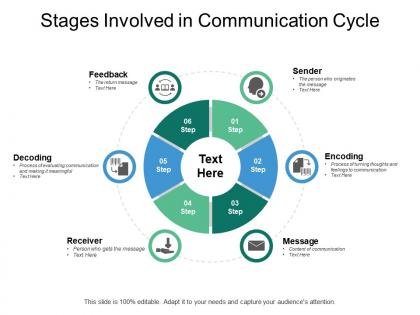
Stages involved in communication cycle




Try Before you Buy Download Free Sample Product
 Impress Your
 Audience
 100%
100% Editable
 Save Hours
 of Time


Give them the desired inputs with our Stages Involved In Communication Cycle. Ensure access to critical information.
People who downloaded this PowerPoint presentation also viewed the following :
Stages involved in communication cycle with all 5 slides:
Ensure access to critical information with our Stages Involved In Communication Cycle. Give them the desired inputs.

FAQs for Stages involved
Okay so there's basically six parts to how communication works: you've got the sender, encoding, message, channel, receiver, and decoding. Oh and feedback too - which honestly everyone sleeps on but it's clutch. Here's the flow: you start with an idea, turn it into words or whatever, pick how to send it (text, talking, smoke signals lol), then they decode what you actually meant. Feedback brings it full circle. When you're trying to get something across, just think - am I being clear enough? And actually listen to their response instead of just waiting for your turn to talk.
Okay so feedback is basically how you know if people actually get what you're saying. Like when someone responds with "got it" or asks questions, you can tell if your message made sense or if they're totally confused. It's your reality check - otherwise you're just talking and hoping something sticks, which honestly never works out well. The trick is giving people room to actually respond instead of just steamrolling through everything. Then you gotta listen to what they tell you back. Without that back-and-forth, conversations go nowhere fast.
Honestly, it's usually noise - either actual noise or just cluttered messaging. Plus people make assumptions about what you already know, which is super annoying. If someone's stressed or distracted, good luck getting through to them at all. Language barriers mess things up, cultural stuff gets lost in translation, and tech always finds a way to fail at the worst moment. Multitasking during conversations? Don't even get me started on that one. When you feel like you're talking past each other, just stop and ask "what did you hear me say?" Sounds simple but it'll blow your mind how often that fixes everything.
Honestly, once I figured out the communication cycle thing, my presentations got so much better. You're basically creating actual conversation instead of just rambling at people - which I definitely used to do way too much! The trick is building in feedback moments every 5-7 minutes. Could be polls, Q&A, or just watching faces to see if everyone looks confused. Then you adjust based on what you're seeing. Makes everything way more interactive. I mean, nobody wants to sit through someone's monologue, right? Real-time adjustments keep people engaged and the whole thing becomes memorable.
Three things that actually work: get specific instead of being vague, organize your thoughts before you speak, and talk to people the way they want to be talked to. I swear, half the office just throws around meaningless buzzwords that sound important but say nothing. Keep it simple when you can. Give context up front so people aren't lost. Visual stuff helps too if it's complicated. But here's the real test - watch their faces or just ask "make sense?" Because honestly, if they look confused, your message didn't land.
Okay so here's the thing - your body language and tone are constantly sending messages, even when you're not thinking about it. People actually trust what they see over what you say when there's a disconnect, which is kinda wild if you think about it. This affects how you present your message, what actually comes across, and how they interpret everything. Short version: if your face says one thing but your words say another, you've basically created static that messes up the whole conversation. Just be aware of what your body's doing while you talk!
Honestly, cultural stuff can totally derail communication at every step. When you're crafting a message, your own cultural background shapes whether you're direct or beat around the bush. Then there's channel choice - some cultures expect face-to-face convos while others are fine with quick emails. But decoding is where it gets messy. People filter everything through their cultural lens, so your tone or meaning might land completely wrong. Oh, and feedback styles? They're all over the map depending on where someone's from. I learned this the hard way once! Just think about who you're talking to before you send anything - your style won't work for everyone.
Okay so active listening is literally what makes communication actually work instead of just two people talking past each other. You know how sometimes you're just waiting for your turn to speak? Don't do that lol. Instead, really focus on what they're saying - their tone, body language, the whole thing. Then reflect back what you heard before jumping into your response. It creates this natural flow where you're actually having a conversation instead of just... idk, taking turns making speeches? Honestly it's such a game changer once you start doing it consistently.
Honestly, tech can be a game-changer for communication or completely mess it up. Video calls and messaging apps make feedback way faster - you can clear up confusion right away. But here's where people screw up: they pick the wrong tool for the job. Like trying to explain something complicated over text? Bad idea. Poor connection quality doesn't help either. Oh, and don't get me started on notification overload - so distracting. You've got to match your tech choice to what you're actually trying to say and who you're talking to. Makes all the difference.
Honestly, just keep your eyes open and be ready to pivot. Confused faces or people asking "wait, what?" means you're going too fast - slow down and throw in more examples. Phone checking is the worst... that's when I usually ask someone a direct question to snap everyone back. Works every time. Break big concepts into bite-sized pieces if they look overwhelmed. But if they're nodding along easily, speed things up or go deeper. I've bombed way too many presentations by just plowing through my script instead of actually watching people's reactions. Stay flexible!
Context is basically everything when you communicate. It affects what words you pick, how formal you sound, even which method you use - like obviously you wouldn't text your boss terrible news lol. Your audience filters everything through their own context too. Their mood that day, what happened earlier, where they are. I swear people forget this part. Feedback works the same way - context colors how they respond. Before you send anything, just think about the whole situation first. What's really going on here?
Good communication happens constantly at work, but most people miss it. Project meetings are perfect examples - managers explain goals, team members ask questions, then everyone confirms what they're doing next. Customer service reps do this too when they repeat back your complaint and check if their solution actually works. I've noticed even basic emails work way better when you confirm you got someone's message instead of just sending stuff and hoping. The whole point is making sure your message actually landed, not just that you hit send.
Dude, visuals are a game changer. Your brain processes what it sees and hears at the same time, so info sticks way better. I learned this the hard way after boring people to death with text-heavy slides lol. You can also read the room better - if someone looks lost, you'll catch it immediately and pivot. The trick is keeping visuals simple though. Don't make people choose between reading your slide or listening to you. I always do this quick test: can someone get the main point in like 3 seconds? If not, it's too cluttered.
Honestly, just start with response times - see how fast people actually get back to you. Then check if they really understood by asking follow-up questions or doing quick surveys. You'll be shocked how many people nod along but have no clue what you meant! Also track if people actually DO what you asked them to. Oh, and here's a big one - notice how often you're repeating yourself. If you're constantly re-explaining the same stuff, something's broken in your communication. Response times and comprehension checks will tell you the most about what's working and what isn't.
Virtual presentations are tricky because you can't read the room like normal. People zone out so easily - I swear half my coworkers are doing dishes during calls. You've got to be super clear with your message since distractions are everywhere. Don't wait for natural feedback either. Build in polls, chat questions, whatever works. Ask direct questions throughout instead of just talking at people. The whole thing falls apart if you're basically presenting to silence. Make multiple check-ins so you know people are actually listening, not just staring at their phone.
No Reviews