

Six stages communication cycle ppt background




Try Before you Buy Download Free Sample Product
 Impress Your
 Audience
 100%
100% Editable
 Save Hours
 of Time


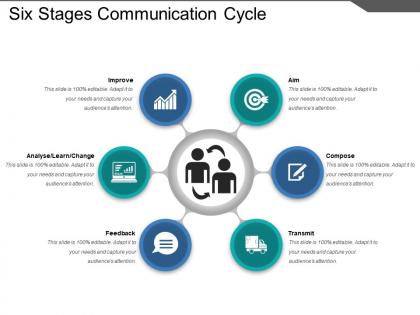
Get this Six Stages Communication Cycle PPT Background to streamline your communication processes at work effectively. The communication process is the set of some sequential steps that are involved in transferring messages as well as feedbacks. Display the entire process of communication that begins with conceptualizing the desired message. Effectively run and manage your business by using this communication cycle PPT template. Ensure that after the message has been encoded, it is transmitted through the appropriate channel or medium. Communication is an exchange process. With the six stages of aiming, composing, transmitting, analyzing, and giving feedback used in this PPT slide, making the communication process easy amongst your team members. It is a professionally designed template and is fully customizable. Communicate and guide your business across all levels. Connect, build morale, and understand each other better. Invest less time in an attractive and influential presentation with communication management PPT template.
People who downloaded this PowerPoint presentation also viewed the following :
Six stages communication cycle ppt background with all 5 slides:
Encourage the agricultural community with our Six Stages Communication Cycle Ppt Background. They will do their best to achieve a bumper harvest.
FAQs for Six stages communication
So basically there are six parts to how we communicate: sender, message, encoding, channel, receiver, and decoding. Plus feedback, which is honestly the most important bit. You encode your thoughts into words, send them through whatever method (text, talking, email), then the other person decodes what you meant. Sounds fancy but it's pretty simple. Here's the thing though - without feedback, you're basically talking to a wall. That's why I always ask "does that make sense?" or wait for questions. Makes such a difference between actually connecting with someone versus just... talking at them, you know?
Honestly, feedback is just how you know if people actually get what you're saying. Like when someone nods or asks follow-up questions - that tells you they're tracking with you. Without it? You're basically shouting into the void hoping something sticks. I see this all the time in work meetings where everyone just sits there looking blank. Ask stuff like "make sense?" or watch for those confused faces. You can totally pivot mid-conversation if needed. Oh, and don't assume they understood just because they didn't interrupt - always double-check before moving on to the next thing.
Honestly, the biggest game-changer is just picking the right tool for what you're trying to do. Video calls are clutch when you need those face-to-face vibes and body language. Quick questions? Hit them up on Slack or whatever messaging app your team uses. I've been using some AI writing tools lately (probably too much tbh) but they actually help me sound more coherent in emails. The real trick is figuring out where you're currently struggling with communication - like, are people always confused by your messages? Do responses take forever? Once you know that, you can grab specific tools that fix those exact problems instead of just defaulting to email for literally everything.
Oh man, there's so many things that can screw up communication! Noise is huge - like actual noise or just being distracted and not really listening. Language barriers obviously mess things up. Cultural stuff too, which people don't think about enough honestly. Your mood can totally change how you hear things or how you come across. Bad phone connections are the worst lol. But the big one? Assumptions. You think they get what you're saying when they're completely lost. Best thing is just checking in - "does that make sense?" or picking better timing when you're both actually focused.
Dude, non-verbal stuff is HUGE. Like you can say the "right" words but if your tone or body language is off, people will pick up on that instead. Think about when someone goes "I'm fine" while clearly rolling their eyes - we all know what that actually means lol. Your facial expressions, how you're standing, even awkward pauses... they're all sending messages whether you realize it or not. Honestly I think people trust body language more than words half the time. So yeah, watch what you're putting out there and read what others are really telling you beyond just what they're saying.
Active listening? It's everything in communication. Most people just wait for their turn to talk (guilty as charged), but real listening means you're actually processing what they said. Ask questions. Give feedback. Paraphrase stuff back to them - seriously, try it sometime. You'll catch so many misunderstandings before they blow up into drama. Without active listening, messages get totally twisted or lost. The whole conversation falls apart. It's like - how can you respond properly if you didn't really hear them? Makes no sense.
Oh man, this is huge. Direct communication works perfectly with some people but totally backfires with others from different backgrounds. Eye contact alone means completely opposite things depending on where someone's from - wild, right? Even how much detail you include or comfortable silences can get misread. Plus the feedback you'll get gets filtered through their ideas about hierarchy and conflict. I learned this the hard way at my last job. Anyway, definitely worth researching communication styles before big meetings or presentations with diverse teams.
Be specific instead of vague - that's honestly the biggest thing. Skip the jargon and use simple words (I'm guilty of overcomplicating this too). One main point per paragraph works best. Think about what your audience actually knows about the topic. Like, would someone totally new to this get it? Before you send anything, scan for confusing terms or assumptions you're making. Oh, and read it back like you're seeing it for the first time - that'll catch most problems. It's weird how different things sound when you flip perspectives like that.
Communication styles can totally make or break how well you connect with people at work. Like, if you're super direct but your coworker needs all the background info first, they'll probably feel rushed and miss your point entirely. Goes both ways too - detail people can absolutely overwhelm the quick-decision folks with way too much information. You gotta watch for signs when your usual approach isn't working. Those blank stares? Dead giveaway. Try matching their pace and how much detail they actually want. Makes conversations flow so much better honestly.
Honestly, it all comes down to how your audience actually hears what you're saying. You could spend forever crafting the "perfect" message, but if they're interpreting it totally wrong? Game over. Their whole life experience - emotions, biases, whether they had a crappy morning - filters everything you say. Communication is weirdly subjective like that. The cycle isn't done until you get feedback and know they actually got your point. So yeah, always double-check they understood you, especially when it matters.
Honestly, visuals are like having a backup singer for your main message - people remember way more when they're hearing AND seeing stuff. Charts make boring data actually make sense. Plus images hit you emotionally in ways that just talking never does. We've all been tortured by those awful slide decks covered in tiny text, right? Your visuals should back up what you're saying, not fight against it. Simple is better. Oh, and try that 6x6 thing - only 6 bullet points with 6 words max each. Works surprisingly well.
Okay so this might sound awkward at first, but try the "echo back" thing - just repeat what someone said in your own words before you respond. Catches tons of misunderstandings! Do feedback rounds where everyone shares what they heard and asks questions. Oh and pause meetings sometimes to check if you're all actually on the same page (you'd be surprised how often you're not). Next meeting, just start with "let me make sure I got this right..." Trust me, it'll change everything. The trick is making it feel normal, not like some corporate exercise.
Okay so emotional intelligence is just being able to read people and not losing your shit when things get heated. Like, you notice when someone's stressed or annoyed before they even say it - then you can actually respond to what's really going on instead of just their words. I swear the pause thing works though. Next time someone's being difficult, just wait a beat before you respond. You'll probably pick way better words and not make things worse. Managing your own emotions is honestly half the battle - nobody wants to deal with someone who fires back instantly every time. It makes such a difference in how conversations go.
Honestly, the biggest thing is just being super specific - no weird jargon that'll confuse people. I always ask "what questions do you have?" instead of "any questions?" because it actually gets people talking. Watch their faces too - if someone looks lost, they probably are! Oh and definitely repeat your main points but say them differently each time. I've had way too many conversations where I thought we were on the same page and... nope. Examples help a ton. Don't be afraid to over-communicate a bit - better safe than having to backtrack later.
Your choice of medium totally changes how communication works. Face-to-face lets you catch body language and ask questions right away. Email though? That's where misunderstandings live - you can't hear tone and everything gets delayed. We've all been there with the "wait, are they mad at me?" emails. Video calls are decent but still feel awkward sometimes. With written stuff, you have to be way more careful since there's no voice or hand gestures to help. Text messages make everything super condensed. Honestly, pick richer channels for complex topics and save quick methods for simple updates.
-
Excellent Designs.
-
Best Representation of topics, really appreciable.