


Communication cycle process powerpoint presentation




Try Before you Buy Download Free Sample Product
 Impress Your
 Audience
 100%
100% Editable
 Save Hours
 of Time


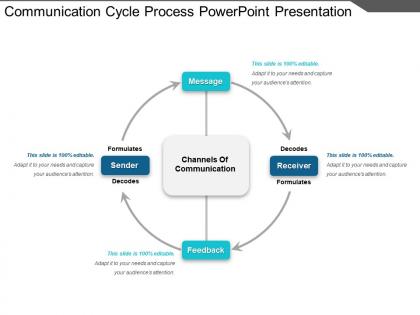
Depict the process of communication with this Communication Cycle Process PowerPoint Presentation. Communicate your effective plans with this ready-to-use PPT slide. It is a 4 stage communication process, including the sender, message, receiver, and feedback. Illustrate how the sender encodes the message and how the receiver decodes it. All the channels of communication can be easily depicted using this professionally designed PPT template. This slide can be used in schools, colleges or wherever it is necessary. Communication is the most crucial part of the organization. If you can communicate in a better way, your employees will be willing to work with you, creating a healthy environment. Our communication template is an excellent tool for generating team spirit within an organization. Alter the size of the text holders and adjust it accordingly. Download this slide now and focus on the importance of communication.
People who downloaded this PowerPoint presentation also viewed the following :
Communication cycle process powerpoint presentation with all 5 slides:
Cater to the buyer with our Communication Cycle Process Powerpoint Presentation. Convince them your goods have the desired class.


FAQs for Communication cycle
So there are six parts to how communication works - sender, message, encoding, channel, receiver, and feedback. Basically you take your thoughts and turn them into words (that's encoding), then send it through whatever method - could be text, email, talking in person, whatever. The other person receives it and tries to figure out what you actually meant. Then they give you feedback so you know if they got it. Honestly, the feedback part is where most people mess up because they assume the other person understood perfectly. Oh, and "noise" can screw things up at any point - like bad phone connection or just being distracted. Pretty straightforward once you think about it.
Honestly, feedback is what separates actual conversation from just talking at someone. You know when you're explaining something and the person just stares blankly? That's when you realize you have no clue if they get it. But when someone nods, asks questions, or even looks confused - now you can actually adjust what you're saying. It turns your monologue into real back-and-forth communication. Don't just assume quiet means they understand either. I always end with something like "make sense?" or "questions?" Works way better than hoping for the best.
Communication breaks down everywhere, not gonna lie. You might pick confusing words or think someone knows stuff they don't. Then there's all the interference - crappy connection, loud background, you name it. The person listening brings their own baggage too, like personal biases or just having a bad day. But honestly? The worst part is when there's zero feedback happening. You'll be totally clueless that everything went sideways until it's way too late. So yeah, definitely ask if things make sense and give people room to speak up.
Honestly, visuals are like shortcuts for your brain. Charts and diagrams let people absorb info way faster than just talking at them. Some people need to *see* stuff to get it - I'm totally one of those people. Plus when everyone's staring at the same graphic, there's less room for weird misunderstandings. They can actually point to what they're confused about instead of just going "huh?" Try sketching something out next time you're explaining complicated stuff. Way fewer blank stares, trust me. You'll get actual questions instead of people just nodding along pretending they followed.
Your perception literally kicks off the whole communication thing. It decides whether you'll even bother saying something in the first place. Like, if you think something's super critical, you'll probably fire off a text immediately - but if it seems routine, maybe you'll wait until later (or honestly, forget completely). How you see the situation shapes your entire message. You might choose email for formal stuff or just call if it feels urgent. The weird thing is, we don't always realize our perception might be off. So before you send that message, just pause and think - am I reading this right?
Dude, culture totally screws with communication at every level. Your background affects how you say things and what you think is obvious. Different cultures handle directness super differently too - some are blunt, others dance around everything. Then the person receiving your message? They're filtering it through their own cultural stuff, which might be nothing like yours. I swear I've watched this tank so many work meetings it's not even funny. The trick is checking if people actually got what you meant instead of just assuming they did. Extra feedback never hurts.
Honestly, it comes down to three things. First, organize your thoughts before you speak - use simple words instead of corporate jargon nobody understands. Second, always check if people are following along. Ask "make sense?" or just watch their faces. I've bombed so many meetings because I skipped this step! Also give context upfront so they know why they should care. But here's what really works - actually listen to how people respond and adjust. Like if someone looks lost, backtrack and explain differently. It's way more effective than just plowing ahead with your original plan.
So basically active listening is what stops conversations from becoming total train wrecks. Instead of just waiting for your turn to talk, you're actually processing what they're saying and asking follow-up questions. The whole point is creating that feedback loop - otherwise the person talking has no clue if you understood them or if you're thinking about lunch. I swear, just paraphrasing back what you heard before jumping in with your response changes everything. It's honestly such a simple thing but most people skip it completely. That's how you end up with those frustrating conversations where you're both saying different things but think you agree.
Honestly? Just pick 2-3 tools and stick with them - jumping between platforms kills productivity. Slack or Teams work great for quick back-and-forth stuff. For project tracking, Asana's pretty solid (though Monday's UI is cleaner imo). Video calls beat email chains every time when you need real feedback. Loom's clutch for async stuff too. Email still has its place for formal communication, but man is it slow. I'd start by figuring out where your current process gets stuck, then work backwards from there.
Honestly? Just see if people actually *get* what you're saying and do something about it. Ask them to repeat it back - sounds awkward but works. Fast replies are usually a good sign too. When I'm talking face-to-face, I watch for that glazed-over look that means I've totally lost them lol. The real proof is whether they change their behavior or take action afterward. Oh, and don't overthink it - pick one thing to pay attention to in your next few conversations. You'll figure out pretty quick if you're getting through or just talking to a wall.
Dude, non-verbal stuff is like 55% of communication - seriously! Your body language and tone can totally sabotage what you're actually saying. I watched this guy give a presentation once where he kept his arms crossed the whole time while talking about "being open to new ideas." Yeah right. People read those signals way more than you think. Your posture might be screaming one thing while your mouth says another. Just make sure your face and body aren't contradicting your words, you know? Otherwise you'll confuse everyone.
Honestly, EI is a game-changer for reading people during conversations. You start thinking about how they'll actually receive what you're saying based on their mood. Plus you catch those non-verbal signals - like when someone's getting confused or pushback is coming. Most fights happen because we miss this stuff anyway. When they respond, you can separate the emotion from what they're actually trying to tell you. Here's what works for me: pause when things get tense. Gives your brain a second to pick a smart response instead of just blurting out whatever.
Oh man, remote work feedback loops are such a pain. You miss all those random conversations that actually keep projects moving. Time zones make everything worse - someone's always asleep when you need an answer. Written messages are the worst for tone too, like I swear half my team thinks I hate them because I write short Slack messages when I'm busy lol. Jumping between different apps fragments everything. My advice? Be super explicit about confirming you got important stuff, and set clear deadlines for responses. Otherwise things just... disappear into the void.
Check in constantly, not just at the end - that's the secret sauce. Ask stuff like "does this track?" early on, then watch for confused faces or glazed-over looks. I used to word-vomit everything at once, which was awful. Make it feel natural though, not like some formal feedback session. People need to feel safe saying "wait, I'm totally lost here" without looking dumb. Oh, and always wrap up by repeating back what you heard. "So you're saying X, right?" It's honestly a game-changer for actual understanding.
Oh man, communication breakdowns are the worst - everything just falls apart from there. People start getting the wrong info, deadlines get missed, and suddenly nobody's on the same page. Productivity tanks. Departments start butting heads over stupid stuff. Decision-making crawls to a halt because feedback isn't flowing properly. Trust between teams? Gone. I've seen it happen so many times and it's painful to watch. Set up regular check-ins with your team and actually confirm people understood what you meant - especially for the big stuff. Sounds obvious but most people skip that step.
-
Understandable and informative presentation.
-
Best way of representation of the topic.