


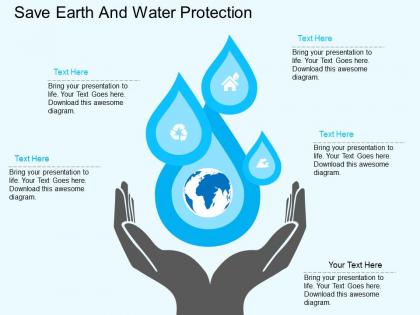
Save earth and water protection flat powerpoint desgin




Try Before you Buy Download Free Sample Product
 Impress Your
 Audience
 100%
100% Editable
 Save Hours
 of Time


Our Save Earth And Water Protection Flat Powerpoint Desgin can carry a heavy burden. You will find they have great capacity.
People who downloaded this PowerPoint presentation also viewed the following :
Save earth and water protection flat powerpoint desgin with all 4 slides:
Ideas go further with our Save Earth And Water Protection Flat Powerpoint Desgin. Add that extra to your achievement.

FAQs for Save earth and water protection
Effective urban water conservation strategies include smart metering systems, rainwater harvesting infrastructure, greywater recycling programs, drought-resistant landscaping initiatives, and tiered pricing structures. These approaches streamline resource management by reducing consumption, maximizing reuse, and encouraging behavioral changes, with many cities finding that strategic combinations deliver significant cost savings while enhancing long-term sustainability and operational efficiency.
Communities can implement rainwater harvesting through rooftop collection systems, underground storage tanks, permeable pavements, and community-wide retention ponds. These approaches streamline water management by capturing runoff, reducing municipal demand, and enhancing local water security, with many urban neighborhoods and rural cooperatives finding that strategic harvesting delivers significant cost savings while building resilience against drought conditions.
Agriculture accounts for approximately 70% of global freshwater use through irrigation, livestock watering, and crop processing, making it the largest consumer of water resources worldwide. Farmers can adopt sustainable practices like drip irrigation, crop rotation, drought-resistant varieties, and precision farming technologies, with many agricultural operations finding that these methods reduce water usage by 20-40% while maintaining yields and enhancing long-term soil health.
Pollutants affect water sources through industrial discharge, agricultural runoff, plastic waste, and chemical contamination, degrading quality and threatening ecosystems. Organizations can minimize contamination by implementing advanced filtration systems, adopting sustainable manufacturing practices, reducing single-use plastics, and investing in water treatment technologies, ultimately delivering cleaner resources and environmental sustainability.
Climate change significantly reduces freshwater availability through altered precipitation patterns, increased evaporation rates, prolonged droughts, accelerated glacier melting, and intensified extreme weather events. Organizations across sectors, from agricultural cooperatives to municipal water authorities, are adapting by implementing advanced water recycling technologies, developing drought-resistant infrastructure, and enhancing storage capabilities, ultimately delivering greater water security and operational resilience.
Technology enhances water resource management through IoT sensors, satellite monitoring, AI analytics, smart meters, and predictive modeling systems. These solutions enable real-time tracking of water quality, usage patterns, and distribution efficiency, with utilities and agricultural operations finding significantly reduced waste, optimized irrigation schedules, and proactive leak detection that ultimately delivers cost savings and sustainable resource conservation.
Recycled water benefits include reduced freshwater demand, lower utility costs, enhanced drought resilience, improved soil nutrition, and decreased wastewater discharge into natural systems. Through advanced treatment technologies, residential developments and agricultural operations streamline water management while delivering significant cost savings, sustainable crop yields, and environmental protection, with many communities finding that strategic water reuse creates long-term resource security.
Public awareness campaigns influence water conservation behaviors by educating communities about scarcity impacts, demonstrating practical conservation methods, and showcasing measurable environmental benefits through targeted messaging. These strategic initiatives streamline adoption across households and organizations, with many municipalities finding that combining educational content with actionable tips ultimately delivers reduced consumption rates and enhanced community engagement in sustainability practices.
Governments can implement water pricing mechanisms, mandatory conservation standards, pollution control regulations, groundwater extraction limits, and incentive programs for efficient technologies. These policies streamline resource allocation by encouraging responsible usage, penalizing waste, and promoting innovation, with many municipalities finding that strategic combinations ultimately deliver enhanced water security and environmental sustainability.
Water scarcity creates significant economic challenges including increased operational costs, supply chain disruptions, reduced agricultural productivity, higher water treatment expenses, and decreased property values in affected regions. Industries like manufacturing, agriculture, and hospitality face substantial cost increases and potential relocation needs, while communities experience reduced economic development opportunities and increased infrastructure investments, ultimately requiring strategic water management to maintain competitive advantage.
Schools can integrate water protection education through science lessons on watersheds and pollution, geography studies of water scarcity, math projects calculating water usage, and hands-on activities like rain gardens. These interdisciplinary approaches enhance environmental awareness while developing critical thinking skills, with many institutions finding that practical conservation projects, community partnerships with local water authorities, and student-led sustainability initiatives ultimately deliver engaged learning experiences and measurable campus water reduction.
Over-extracting groundwater causes land subsidence, saltwater intrusion into freshwater aquifers, reduced stream flows, and ecosystem disruption affecting wetlands and vegetation. These consequences create cascading environmental challenges, with agricultural regions, coastal communities, and urban areas increasingly experiencing infrastructure damage, compromised water quality, and habitat loss, ultimately threatening long-term water security and ecological balance.
Water protection efforts intersect with biodiversity conservation through habitat preservation, pollution reduction, and ecosystem restoration initiatives that safeguard aquatic species and wetland environments. These integrated approaches enable organizations, environmental agencies, and conservation groups to streamline resource allocation while delivering enhanced ecosystem stability, improved species resilience, and ultimately stronger environmental outcomes across interconnected natural systems.
Innovative water shortage solutions include atmospheric water generation, advanced desalination technologies, smart irrigation systems, water recycling infrastructure, and AI-powered distribution networks. These approaches streamline resource management by reducing waste, enhancing efficiency, and maximizing accessibility, with many municipalities and agricultural sectors finding that strategic combinations ultimately deliver sustainable supply chains and significant cost reductions.
Individuals can contribute through water-efficient practices like fixing leaks, using low-flow fixtures, reducing shower times, and choosing water-conscious appliances. These conservation methods, combined with responsible chemical disposal and supporting water-focused organizations, enable households to significantly reduce consumption while protecting local water systems, with many communities finding that collective residential efforts deliver substantial environmental and cost-saving benefits.
-
Presentation Design is very nice, good work with the content as well.
-
Innovative and attractive designs.