


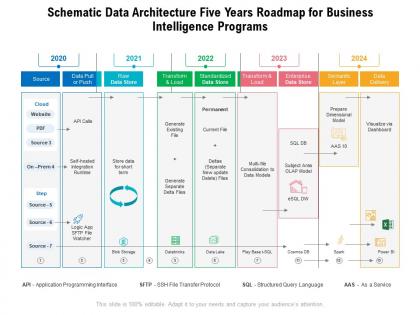
Schematic data architecture five years roadmap for business intelligence programs




Try Before you Buy Download Free Sample Product
 Impress Your
 Audience
 100%
100% Editable
 Save Hours
 of Time


Visualize your work plan and communicate your ideas impactfully with our pre designed Schematic Data Architecture Five Years Roadmap For Business Intelligence Programs. Showcase the detailed overview of the project, the key deliverables, and the milestones to be achieved with the help of our fully customizable PowerPoint layout. You can easily emphasize on the project goals and discuss all the activities involved in an easy to comprehend manner by utilizing our professionally designed PPT theme. This roadmap PowerPoint layout is a perfect strategic planning tool that can help in keeping the project on track. With our attractive PowerPoint theme, you can articulate the workflow, track the work progress, and have a clear vision of the goal to be achieved. Download this versatile Schematic Data Architecture Five Years Roadmap For Business Intelligence Programs and save your hours of work.
People who downloaded this PowerPoint presentation also viewed the following :
Schematic data architecture five years roadmap for business intelligence programs with all 2 slides:
Use our Schematic Data Architecture Five Years Roadmap For Business Intelligence Programs to effectively help you save your valuable time. They are readymade to fit into any presentation structure.

FAQs for Schematic data architecture five years roadmap for
Ok so five main things for your data roadmap. Map out what you currently have - all your systems, data sources, the whole mess. Define where you want to end up with clear business goals. Migration strategy is huge (seriously, this is where everyone screws up because they think it'll be easier than it is). Build in governance and tech standards right from the beginning - don't try to add them later. Realistic timelines with actual milestones you can hit. Honestly though, start by just documenting your current setup first. You can't plan the journey if you don't know where you're starting from.
Think of business goals as your GPS for data stuff. Real-time customer personalization? You'll want streaming pipelines, not slow batch processing. Cost cutting means focusing on cloud migration and better storage. Honestly, most people get this backwards and jump straight into the tech side. It's like designing plumbing without knowing if you're building a tiny apartment or some huge mansion. Map out what your business actually needs first, then figure out the technical bits. Way less headache that way, trust me.
Don't jump straight into migration - assess where you are first, then map everything to cloud-native patterns. Data governance has to come early (most people skip this and hate themselves later). Set up ownership, track lineage, get security policies that work across hybrid setups. Go API-first so your data services can scale on their own. Pick cloud providers that actually fit your current tech stack instead of whatever's trending. Honestly, I'd start with just one business unit as a pilot. Get the architecture right there, then expand. Oh and document everything - I mean everything.
Start with figuring out where you actually stand right now - and I mean *actually*, not where you hope you are. Check stuff like data governance, quality, how well systems talk to each other. Most companies use frameworks like DMBOK or just make their own scorecard. Rate everything from "total mess" to "pretty solid." Here's the thing though - get people from different departments involved because IT always thinks data is cleaner than it really is. Look at how much manual work happens, whether teams define "customer" the same way, how fast you can answer random business questions. Those gaps become your roadmap priorities.
Think of data governance like building codes for your house - you can't just slap them on after the foundation's done. Trust me, I've seen teams try to retrofit compliance and it's a nightmare. Your roadmap needs governance checkpoints at every milestone, not just at the end. GDPR and other regs will literally force certain architecture decisions on you (sometimes annoying ones tbh). Map out what compliance stuff you're dealing with first, then figure out your data classification and storage rules. The access controls flow from there. Short version: don't treat governance like an afterthought.
For visual roadmaps, I'd check out Lucidchart, Draw.io, or Visio first - they're solid for data flows and timelines. If you need something heavier duty, try Archimate or Sparx Enterprise Architect. But honestly? I've seen teams crush it with just PowerPoint or Miro, especially when everyone's working remote. The main thing is using something your stakeholders can actually read and won't hate updating. My advice: start with whatever diagramming tool you're already using. You can always level up later if you need fancy stuff like version control or integrations.
Start with whatever directly impacts revenue or keeps operations running - that's your bread and butter. Map dependencies first though, because building fancy analytics on crappy data is like putting lipstick on a pig. Go for quick wins early to get leadership excited, then handle the boring foundational stuff like governance before jumping into AI projects. Honestly, a scoring matrix helps tons here - rate everything on business value, effort, and risk so you're not just going with your gut. Foundation first, flashy stuff later.
Ugh, legacy systems are the worst - nothing talks to each other properly. Data quality will make you want to pull your hair out, and don't even get me started on department heads hoarding their precious data like dragons. Budget issues always come up halfway through too. Finding people who actually know this stuff? Good luck with that hiring process. Oh, and everyone hates changing how they work. Honestly though, pick one small project that'll show results fast. Once people see it actually works, they'll stop fighting you on the bigger stuff.
Yeah, just treat it like any other agile project honestly. Break everything into 2-4 week sprints instead of planning some massive 3-year thing upfront. Each sprint delivers something real - a new pipeline, governance updates, whatever. Sounds kinda weird for architecture stuff but it actually works great. Show stakeholders demos regularly so you can change direction when they inevitably shift priorities (they always do lol). Start with your most critical data flows first. Build incrementally from there. The key is making sure each piece adds actual value, not just busy work.
Track both the tech stuff and business impact to see if your roadmap's actually working. Data quality scores, uptime, query speed - is everything getting more reliable? Then look at business metrics like how fast teams can grab data and whether you're breaking down those annoying silos. User adoption is honestly make-or-break though - I've seen so many beautiful systems that nobody touches. Pick maybe 3-5 metrics your stakeholders care about most and check them quarterly. Don't go overboard with tracking everything or you'll spend more time measuring than improving.
Honestly, AI and blockchain flip your whole data setup upside down - they're not just plug-and-play features. With AI, you're looking at huge data pipelines and real-time processing that needs to handle messy, unstructured stuff at scale. Blockchain's even trickier since it's all decentralized with immutable records and consensus mechanisms (which, not gonna lie, sounds intimidating). Both eat up way more computing power and need bulletproof security from the start. My advice? Figure out what actually needs these technologies first. Half the time companies just want the cool factor.
Honestly, your roadmap's dead in the water without stakeholder buy-in. These are the people actually using the data daily - they know where things break down and what's missing. Map out who matters first, then start having real conversations with them. Trust me, they'll sabotage anything they weren't part of building. But flip side? Get them involved early and they become your biggest advocates. They're also controlling the budget, so there's that practical angle too. Don't build in isolation - it never works out.
Build everything modular from the start - like LEGO blocks that won't break when you swap pieces out. Go cloud-native with microservices so you can scale parts independently without touching the rest. Seriously, I've watched teams get stuck with massive monoliths that become impossible to fix later. APIs everywhere keep things from getting too tangled up. Data lakes or lakehouses work great since they handle both messy and clean data. Just avoid getting locked into one vendor's ecosystem - that always bites you eventually. Oh, and document your data flow as you go. Trust me on this one.
Honestly, phased migration is your best bet here - way less scary than ripping everything out at once. Map out which legacy systems actually matter first (some are probably just sitting there doing nothing useful). API wrappers can make your old stuff talk to new tools pretty easily. Data virtualization is clutch too since you can access legacy data without moving it right away. I'd prioritize based on what's causing the biggest headaches and business impact. Oh, and your stakeholders will definitely prefer the gradual approach over some massive overhaul that breaks everything.
You really can't treat data quality as an afterthought - it has to be baked into your architecture from the start. Picture building a house and trying to add the electrical wiring later... total nightmare. Map out your critical data domains first, then build quality checks and validation rules directly into your pipelines and storage design. Your roadmap needs dedicated spots for profiling tools, cleansing components, and quality scorecards sitting right alongside your databases. I've seen too many teams try to bolt this stuff on later and it never works well. Start with your architectural decisions and tie quality requirements to each one.
No Reviews