


Scope Research Methodology And Research Objectives Craft Beer Industry Outlook IR SS




Try Before you Buy Download Free Sample Product
 Impress Your
 Audience
 100%
100% Editable
 Save Hours
 of Time


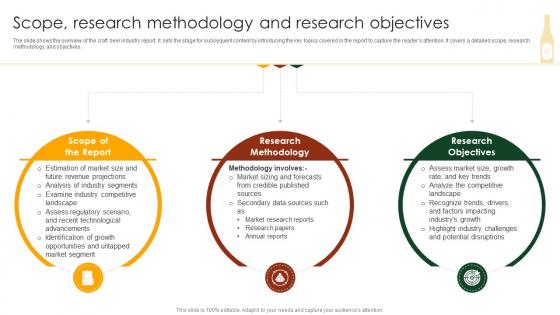
The slide shows the overview of the craft beer industry report. It sets the stage for subsequent content by introducing the key topics covered in the report to capture the readers attention. It covers a detailed scope, research methodology, and objectives.
People who downloaded this PowerPoint presentation also viewed the following :
Scope Research Methodology And Research Objectives Craft Beer Industry Outlook IR SS with all 9 slides:
Use our Scope Research Methodology And Research Objectives Craft Beer Industry Outlook IR SS to effectively help you save your valuable time. They are readymade to fit into any presentation structure.








FAQs for Scope Research Methodology And Research Objectives Craft Beer Industry
Primary data sources for craft beer industry analysis include consumer surveys, brewery interviews, point-of-sale data, market research reports, and industry association publications. These sources enable businesses to track consumer preferences, production volumes, and market dynamics by combining quantitative sales metrics with qualitative insights, ultimately delivering comprehensive market intelligence that helps breweries optimize product development and strategic positioning.
Consumer demographic data transforms craft brewery marketing strategies by revealing age preferences, income levels, geographic concentrations, lifestyle patterns, and purchasing behaviors that guide targeted campaigns. Through demographic insights, breweries tailor product positioning, select optimal distribution channels, and customize messaging approaches, with many craft breweries finding that younger demographics prefer bold flavors while older consumers favor traditional styles, ultimately enabling more efficient resource allocation and stronger customer connections.
Effective methodologies include sensory analysis panels, consumer surveys with preference mapping, focus groups, A/B taste testing, and behavioral analytics from sales data. These approaches streamline preference identification by combining qualitative feedback, quantitative scoring, and real-world purchasing patterns, with many craft breweries finding that strategic combinations of tasting sessions and digital feedback ultimately deliver deeper customer insights and competitive market positioning.
Sentiment analysis from social media reveals consumer emotions, opinions, and brand associations through automated text analysis of posts, comments, reviews, hashtags, and discussions. This technology enables craft breweries to monitor brand reputation, identify flavor preferences, track competitor positioning, and detect emerging trends in real-time, ultimately delivering actionable insights for product development and marketing strategies.
Focus groups provide craft breweries with direct consumer feedback on flavor profiles, packaging concepts, naming strategies, and market positioning before product launch. These sessions enable brewers to refine recipes, identify target demographics, and validate marketing approaches, with many craft breweries finding that consumer insights significantly reduce development costs while enhancing market acceptance and competitive positioning.
Effective craft beer surveys incorporate demographic segmentation, consumption frequency tracking, flavor preference mapping, purchasing behavior analysis, and brand loyalty metrics. These methodologies enable breweries and distributors to identify emerging trends like seasonal preferences, premium pricing acceptance, and regional taste variations, ultimately delivering targeted product development and strategic market positioning in an increasingly competitive craft beverage landscape.
Craft beer sales analysis commonly employs regression analysis, time series forecasting, cluster analysis, ANOVA for market segmentation, and correlation matrices to identify purchasing patterns. These statistical tools enable breweries to optimize inventory management, predict seasonal demand fluctuations, and identify high-performing product categories, with many craft breweries finding that data-driven insights significantly enhance operational efficiency and competitive positioning.
Geographic location significantly influences craft beer consumption through regional taste preferences, local brewing traditions, climate conditions, and cultural attitudes toward alcohol. Different regions show distinct patterns, with Pacific Northwest consumers favoring hop-heavy IPAs, Southern markets preferring lighter styles, and urban areas driving premium craft adoption, ultimately creating diverse regional markets that breweries strategically target for competitive advantage.
Brewery size significantly impacts market positioning through production capacity, distribution networks, and resource allocation, with larger craft breweries achieving broader geographic reach while smaller operations focus on local community engagement and niche specialization. These scaling differences enable varied strategies, where regional breweries leverage enhanced distribution partnerships and brand recognition, while microbreweries cultivate intimate customer relationships and unique product offerings, ultimately delivering competitive advantages tailored to their operational capacity.
Case studies of successful craft breweries provide insights by analyzing their market positioning strategies, operational efficiency models, customer engagement approaches, and distribution channel optimization techniques. These real-world examples reveal how breweries like Stone Brewing and Dogfish Head scaled operations, built brand loyalty through storytelling and community involvement, and navigated regulatory challenges, ultimately delivering actionable frameworks for sustainable growth and competitive differentiation.
Ethical considerations include obtaining informed consent, protecting consumer privacy, ensuring voluntary participation, avoiding bias in data collection, and maintaining confidentiality of personal drinking habits. Researchers must also consider responsible representation of alcohol consumption patterns, especially when studying vulnerable populations, while ensuring transparency in methodology and findings that could influence industry marketing practices, ultimately delivering credible insights that respect consumer autonomy.
Economic factors significantly influence craft brewery viability through consumer spending patterns, ingredient costs, real estate prices, and access to capital for expansion. While economic downturns can reduce discretionary spending on premium beverages, many craft breweries find that local loyalty and unique positioning help maintain resilience, with strategic pricing and operational efficiency ultimately delivering competitive advantages.
Innovation drives craft beer R&D through experimental ingredient sourcing, novel brewing techniques, flavor profile development, and consumer trend analysis. These methodologies enable breweries to differentiate products, capture niche markets, and respond to evolving preferences, with many craft producers finding that systematic innovation processes ultimately deliver competitive advantage and sustained growth.
Collaboration between craft breweries enhances market research through shared consumer insights, pooled data collection resources, joint trend analysis, and coordinated taste testing initiatives across diverse demographics. These partnerships enable smaller breweries to access broader market intelligence, reduce individual research costs, and accelerate product innovation cycles, with many finding that collaborative efforts deliver stronger competitive positioning and faster market entry.
Secondary data limitations in craft beer industry research include outdated information, lack of specificity to local markets, inconsistent data collection methods, and limited access to proprietary brewery information. While these constraints present challenges, many researchers find that combining secondary sources with primary data collection methods like surveys and interviews ultimately delivers more comprehensive market insights and competitive advantage in this rapidly evolving industry.
-
“I required a slide for a board meeting and was so satisfied with the final result !! So much went into designing the slide and the communication was amazing! Can’t wait to have my next slide!”
-
SlideTeam is my one-stop solution for all the presentation needs. Their templates have beautiful designs that are worth every penny!