

Scrum Sprint Retrospective Matrix To Examine Meeting Process




Try Before you Buy Download Free Sample Product
 Impress Your
 Audience
 100%
100% Editable
 Save Hours
 of Time


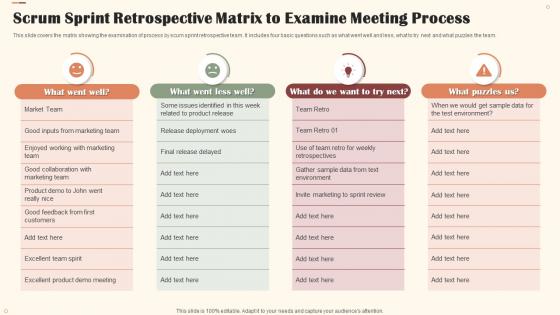
This slide covers the matrix showing the examination of process by scum sprint retrospective team. It includes four basic questions such as what went well and less, what to try next and what puzzles the team.
People who downloaded this PowerPoint presentation also viewed the following :
Scrum Sprint Retrospective Matrix To Examine Meeting Process with all 6 slides:
Use our Scrum Sprint Retrospective Matrix To Examine Meeting Process to effectively help you save your valuable time. They are readymade to fit into any presentation structure.





FAQs for Scrum Sprint Retrospective Matrix To
The whole point is getting your team to actually reflect on what's working vs what sucks, then doing something about it. You create categories like start/stop/continue or focus on specific stuff like processes and tools. Way better than people just randomly venting! Short sentences keep things focused. The matrix format helps you spot patterns you might miss otherwise - honestly, it's pretty satisfying when themes start emerging. But here's the key: you've gotta walk away with real action items your team will actually try next sprint. Otherwise it's just expensive therapy, you know?
Dude, that retrospective matrix thing actually works pretty well. Everyone looks at the same board - like Start/Stop/Continue or whatever format - so you're not just sitting there while people randomly complain about stuff. The quiet people on your team can throw their sticky notes up there before anyone talks, which honestly helps a ton. What's cool is when you group everything together, you start seeing patterns you'd totally miss otherwise. I mean, three people might mention the same issue in different ways, but suddenly it's obvious when it's all visual. Try it with sticky notes next time - seriously, your team will zero in on the real problems way faster.
Here's what works for me: Four sections - "Start," "Stop," "Continue," and "More/Less" (though honestly some teams just do separate More and Less boxes if that's clearer). Time-box each part or you'll be there forever talking in circles. Focus on specific stuff, not just "communication sucks" type complaints. That gets you nowhere. The key is picking maybe 2-3 actual things to work on next sprint. Don't try fixing everything - you'll just overwhelm yourselves and nothing will stick.
So instead of just talking in circles about what sucked, you're plotting stuff on a grid. Like impact vs effort or whatever makes sense for your team. It's way more visual than the usual "what went well" ramble. Honestly, seeing issues laid out this way makes patterns super obvious. Your team stops arguing about priorities because you can literally see what matters most. Plus it forces people to actually think about where problems fit compared to each other. Next retro, try a simple 2x2 - feasibility on one side, impact on the other. Game changer.
Miro and Mural are solid choices - they've got drag-and-drop plus retro templates built in. If your team's already using Figma, FigJam works great too. Honestly? Sometimes I just throw together a Google Sheets table and it does the job perfectly fine. Retrium and Parabol are more specialized but might be way more than you need. Oh, and Notion tables work surprisingly well if you're into that. The main thing is picking something where everyone can jump in at the same time and you can sort feedback into those matrix sections easily. Start with whatever tool your team already knows.
The retrospective matrix is honestly a game-changer for organizing team feedback. Instead of random complaining, you're actually categorizing what worked, what sucked, and what to try next. Visual format makes it super easy to spot patterns - like when the same deployment issues keep coming up every sprint (ugh). Here's what I'd do: spend 15 minutes comparing your current matrix with the previous one. You'll actually see progress happening, which is weirdly motivating. Plus it stops you from rehashing identical problems every two weeks. Your team's improvement journey becomes really obvious when you can flip through old matrices.
So I'd focus on tracking how often the same issues pop up in each section - especially if your "Stop Doing" pile keeps growing with repeat offenders. That usually means you're not fixing the actual problems. Also check how many "Start Doing" ideas you actually follow through on vs just talk about (spoiler: it's probably way less than you think). You could track the split between process drama and people issues too. Honestly though, pick like 2-3 things max to actually monitor sprint to sprint. Otherwise you'll just end up with a bunch of unused spreadsheets collecting digital dust.
Your Scrum Master should facilitate and keep things moving smoothly through each section. The Product Owner brings that business perspective - like how changes might affect customers or priorities. Dev team members are obviously where you get the real technical insights and those daily process pain points nobody else sees. Honestly, rotating who leads different sections works way better than I expected - keeps everyone engaged instead of just one person driving everything. Main thing is creating that safe space where people actually speak up in all the quadrants, not just the "safe" feedback areas.
Honestly? Getting people to actually be real instead of just checking boxes is the hardest part. Teams always get stuck arguing whether something's a "process issue" or "communication problem" - like it even matters that much. You'll have the usual suspects who won't shut up while others just sit there. Oh, and they'll waste forever debating where stuff goes on the matrix instead of actually fixing anything. Start with basic categories. Make it super clear you're not pointing fingers at anyone. Takes some practice but they'll get it.
Honestly, just throw some color at that thing! Grab different colored sticky notes for themes, toss in emoji stickers to show how people actually feel about stuff. Even crappy stick figure drawings work better than walls of text - trust me on this one. Try thumbs up/down ratings or smiley faces. Different sized post-its can show impact levels too. Start with colored markers and watch your team suddenly get way more into it. Makes the whole thing feel less like homework, you know?
Look for patterns first instead of getting caught up in individual issues - that's where you'll find the real themes. When prioritizing, go for stuff that's both high impact AND doable. Seriously don't try tackling everything (I've watched too many teams crash and burn that way). Pick maybe 1-2 things your team can actually handle. Get everyone talking, especially the quiet ones who usually have the best insights. Here's the thing though - dig into WHY each item matters rather than just taking it at face value. Oh, and write down what you decide with clear owners and deadlines.
So instead of doing each retro in isolation, track the same categories across multiple sprints in a matrix. I use a simple spreadsheet - sprint numbers across the top, retro categories down the side. After each ceremony, just fill in what came up. The patterns jump out at you pretty quickly. Like you'll notice "unclear requirements" keeps showing up every few sprints, or velocity always tanks when certain people are out. It's honestly kind of eye-opening once you see your team's feedback laid out like that over time. Makes it way harder to ignore recurring issues.
Oh this is super fixable! Start with silent brainstorming so your quiet teammates actually get heard before the loud ones take over. Mix up who runs it too - seriously changes everything when different people facilitate. Anonymous sticky notes work great if people are being weird about speaking up. Break into smaller groups maybe? Some people just clam up in big crowds but they'll talk your ear off one-on-one. You could also directly ask specific folks what they think about different sections. The trick is being deliberate about it instead of crossing your fingers and hoping everyone jumps in naturally.
Take your retro insights and actually use them in sprint planning - sounds obvious but most teams don't do this. Look at what worked well and recreate those conditions. Like if collaboration was amazing because someone ran standups differently, keep doing that. Pick one or two improvement areas (not ten) and block out actual sprint time to tackle them. Otherwise you'll just have the same complaints next retro, which honestly drives me crazy. Turn those sticky note observations into real sprint goals or team agreements. The whole point is making your retro actionable, not just a venting session.
Honestly, good facilitation makes or breaks your retrospective matrix. Without it, you're just throwing random complaints into boxes. The facilitator needs to dig deeper - like when someone says "communication was bad," they should ask WHY it was bad. Also gotta make sure the quiet people actually speak up (they usually have the best insights anyway). I've watched so many retros turn into surface-level whining sessions because nobody connected the dots between problems and real solutions. Your facilitator should keep things moving while still leaving room for those lightbulb moments. Trust me, it's worth finding someone who knows what they're doing.
-
SlideTeam is my go-to resource for professional PPT templates. They have an exhaustive library, giving you the option to download the best slide!
-
Easily Editable.