

Secops V2 Conceptual Architecture Of Security Operations Center




Try Before you Buy Download Free Sample Product
 Impress Your
 Audience
 100%
100% Editable
 Save Hours
 of Time


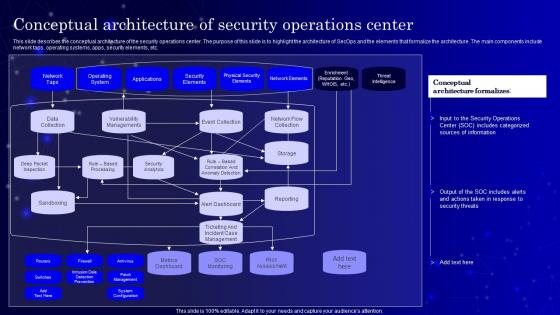
This slide describes the conceptual architecture of the security operations center. The purpose of this slide is to highlight the architecture of SecOps and the elements that formalize the architecture. The main components include network taps, operating systems, apps, security elements, etc.
People who downloaded this PowerPoint presentation also viewed the following :
Secops V2 Conceptual Architecture Of Security Operations Center with all 9 slides:
Use our Secops V2 Conceptual Architecture Of Security Operations Center to effectively help you save your valuable time. They are readymade to fit into any presentation structure.








FAQs for Secops V2 Conceptual Architecture Of
Traditional security operations rely on reactive, siloed approaches with manual processes and basic monitoring tools, while SecOps V2 integrates automated threat detection, AI-driven analytics, cross-functional collaboration, and proactive threat hunting. This evolution enables organizations to streamline incident response, enhance threat visibility, and minimize security gaps, with many financial institutions and healthcare providers finding that automated workflows ultimately deliver faster containment and reduced operational costs.
SecOps V2 enhances collaboration by providing unified dashboards, shared incident response workflows, and integrated communication channels that break down traditional silos between security and IT teams. Through centralized threat intelligence and automated alert prioritization, organizations streamline cross-team coordination, reduce response times, and ultimately deliver more effective security outcomes while minimizing operational friction.
Automation serves as the backbone of SecOps V2 effectiveness by enabling real-time threat detection, streamlining incident response workflows, and reducing manual security tasks that traditionally slow operations. Through automated orchestration and intelligent response systems, organizations achieve faster threat containment, minimize human error, and scale security operations efficiently, ultimately delivering enhanced protection while reducing operational costs and improving team productivity.
SecOps V2 enhances incident response through automated threat detection, integrated workflows, real-time monitoring, and centralized orchestration platforms that accelerate response times. These advanced capabilities enable organizations to minimize breach impact, streamline coordination between security and operations teams, and reduce manual intervention, with many financial institutions and healthcare organizations finding significantly faster containment and recovery.
Primary SecOps V2 success metrics include mean time to detection (MTTD), mean time to response (MTTR), threat containment rates, false positive reduction, and security incident volume trends. These measurements enable organizations to demonstrate improved operational efficiency, enhanced threat visibility, and streamlined security workflows, with many enterprises finding that integrated SecOps platforms ultimately deliver faster incident resolution and stronger overall security posture.
A shift-left approach enhances SecOps V2 by integrating security measures earlier in the development lifecycle, enabling proactive threat detection, automated vulnerability scanning, and continuous compliance monitoring throughout code development. This strategic combination streamlines incident response, reduces remediation costs, and accelerates secure software delivery, with many organizations finding that early security integration ultimately delivers faster deployment cycles and stronger overall security posture.
Essential SecOps V2 tools include SIEM platforms, SOAR automation systems, threat intelligence feeds, endpoint detection and response solutions, and cloud security monitoring tools. These technologies streamline incident response by correlating alerts, automating workflows, and providing real-time visibility, with many organizations finding that integrated toolsets reduce response times significantly while enhancing overall security posture.
SecOps V2 addresses compliance challenges by automating regulatory reporting, centralizing audit trails, and implementing continuous monitoring frameworks that align with standards like SOX, GDPR, and HIPAA. Through integrated dashboards and real-time compliance tracking, organizations streamline regulatory processes, reduce manual oversight requirements, and maintain consistent adherence across multiple jurisdictions, ultimately delivering faster audit responses and minimized compliance risks.
Threat intelligence integration enhances SecOps V2 operations by providing contextual data for faster incident response, automating threat detection with real-time feeds, and enabling proactive defense strategies through predictive analytics. These capabilities streamline security workflows by reducing false positives, accelerating threat hunting, and improving decision-making accuracy, ultimately delivering enhanced operational efficiency and stronger organizational resilience.
Continuous monitoring is absolutely critical in SecOps V2, serving as the foundation for real-time threat detection, automated incident response, and proactive vulnerability management. This always-on approach enables organizations to identify security anomalies within minutes rather than days, while streamlining compliance reporting and reducing mean time to resolution, ultimately delivering enhanced security posture and operational efficiency.
Critical skills for SecOps V2 professionals include advanced threat detection, cloud security architecture, automation scripting, incident response orchestration, and cross-functional collaboration capabilities. These competencies enable security teams to manage hybrid infrastructures, streamline threat remediation, and integrate seamlessly with DevOps workflows, with many organizations finding that professionals combining technical expertise with strategic communication deliver faster incident resolution and enhanced operational resilience.
Organizations ensure a security culture within SecOps V2 through comprehensive training programs, cross-functional collaboration frameworks, and embedded security practices across all operational levels. By implementing continuous education initiatives, automated security workflows, and clear accountability structures, companies in sectors like healthcare and financial services foster proactive security mindsets, ultimately delivering enhanced threat detection and organizational resilience.
Cloud-native technologies for SecOps V2 include container orchestration platforms, microservices architectures, serverless computing, API gateways, and cloud security posture management tools. These technologies enhance security operations by enabling automated threat detection, scalable incident response, and seamless integration across cloud environments, with many organizations finding that this strategic combination delivers faster threat mitigation and improved operational efficiency.
Machine learning revolutionizes SecOps practices by automating threat detection, accelerating incident response, and reducing false positives through predictive analytics and behavioral analysis. These AI-driven capabilities enable security teams to process vast data volumes, identify sophisticated attack patterns, and respond to threats in real-time, ultimately delivering faster containment and enhanced organizational resilience.
Organizations balance speed and security in SecOps V2 through automated threat detection, real-time monitoring, integrated development pipelines, risk-based prioritization, and continuous compliance checks. These approaches enable financial services and healthcare institutions to accelerate deployment cycles while maintaining robust security postures, ultimately delivering faster innovation without compromising protection, with many enterprises finding competitive advantage through this strategic combination.
-
“One of the best experiences with SlideTeam for my presentation.Everything on time, communication is efficient and price is reasonable. All good in one place.”
-
Great designs, Easily Editable.