

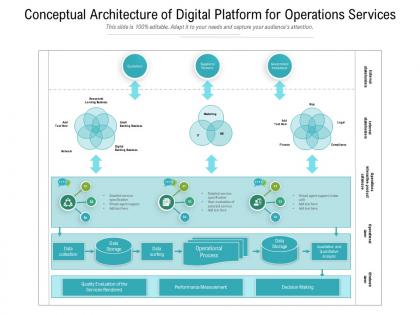
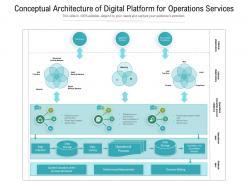
Conceptual architecture of digital platform for operations services




Try Before you Buy Download Free Sample Product
 Impress Your
 Audience
 100%
100% Editable
 Save Hours
 of Time


Our Conceptual Architecture Of Digital Platform For Operations Services are topically designed to provide an attractive backdrop to any subject. Use them to look like a presentation pro.
People who downloaded this PowerPoint presentation also viewed the following :
Conceptual architecture of digital platform for operations services with all 2 slides:
Use our Conceptual Architecture Of Digital Platform For Operations Services to effectively help you save your valuable time. They are readymade to fit into any presentation structure.
FAQs for Conceptual architecture of digital platform
Digital platform architecture includes APIs, microservices, data management systems, user interfaces, and security frameworks. These components work together by enabling seamless integration, supporting scalable operations, and facilitating real-time data processing, with many organizations finding that this strategic combination ultimately delivers enhanced customer experiences and operational efficiency across diverse business functions.
Microservices architecture enhances scalability by breaking applications into independent, loosely-coupled services that can be developed, deployed, and scaled individually. This approach enables organizations to allocate resources precisely where needed, handle increased user loads efficiently, and update specific functions without affecting entire systems, ultimately delivering faster performance and reduced operational costs.
API management significantly influences digital platform success by ensuring reliable connectivity, enforcing security protocols, monitoring performance metrics, and enabling seamless third-party integrations. Through effective API governance, organizations streamline developer experiences, accelerate partner onboarding, and maintain consistent service quality, with many financial services and retail platforms finding that robust API management ultimately delivers competitive advantage and scalable growth opportunities.
Cloud computing serves as the foundational infrastructure for modern digital platforms, providing scalable storage, computing power, automated deployments, real-time data processing, and global accessibility. Through cloud services, organizations streamline operations, reduce infrastructure costs, and enhance user experiences across multiple regions, with many enterprises finding that cloud-native architectures deliver greater flexibility and competitive advantage.
Data privacy and security integrate into digital platform architecture through encryption protocols, access controls, data anonymization, audit trails, and compliance frameworks built at the foundational level. These security measures streamline operations by automating threat detection, minimizing vulnerabilities, and ensuring regulatory compliance, with many financial services and healthcare organizations finding that embedded privacy-by-design approaches ultimately deliver enhanced customer trust and competitive advantage.
Monolithic architecture integrates all platform components into a single, unified system, while decoupled architecture separates components into independent, interconnected services that communicate through APIs. Decoupled systems enable organizations to scale individual components independently, update services without affecting others, and integrate new technologies more seamlessly, ultimately delivering greater flexibility and operational efficiency for growing businesses.
Front-end and back-end technologies interact through APIs, microservices, and data exchange protocols that enable seamless communication between user interfaces and server-side systems. This architecture allows banks to deliver real-time account updates, helps e-commerce platforms process transactions instantly, and enables healthcare systems to access patient records efficiently, ultimately streamlining operations while enhancing user experiences across multiple touchpoints.
**INPUT**: What design patterns are most effective for building resilient digital platforms? **OUTPUT**: Effective design patterns for resilient digital platforms include microservices architecture, circuit breakers, event-driven systems, API gateways, and distributed caching mechanisms. These patterns enhance platform stability by enabling fault isolation, automatic failover, and seamless scaling, with many financial services and e-commerce organizations finding that strategic implementation ultimately delivers improved uptime and competitive advantage. **Word count: 54 words**
Digital platform architecture supports multi-tenancy through data isolation, resource sharing, customizable user interfaces, scalable infrastructure, and security controls. These technologies streamline operations by enabling multiple organizations to share the same platform while maintaining separate data and configurations, with many SaaS providers finding that this approach delivers cost efficiency and faster deployment.
Essential monitoring tools include application performance monitoring (APM) solutions, infrastructure monitoring platforms, log management systems, synthetic monitoring tools, and real-time analytics dashboards. These technologies streamline performance optimization by identifying bottlenecks, tracking user experiences, and predicting system failures, with many organizations finding that proactive monitoring ultimately delivers faster response times and enhanced operational efficiency.
User experience considerations fundamentally shape digital platform architecture by influencing interface design, navigation structures, response times, and accessibility features. These UX principles drive technical decisions around load balancing, content delivery networks, and mobile optimization, with platforms like e-commerce sites and banking applications finding that seamless user journeys directly correlate with higher engagement rates and competitive advantage.
Transitioning from legacy systems to digital platform architecture presents challenges including data migration complexities, integration difficulties, staff retraining requirements, security vulnerabilities, and substantial upfront costs. While these obstacles can be significant, many organizations find that strategic phased implementation, comprehensive change management, and robust testing protocols ultimately deliver enhanced scalability, operational efficiency, and competitive advantage.
DevOps practices integrate into digital platform architectures through automated CI/CD pipelines, infrastructure as code, containerization, continuous monitoring, and cross-functional collaboration between development and operations teams. These approaches streamline deployment cycles, enhance system reliability, and accelerate feature delivery, with many organizations finding that DevOps-enabled platforms deliver faster time-to-market and improved operational efficiency.
Effective interoperability strategies include standardized APIs, common data formats, middleware integration layers, cloud-based connectivity solutions, and microservices architectures. These approaches streamline platform communication by enabling seamless data exchange, reducing integration complexity, and minimizing technical barriers, with many organizations finding that strategic API management and unified data standards ultimately deliver operational efficiency and enhanced customer experiences.
**INPUT**: How do emerging technologies like AI and blockchain influence the evolution of digital platform architecture? **OUTPUT**: AI and blockchain significantly reshape digital platform architecture by enabling intelligent automation, decentralized data management, enhanced security protocols, and real-time decision-making capabilities. These technologies streamline operations through predictive analytics, smart contracts, and distributed processing, with financial services and healthcare organizations finding that integrated architectures deliver faster transactions, improved transparency, and ultimately stronger competitive advantage. [Word count: 58 words]
No Reviews