

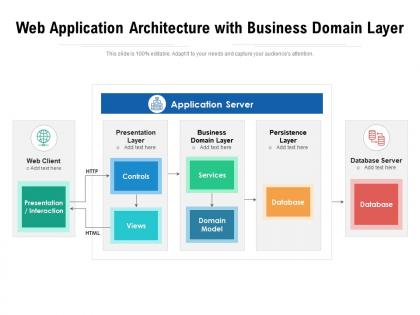
Web application architecture with business domain layer




Try Before you Buy Download Free Sample Product
 Impress Your
 Audience
 100%
100% Editable
 Save Hours
 of Time


Our Web Application Architecture With Business Domain Layer are topically designed to provide an attractive backdrop to any subject. Use them to look like a presentation pro.
People who downloaded this PowerPoint presentation also viewed the following :
Web application architecture with business domain layer with all 2 slides:
Use our Web Application Architecture With Business Domain Layer to effectively help you save your valuable time. They are readymade to fit into any presentation structure.

FAQs for Web application architecture with
So you've got your frontend where users click around, then backend APIs handling all the logic stuff. Database stores everything, plus you need hosting obviously. Most apps throw in a CDN for images and whatnot, Redis for caching, and auth services. Monitoring and logging are super boring but you'll thank yourself later when stuff crashes at weird hours - learned that one the hard way. The tech stack changes depending on what you're building, but those pieces basically work together to grab requests, crunch data, send responses back. I'd sketch out how data flows between everything first.
Oh dude, microservices are a game changer for this stuff. Instead of scaling your entire app when one part gets slammed, you can just beef up the specific service that's struggling. Like if everyone's logging in at once but nobody's buying anything, just add more auth servers and leave payments alone. Each service can run whatever tech makes sense for it too - maybe Go for the fast stuff, Python for data processing, whatever. You'll save a ton on server costs since you're not wasting resources on parts that don't need them. I'd start by looking at what's eating up the most CPU or memory. Those are your best bets for splitting off first.
Honestly, think of API design as the plumbing of your app - it's how your frontend and backend actually talk to each other. Bad APIs will bite you in the ass later when you're trying to scale or add features. Performance, security, debugging - all of it depends on getting this right from the start. You'll want consistent naming (seriously, stick to one convention) and proper HTTP codes. Oh, and document everything because future you will thank present you. I always sketch out endpoints during planning now - learned that the hard way after some brutal refactoring sessions.
So serverless is pretty cool - you just write your functions and AWS Lambda or Vercel handles all the server stuff automatically. No more worrying about provisioning or scaling. You only pay for what you actually use, which is awesome for apps with unpredictable traffic. Though honestly, the pricing can get confusing at first. The whole approach makes you think differently about building apps - instead of one big server, you're working with tiny stateless functions. Deployment is super fast since you're just pushing code that gets distributed everywhere. I'd start with something simple like an API endpoint to get a feel for it.
First thing - get your indexing sorted on columns you query all the time. Normalize that schema too, redundancy will bite you later. Don't create new database connections per request (learned this the hard way), use connection pooling instead. Parameterized queries are your friend for SQL injection protection. Heavy traffic? Read replicas help a ton. Honestly, I'd start by checking which queries are slowest right now - that'll show you where indexing matters most. And please automate your backups, then actually test restoring them. Trust me on this one.
Authentication and authorization have to be your starting point - can't mess around with those. HTTPS everywhere too, even in dev (I've seen way too many people skip this). Sanitize all user inputs or you're gonna get wrecked by SQL injection. XSS attacks are nasty too. Session management needs to be solid, and don't forget CORS policies for cross-origin stuff. Rate limiting's super helpful. Oh, and update your dependencies regularly - seriously, old packages are security nightmares waiting to happen. Once you've got those down, you can add fancy things like WAFs.
So your React/Angular components basically just make HTTP requests to talk to the backend - nothing fancy. I usually use Axios but fetch works fine too. You send requests, backend sends back JSON responses. Pretty simple stuff. The trick is mapping out what data each component actually needs first, then building your API calls around that. Also don't forget about loading states - users hate staring at blank screens lol. REST or GraphQL both work, though I'm personally more of a REST person. Just keep your endpoints organized and you'll be fine!
So load balancing basically spreads your traffic across multiple servers instead of dumping everything on one. Your app won't crash when you suddenly get slammed with users - which honestly always seems to happen during lunch or right before a demo. If one server dies, the others keep running. Response times get better too since requests go to whichever server isn't swamped. I'd start with simple round-robin distribution, then tweak it once you see how your traffic actually behaves.
So basically CDNs store copies of your static stuff (images, CSS, JS) on servers worldwide. Users grab content from whichever server's closest to them instead of hitting your main one. Load times drop by hundreds of milliseconds - sounds small but people totally feel the difference. Your servers get a break too since they're not handling those requests anymore. Honestly can't think of a reason not to use one if you've got users spread out geographically. CloudFlare's what I'd go with first, their free plan is pretty generous. AWS CloudFront works great too but... slightly more complicated to set up initially.
Honestly, it's all about complexity vs scaling. Monoliths are way easier to deploy and debug - everything's right there. But when you need to scale up, you're stuck scaling the whole damn thing even if just one piece needs it. Microservices flip that around - you can scale individual parts and mix tech stacks, which is pretty nice. The downside? Network calls everywhere, data consistency headaches, and suddenly you've got like 20 services to babysit. Small teams usually get crushed by microservices complexity. I'd say stick with monolith first, then split things when you actually hit scaling problems.
So DevOps basically forces you into more modular stuff - containers, microservices, the whole deal. Breaking up monoliths becomes inevitable since you need to deploy pieces separately. Container orchestration is huge, and honestly? Infrastructure as code will save your sanity later. Manual environment management is a nightmare I wouldn't wish on anyone. Your architecture has to play nice with CI/CD pipelines from the start. The big mental shift is designing for operations upfront, not bolting it on after. Just start containerizing what you have and add some health endpoints - that'll get you moving in the right direction.
Look, your web app's architecture is basically what makes or breaks the user experience. Fast loading? Smooth interactions? That's all architecture. Pick the wrong setup and you'll get those awful delays that make people bounce immediately. Users honestly couldn't care less about what fancy tech you're using - they just want stuff to load instantly. I'd probably start with data flow and caching since those usually give you the most bang for your buck. Real-time features, page loads, everything depends on getting this foundation right. Mess it up and you're looking at crashes when traffic hits.
Dude, these patterns are honestly game-changers for team productivity. MVC and MVVM give everyone the same blueprint, so you're not constantly explaining where stuff goes. Different people can work on UI, business logic, and data without conflicts - which is huge. When bugs pop up, you actually know where to hunt instead of digging through spaghetti code for hours. New team members get up to speed crazy fast too. I've watched junior devs who usually take weeks to contribute actually push meaningful code in days. Start with MVC though - MVVM can get weird with the binding stuff if you're just learning patterns.
Track your response times, error rates, and throughput first - that's your holy trinity for knowing if users are happy or about to bounce. CPU and memory will sneak up on you, so watch those too. Database queries are massive (nothing kills user experience like waiting forever for a page). Cache hit rates matter if you're running Redis or whatever. Oh, and don't sleep on load balancer metrics. I learned that one the hard way last year. SSL cert expiration dates are boring but they'll ruin your weekend if you forget. Set alerts for everything and actually check your dashboards daily - way better than finding out about problems from angry customer emails.
So cloud computing is basically breaking everything into tiny pieces - microservices, serverless stuff, distributed systems instead of those huge monolithic apps we used to build. Auto-scaling without managing servers is wild honestly, especially when you think about all the ops nightmares from before. Your frontend can just plug into managed services for databases, AI APIs, whatever you need. Oh and you're designing for multiple regions now instead of just one server. I'd definitely try serverless functions for your next feature - easiest way to see how different this whole approach feels.
-
Much better than the original! Thanks for the quick turnaround.
-
Out of the box and creative design.
-
Understandable and informative presentation.
-
Excellent Designs.
-
Out of the box and creative design.