


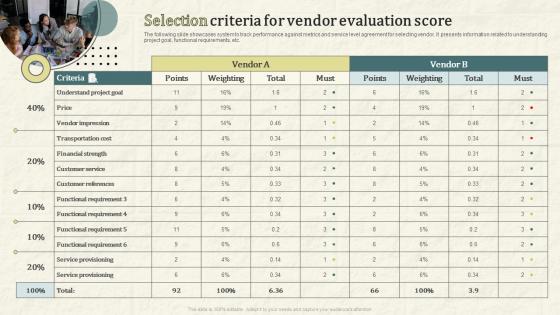
Selection Criteria For Vendor Evaluation Score




Try Before you Buy Download Free Sample Product
 Impress Your
 Audience
 100%
100% Editable
 Save Hours
 of Time


The following slide showcases system to track performance against metrics and service level agreement for selecting vendor. It presents information related to understanding project goal, functional requirements, etc.
People who downloaded this PowerPoint presentation also viewed the following :
Selection Criteria For Vendor Evaluation Score with all 6 slides:
Use our Selection Criteria For Vendor Evaluation Score to effectively help you save your valuable time. They are readymade to fit into any presentation structure.





FAQs for Selection Criteria For
Key factors include annual revenue growth, profit margins, debt-to-equity ratios, cash flow statements, and credit ratings from established agencies. These financial indicators help organizations assess long-term partnership viability, with many companies finding that vendors demonstrating consistent profitability and strong liquidity ultimately deliver more reliable services and sustained innovation capabilities.
Vendor qualifications and certifications significantly influence evaluation by demonstrating compliance capabilities, technical expertise, industry standards adherence, and operational reliability. These credentials help organizations assess risk levels, ensure regulatory compliance, and validate vendor competency, with many procurement teams finding that certified vendors deliver more consistent service quality, reduced implementation risks, and stronger long-term partnerships.
Vendor reputation serves as a critical risk assessment tool, influencing trust, reliability expectations, and long-term partnership viability in procurement decisions. It helps organizations evaluate past performance, client satisfaction levels, and market standing, with many companies finding that strong vendor reputations correlate with better service delivery, reduced project risks, and enhanced stakeholder confidence.
Companies can effectively assess vendor compliance through comprehensive due diligence processes, including reviewing certifications, conducting compliance audits, verifying regulatory documentation, and evaluating past violation records. This systematic approach enables organizations to minimize legal risks, ensure regulatory adherence, and maintain operational continuity, with many enterprises finding that robust vendor compliance assessments ultimately deliver enhanced security and competitive advantage.
Key questions include response time commitments, escalation procedures, support channel availability, account management structure, and service level agreements. These inquiries help organizations evaluate communication frequency, issue resolution processes, and customer satisfaction metrics, with many businesses finding that vendors demonstrating proactive support, dedicated resources, and transparent reporting ultimately deliver stronger partnerships and operational reliability.
A vendor's industry-specific experience is highly important, as it ensures deep understanding of regulatory requirements, operational challenges, and sector-specific workflows that generic providers often miss. Healthcare vendors understand HIPAA compliance, financial services providers know regulatory frameworks, and manufacturing specialists grasp supply chain complexities, ultimately delivering faster implementation and more relevant solutions.
Vendor technological capabilities should be evaluated based on system architecture scalability, integration compatibility, security protocols, performance benchmarks, and innovation roadmaps. Organizations across industries like healthcare, finance, and manufacturing find that vendors demonstrating robust API frameworks, cloud-native solutions, and proven uptime records ultimately deliver enhanced operational efficiency and competitive advantage.
Assessing vendor scalability involves evaluating their infrastructure capacity, workforce flexibility, technology systems, financial stability, and historical performance during demand fluctuations. Banks and retail organizations typically examine vendors' cloud capabilities, automated processes, and resource allocation strategies, with many finding that partners demonstrating elastic scaling models ultimately deliver better service continuity and competitive advantage.
Geographic proximity influences vendor evaluation through logistics considerations, communication efficiency, regulatory compliance requirements, and cultural alignment factors. While digital collaboration tools minimize distance barriers, many organizations find that local or regional vendors enable faster on-site support, streamlined supply chains, and enhanced relationship management, ultimately delivering reduced operational costs and improved service responsiveness.
Sustainability and social responsibility should be integrated through environmental impact assessments, ethical labor practices, community engagement initiatives, and supply chain transparency standards. Organizations increasingly find that vendors with strong sustainability credentials deliver long-term cost savings, enhanced brand reputation, and improved stakeholder relationships, while mitigating regulatory risks and supporting corporate social responsibility objectives.
Vendor quality metrics include product reliability, performance benchmarks, defect rates, compliance certifications, customer satisfaction scores, and service level agreements. These measurements enable organizations to assess consistency, durability, and operational excellence across suppliers, with many procurement teams finding that combining quantitative performance data with qualitative feedback delivers comprehensive vendor assessments and competitive sourcing advantages.
Collaboration potential can be assessed through communication responsiveness, cultural alignment, shared strategic vision, and willingness to co-innovate on solutions. Organizations evaluate vendors' project management approaches, integration capabilities with existing teams, and track record of long-term partnerships, with many finding that vendors demonstrating proactive communication and flexible adaptation ultimately deliver stronger business outcomes and competitive advantage.
Vendor lead time and delivery performance significantly impact operational efficiency, inventory management, customer satisfaction, and supply chain reliability. These factors directly affect production schedules, working capital requirements, and service levels, with many organizations finding that consistent delivery performance reduces stockouts, minimizes rush orders, and ultimately delivers competitive advantage through improved customer experiences and cost optimization.
Risk management practices in potential vendors can be evaluated through comprehensive assessments of their security protocols, compliance certifications, incident response procedures, financial stability, and business continuity plans. Through detailed audits and documentation reviews, organizations streamline vendor selection by examining disaster recovery capabilities, insurance coverage, and regulatory adherence, ultimately delivering enhanced operational security and minimized supply chain vulnerabilities.
Ongoing vendor performance monitoring involves establishing clear KPIs, conducting regular performance reviews, implementing automated tracking systems, maintaining open communication channels, and scheduling periodic contract assessments. Through dashboards and scorecards, organizations can track delivery timelines, quality metrics, and cost efficiency, while quarterly business reviews enable proactive issue resolution, ultimately ensuring vendors consistently deliver value and meet evolving business requirements.
-
Satisfied with the way SlideTeam resolved my query regarding the right business PPTs that I was having difficulty finding. I found the perfect match with their assistance.
-
The website is jam-packed with fantastic and creative templates for a variety of business concepts. They are easy to use and customize.