


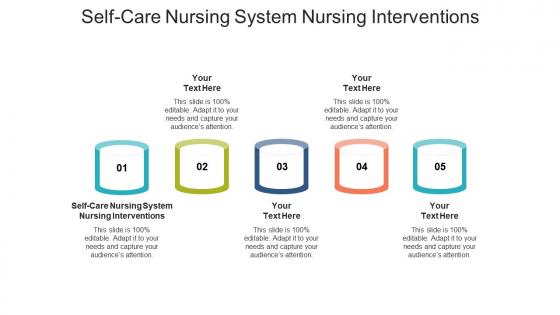
Self care nursing system nursing interventions ppt powerpoint presentation cpb




Try Before you Buy Download Free Sample Product
 Impress Your
 Audience
 100%
100% Editable
 Save Hours
 of Time


Our Self Care Nursing System Nursing Interventions Ppt Powerpoint Presentation Cpb are topically designed to provide an attractive backdrop to any subject. Use them to look like a presentation pro.
People who downloaded this PowerPoint presentation also viewed the following :
Self care nursing system nursing interventions ppt powerpoint presentation cpb with all 6 slides:
Use our Self Care Nursing System Nursing Interventions Ppt Powerpoint Presentation Cpb to effectively help you save your valuable time. They are readymade to fit into any presentation structure.
-
Self care nursing system nursing interventions ppt powerpoint presentation cpb
-

Self care nursing system nursing interventions ppt powerpoint presentation cpb
-

Self care nursing system nursing interventions ppt powerpoint presentation cpb
-

Self care nursing system nursing interventions ppt powerpoint presentation cpb
-

Self care nursing system nursing interventions ppt powerpoint presentation cpb
-

Self care nursing system nursing interventions ppt powerpoint presentation cpb
FAQs for Self care nursing system nursing interventions ppt
Essential self-care nursing interventions include patient education programs, personalized care planning, skills training for daily activities, emotional support systems, and collaborative goal-setting approaches. These interventions enhance patient independence by building confidence, developing practical capabilities, and fostering decision-making skills, with many healthcare institutions finding that empowered patients achieve better health outcomes and reduced readmission rates.
Nurses can effectively educate patients on self-care by using clear demonstrations, personalized care plans, visual aids, teach-back methods, and motivational interviewing techniques. These approaches help patients understand medication management, wound care, and lifestyle modifications, with many healthcare institutions finding that structured education programs significantly improve patient compliance, reduce readmission rates, and enhance overall health outcomes.
Patient assessment serves as the foundation for effective self-care interventions by identifying individual needs, capabilities, limitations, and health goals through comprehensive evaluation of physical, emotional, and social factors. This systematic approach enables healthcare providers to design personalized intervention strategies, monitor progress effectively, and adjust care plans accordingly, ultimately delivering improved patient outcomes and enhanced treatment adherence across diverse healthcare settings.
Mindfulness integrates into self-care nursing interventions through meditation practices, breathing exercises, body awareness techniques, and present-moment focusing strategies. These approaches help nurses manage stress, enhance emotional regulation, and improve patient interactions by promoting mental clarity, reducing burnout symptoms, and fostering resilience, ultimately delivering better healthcare outcomes and sustainable career longevity.
Technology-enabled self-care delivers enhanced accessibility, real-time monitoring, personalized guidance, improved adherence tracking, and seamless healthcare provider communication. Through mobile apps and telehealth platforms, patients experience greater engagement with their care plans, reduced barriers to professional consultation, and data-driven insights into their health patterns, ultimately enabling more proactive management and better clinical outcomes.
Nurses support chronic illness self-care through patient education, personalized care planning, medication management guidance, and regular monitoring of symptoms and progress. These interventions enable patients to better manage conditions like diabetes, hypertension, and heart disease, while empowering them with practical skills, ultimately delivering improved health outcomes and enhanced quality of life.
Cultural considerations for self-care interventions include religious beliefs, family dynamics, communication styles, health perceptions, and traditional healing practices. Healthcare providers must assess cultural backgrounds, incorporate family involvement preferences, respect spiritual practices, and adapt interventions accordingly, with many institutions finding that culturally responsive approaches significantly enhance patient engagement, treatment adherence, and ultimately deliver improved health outcomes across diverse populations.
Self-care for nurses involves implementing structured wellness programs, flexible scheduling, mental health resources, peer support systems, and stress management training within healthcare organizations. Through these initiatives, hospitals and medical facilities can reduce turnover rates, improve job satisfaction, and enhance patient care quality, while many healthcare systems are finding that investing in nurse wellbeing ultimately delivers better outcomes and competitive advantage in staff retention.
Interdisciplinary approaches include collaborating with physicians, physical therapists, nutritionists, social workers, and mental health specialists to create comprehensive care plans. These collaborative strategies enhance patient outcomes by integrating medical expertise, therapeutic guidance, and psychosocial support, with many healthcare institutions finding that coordinated teams deliver improved patient engagement and sustainable self-care practices.
Motivational interviewing enhances patient engagement in self-care by using open-ended questions, reflective listening, and collaborative goal-setting to explore patient motivations and resolve ambivalence about behavior change. This patient-centered approach empowers individuals to identify personal reasons for self-care, ultimately delivering improved treatment adherence, enhanced self-efficacy, and better health outcomes across chronic disease management.
Strategies include culturally tailored education programs, community health worker partnerships, mobile health services, peer support networks, and simplified care protocols. These approaches address barriers by improving health literacy, enhancing accessibility, and building trust within communities, with many healthcare organizations finding that integrated support systems significantly improve self-care adherence and health outcomes.
Nurses can assess self-care intervention effectiveness through patient outcome measurements, behavioral observations, self-reported adherence rates, clinical indicators, and follow-up assessments. These evaluation methods enable healthcare teams to track progress systematically, identify areas needing adjustment, and demonstrate improved patient outcomes, with many healthcare institutions finding that comprehensive monitoring ultimately enhances care quality and patient satisfaction.
Communication serves as the foundation for effective self-care adherence by establishing clear expectations, building trust between patients and providers, and ensuring comprehension of complex medical instructions. Through active listening, simplified explanations, and regular follow-up discussions, healthcare professionals enable patients to confidently manage their conditions independently, ultimately delivering better health outcomes and reduced readmission rates.
Self-care nursing interventions adapt through developmental assessments, age-appropriate education methods, family involvement levels, and tailored goal-setting approaches that match cognitive and physical capabilities. Pediatric interventions emphasize play-based learning and caregiver education, while geriatric approaches focus on maintaining independence, managing chronic conditions, and preventing complications, ultimately delivering personalized care that enhances patient outcomes across all life stages.
Evidence-based practices supporting self-care implementation include mindfulness-based stress reduction programs, structured peer support systems, resilience training modules, wellness coaching interventions, and systematic workload management protocols. These approaches enhance nurse retention by reducing burnout rates, improving job satisfaction, and strengthening emotional resilience, with many healthcare institutions finding that comprehensive self-care programs ultimately deliver better patient outcomes and operational efficiency.
-
Awesomely designed templates, Easy to understand.
-
Best Representation of topics, really appreciable.
-
Illustrative design with editable content. Exceptional value for money. Highly pleased with the product.
-
Top Quality presentations that are easily editable.
-
Innovative and attractive designs.
-
Presentation Design is very nice, good work with the content as well.
-
Great quality slides in rapid time.
-
Great quality product.
-
Great experience, I would definitely use your services further.
-
Excellent design and quick turnaround.